Mobile Lumber Executive Says No to 2006 Governor’s Race as the Field Keeps Growing
Gulf Lumber executive Sandy Stimpson has taken himself out of the 2006 governor's race, but the line of prospective candidates in both parties is barely any shorter for it.
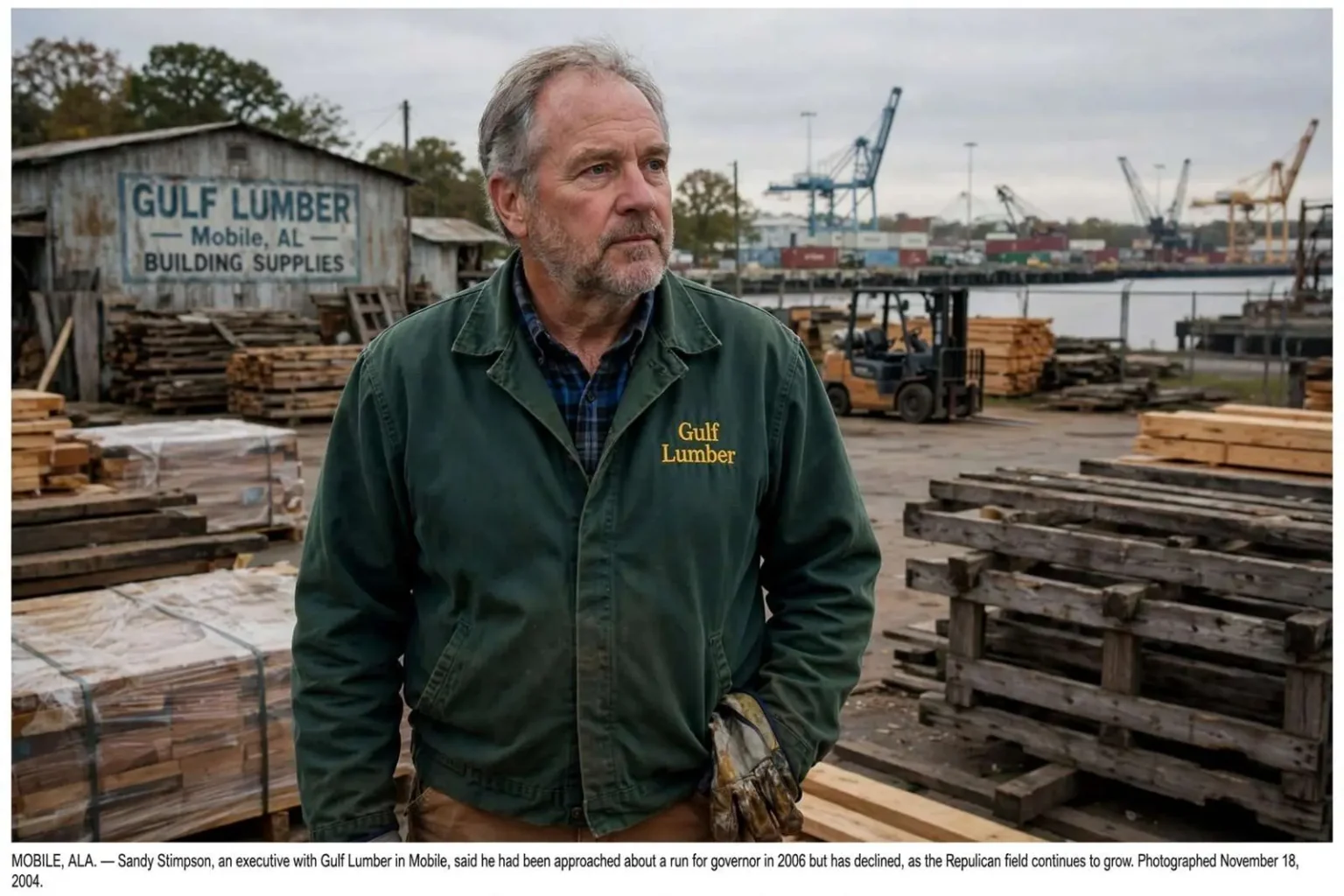
Two weeks after the November 2004 general election, Alabama’s political class has already turned to the next contest, and the line of people thinking about running for governor in 2006 is long enough that one Mobile businessman’s decision not to join it barely shortens it. Sandy Stimpson, an executive with Gulf Lumber in Mobile, said he had been approached about a run, considered it, and decided against it — not in 2006, at any rate.
Those who tried to recruit him have almost certainly moved on to another prospective champion, because the underlying grievance that produced the recruitment has not gone away. Stimpson’s deliberation was brief and his departure from consideration is unlikely to alter the shape of the race, but the fact that a Mobile lumber executive was being courted at all says something about where the Republican Party’s discontent was pointed as 2004 closed out.
A Republican field defined by one fight
That grievance is Gov. Bob Riley’s push for tax reform, which Alabama voters rejected decisively in a September 2003 referendum and which Republican activists have not forgiven. The package Riley carried to the voters was the most ambitious rewrite of the state’s tax structure in modern memory, and its defeat — by a wide margin, in a referendum that drew heavy turnout — became the organizing fact of conservative politics in the state.
The party’s most fundamental catechism admits of no ambiguity on the subject: do we oppose tax increases? Yes, we oppose tax increases. A bishop’s departure from that principle, as one observer put it, is neither easily forgiven nor forgotten. In the church of Alabama Republicanism, the 2003 referendum made Riley the bishop who had strayed, and no amount of contrition has fully settled the account.
Riley is the incumbent, and he is expected to seek a second term. Whether he can quiet the revolt within his own party is the central question of the primary. Others said to be eyeing the Republican contest include Tuscaloosa developer Stan Pate, businessman Tim James and former state Supreme Court Chief Justice Roy Moore — none of them rookies, and none of them likely to leave the tax question alone. Each brings a different base of support and a different argument for why the incumbent should be challenged from the right.
Talk of luring U.S. Sen. Jeff Sessions into the race was a non-starter, which came as a relief to the White House and to party leaders who had no interest in pitting the state’s senior senator against its sitting governor. Suffice to say the Republican field is incomplete, and it will remain so until Riley confirms his intentions and the anti-tax wing of the party settles on a single standard-bearer.
Hovering in the political twilight between the parties is former Alabama Power chief executive Elmer Harris, who has two decisions to make: whether to run at all, and which flag to carry. Harris ran Alabama Power for years and remains one of the most recognizable figures in Alabama business circles, with a network of contacts and a reputation for candor that neither party can dismiss.
His dilemma is unusual. Harris has long been discussed as a candidate with genuine independence from both party establishments, but independence cuts both ways in a state where party labels decide most general elections. That a man of 65 is only now determining which party’s philosophy suits him may trouble primary voters of either stripe, who tend to want to know where a candidate stood before the asking.
A deeper Democratic bench
The Democratic Party boasts a politically deeper and more traditional array of hopefuls. Former Gov. Don Siegelman, whose term ended in 2003 after he lost to Riley, is pleased to be mentioned for a comeback and remains one of the most skillful campaigners the state has produced, with a statewide network built over decades in office.
The Democratic side carries its own complications, of course. The party has been losing ground in statewide races for a decade, its registration edge eroding as conservative Democrats have migrated to the Republican column, and any nominee will enter the general election as an underdog unless the Republican primary wounds its winner badly. But the bench is deeper, the candidates are better known, and the primary fight on the Republican side gives Democrats a reason to hope 2006 can be competitive.
Where the recruitment goes from here
For Stimpson, the decision ends a round of speculation that began among Mobile business leaders who felt the city had been overlooked in Montgomery and wanted one of their own in the conversation. His answer — no, at least not now — leaves the door technically ajar for future cycles while freeing him to focus on Gulf Lumber and on civic work closer to home.
It also reflects a realistic reading of the field. A first-time candidate entering a governor’s race against an incumbent governor, a pack of well-funded challengers and a dominant issue — the tax referendum — already settled has little room to define himself. The businessmen and developers being courted by the anti-tax faction all share the same calculation: the race is Riley’s to lose, and the cost of challenging him is high no matter how deep the grievance runs.
Why the tax fight still burns
To understand the 2006 field, one has to understand what the September 2003 referendum did to Alabama politics. Riley had argued that the state’s antiquated tax system — with its low property taxes and its income tax that began collecting at near-poverty incomes — shortchanged schools and state services, and he staked his governorship on a $1.2 billion package of tax increases that went to the voters in a special election. The package was defeated by roughly a two-to-one margin, and the coalition that defeated it spanned both parties.
For the activists who organized the opposition, the referendum proved that an energized grassroots movement could beat a sitting governor, a business establishment and most of the state’s major newspapers all at once. That victory created both the confidence and the candidate pool now circling the 2006 primary. Pate, James and Moore each positioned himself on the winning side of that fight, and each will remind primary voters of it repeatedly.
Moore, in particular, carries a constituency that goes beyond the tax issue. His removal from the state Supreme Court after refusing a federal order to remove a Ten Commandments monument from the judicial building made him a national figure and a hero to social conservatives, and he demonstrated in 2004 how much support he could command among ordinary Republican voters even against the party’s preferred candidates.
What Mobile takes from the episode
The Stimpson episode is a small piece of a larger story about Mobile’s role in state politics. The city, Alabama’s oldest and most cosmopolitan, has often felt like an afterthought in a state capital oriented toward Montgomery, Huntsville and the Tennessee Valley. Business leaders in the Port City have periodically tried to translate their economic weight into political influence, and the recruitment of a lumber executive for a governor’s race was one more attempt.
That it failed quietly should surprise no one, but it does not mean the impulse has faded. Mobile’s interests — the port, the shipbuilding industry at Brookley, coastal insurance, the interstate connection to the Eastern Shore — require sustained attention in Montgomery, and city leaders know that influence is built either by holding office or by electing those who do. Stimpson’s name will surface again in state political circles; it always does with Mobile executives who have led companies and civic campaigns.
The arithmetic of a primary challenge
Every challenger now weighing the race runs the same numbers. An incumbent governor enters with name recognition, a fundraising network that includes the state’s largest business interests, and the power of his office to distribute news and favors for four years. Beating him requires either a scandal, a schism, or a challenger with enough money and message to survive a year of campaigning in a state where media markets stretch from Huntsville to Mobile.
The anti-tax faction believes it has the schism, and its confidence is not baseless. Primary electorates reward conviction, and the 2003 referendum taught conservative activists that they could organize faster than the establishment could respond. Whether that energy transfers from a referendum campaign to a candidate campaign is the experiment 2006 will run, and it explains why so many names — developers, business executives, former judges and chief executives — keep surfacing in the conversation while the actual filings remain unmade.
For now, the 2006 field remains unfinished business. Riley must decide and announce, the challengers must decide whether he is vulnerable enough to beat, and the Democrats must sort out a primary of their own. The only settled question is the one Stimpson answered: he will be watching the race from Mobile rather than running in it.