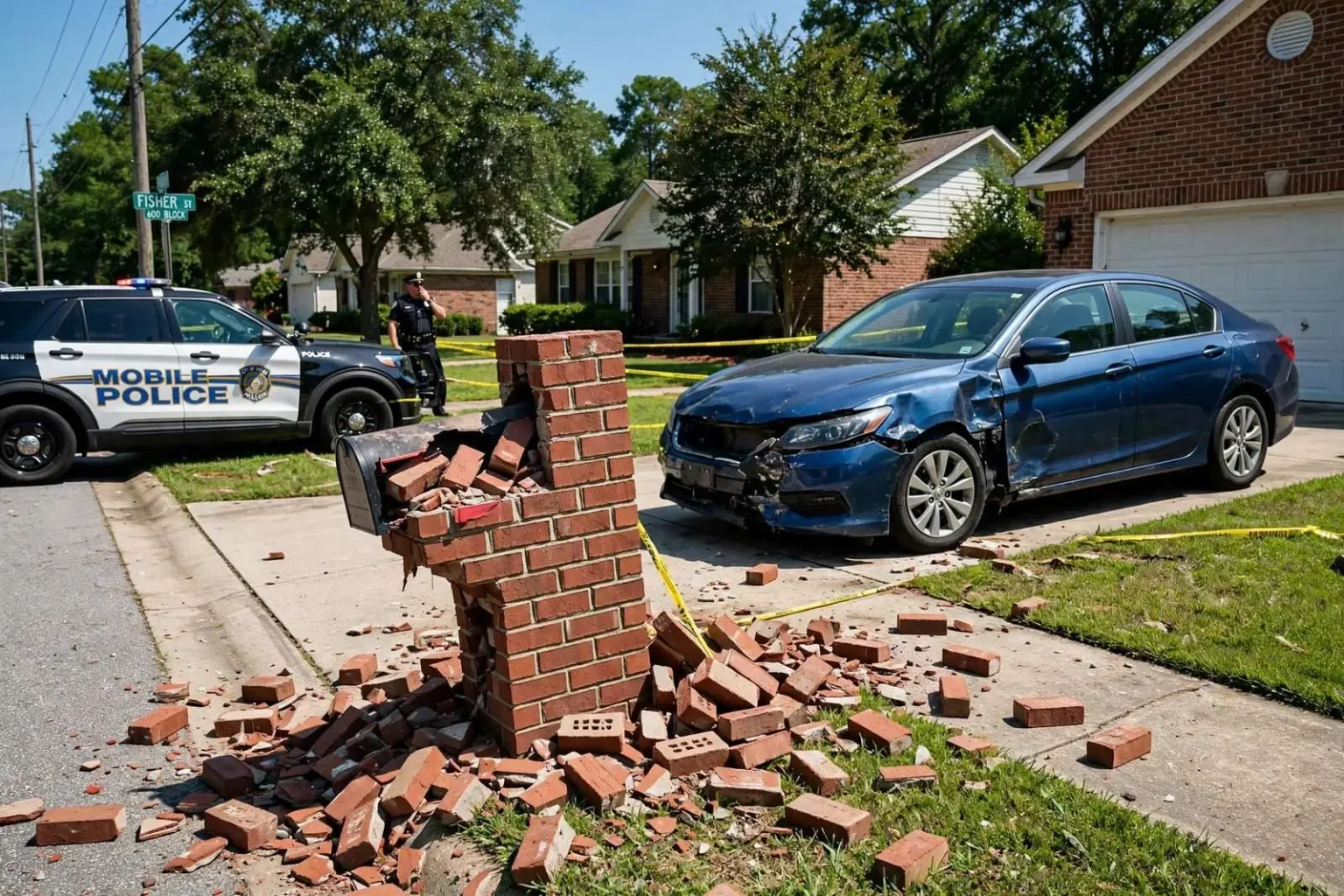
A set of car keys, illustrating a Mobile Police Department juvenile arrest for taking a vehicle from a Fisher Street homePolice say the juvenile took the keys from a woman he knew and returned the car damaged.

A juvenile has been arrested in Mobile after police say he took a woman’s car without permission, struck a brick mailbox with it, and then returned the vehicle to her driveway.

Officers were called to the 600 block of Fisher Street around 2 p.m. Sunday, July 12, in reference to a theft and criminal mischief complaint, according to the Mobile Police Department.

What Officers Determined

Police say a juvenile male took the keys from a woman he knew and left the home in her car. At some point during the drive, he hit a brick mailbox. He then returned the car to the driveway.

The juvenile was arrested and charged with first-degree theft of property and first-degree criminal mischief.

Why the Charges Are Felonies

Both charges are serious, and the reason is worth explaining, because “he brought it back” is a defense many people assume works and which the law does not recognize.

First-degree theft of property in Alabama is a Class B felony. Critically, the theft statute is triggered by the unauthorized taking of a motor vehicle regardless of the vehicle’s value — Alabama treats a car specifically, rather than relying on a dollar threshold. And the offense is complete at the moment of the taking. Returning the property afterward may matter to a judge at sentencing, but it does not undo the crime.

First-degree criminal mischief covers damage to property, and it becomes a first-degree offense when the damage exceeds a statutory threshold. Here, that damage covers the collision with the mailbox and, presumably, the vehicle itself.

What Happens to a Juvenile Defendant

Because the accused is a minor, the case will proceed through Alabama’s juvenile justice system rather than adult criminal court. Juveniles taken into custody in Mobile County are ordinarily processed through the Strickland Youth Center, and juvenile court records are not public in the way adult records are.

See also  Alabama Department of Labor Holds First Non-Profit Career Fair in Mobile

The juvenile system is designed around rehabilitation rather than punishment, with a heavier emphasis on supervision, counseling, restitution and diversion programs. A first-time juvenile offender who damaged property and returned the vehicle is, in most cases, a candidate for exactly those alternatives rather than detention.

The department has not released the juvenile’s name, and it will not — the identities of juvenile defendants are protected under Alabama law.

The Human Layer

One detail sits at the center of this case and is easy to skip: the juvenile and the woman knew each other, and he took the keys from inside the home.

That means this is almost certainly not a stranger crime but a domestic or household matter that ended in an arrest — the sort of case where the complainant and the accused may still have to see one another after the paperwork is filed.
This development matters for residents across South Alabama, where local government decisions directly affect daily life in communities from Mobile to Baldwin County and along the Gulf Coast. When municipal leaders take action on issues like infrastructure, public safety, or economic development, the ripple effects extend to neighborhoods, businesses, and families throughout the region.

For context, South Alabama’s unique position along the Gulf of Mexico means that weather preparedness, coastal resilience, and hurricane recovery are perennial concerns that shape policy priorities. The region’s economy — anchored by the Port of Mobile, aerospace manufacturing at Airbus and Austal, shipbuilding at Ingalls, tourism along the beaches, and a growing healthcare sector — creates both opportunities and challenges for local officials navigating growth and preservation.

See also  Microchip Reunites Mobile County Owner With Dog Missing Two Years

Residents who want to stay informed can attend city council meetings, county commission sessions, and school board gatherings where these matters are debated and decided. Public comment periods offer direct avenues for citizen input, while local news outlets and official government channels provide updates on agendas, ordinances, and community initiatives. Understanding how to engage with these processes helps ensure that community voices are heard on issues affecting property values, traffic patterns, school quality, and public services.

Related programs and resources available to South Alabama residents include emergency management services through county EMA offices, small business assistance via the Mobile Area Chamber of Commerce and Alabama Small Business Development Center network, workforce training through Alabama Community College System institutions like Bishop State and Coastal Alabama Community College, and health services through USA Health, Infirmary Health, and county health departments. Nonprofit organizations such as United Way of Southwest Alabama, Habitat for Humanity, and local food banks provide additional support networks for families facing hardship.

Looking ahead, the trajectory of this story will likely involve follow-up actions from relevant agencies, public hearings where community members can weigh in, and potential adjustments based on feedback and changing conditions. Journalists covering the Gulf Coast beat will continue monitoring developments and reporting on how policies translate into real-world outcomes for the people who live, work, and raise families in this region.

Looking ahead, the trajectory of this story will likely involve follow-up actions from relevant agencies, public hearings where community members can weigh in, and potential adjustments based on feedback and changing conditions. Journalists covering the Gulf Coast beat will continue monitoring developments and reporting on how policies translate into real-world outcomes for the people who live, work, and raise families in this region.

See also  Theodore Firefighter's Truck-Fire Video a Warning as Dry Conditions Persist

Looking ahead, the trajectory of this story will likely involve follow-up actions from relevant agencies, public hearings where community members can weigh in, and potential adjustments based on feedback and changing conditions. Journalists covering the Gulf Coast beat will continue monitoring developments and reporting on how policies translate into real-world outcomes for the people who live, work, and raise families in this region.

Looking ahead, the trajectory of this story will likely involve follow-up actions from relevant agencies, public hearings where community members can weigh in, and potential adjustments based on feedback and changing conditions. Journalists covering the Gulf Coast beat will continue monitoring developments and reporting on how policies translate into real-world outcomes for the people who live, work, and raise families in this region.

Looking ahead, the trajectory of this story will likely involve follow-up actions from relevant agencies, public hearings where community members can weigh in, and potential adjustments based on feedback and changing conditions. Journalists covering the Gulf Coast beat will continue monitoring developments and reporting on how policies translate into real-world outcomes for the people who live, work, and raise families in this region.