University of South Alabama Whistler
A Minister, a Retired Teacher and an Ousted Superintendent: The 2008 School Board Field Takes Shape
Three prospects surfaced for seats on the Mobile County Board of School Commissioners, including a 25-year-old assistant pastor from Whistler and a superintendent who had just been replaced.
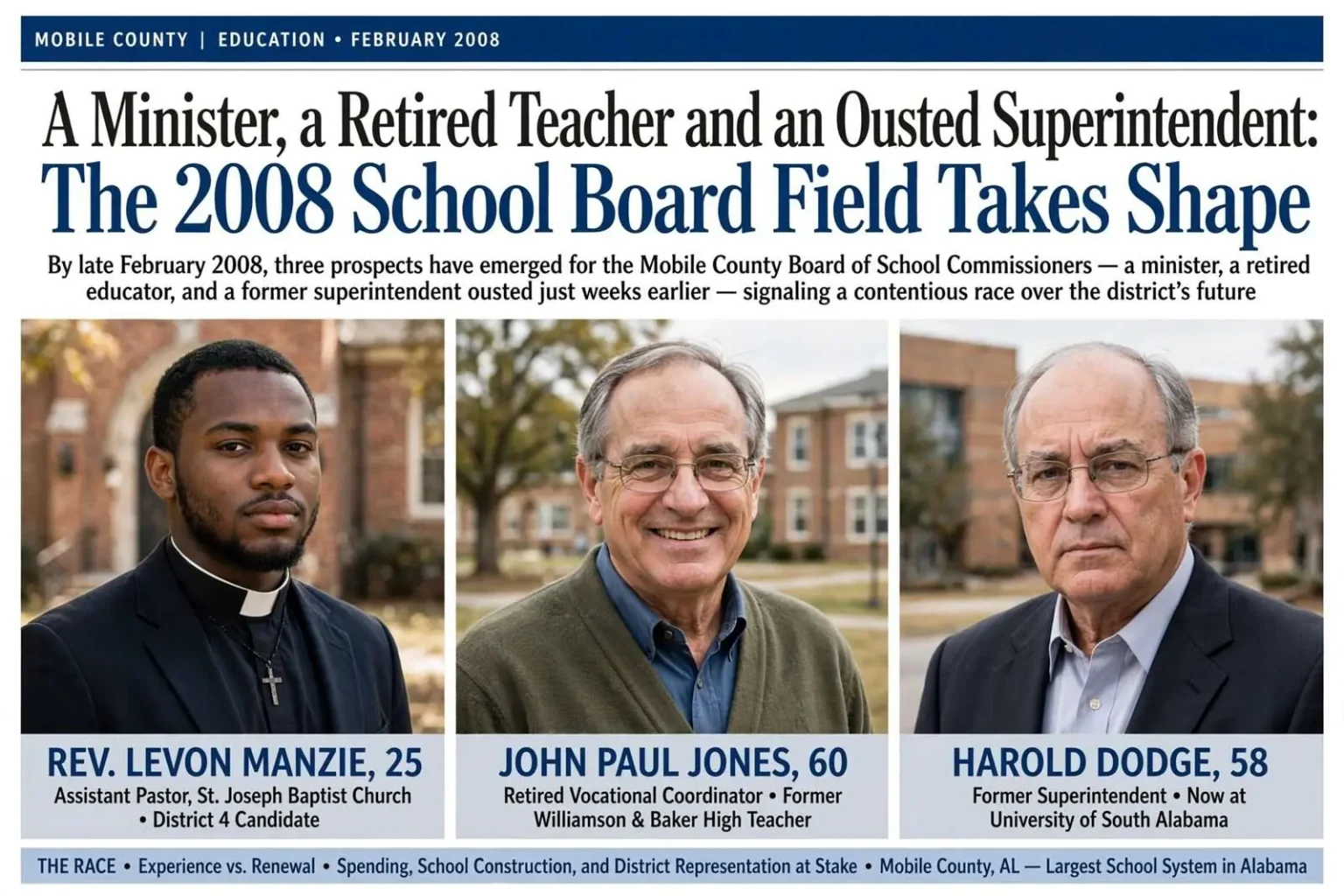
By late February 2008, the races for the Mobile County Board of School Commissioners were beginning to draw candidates — and the emerging field said something about the state of the county’s school system. At least three prospects were weighing bids: a minister, a retired educator and a former superintendent who had been replaced only weeks earlier.
Manzie steps forward
The Rev. Levon Manzie confirmed he intended to run for the District 4 seat then held by school board member Fleet Belle, himself a preacher. Manzie, 25, was the assistant pastor at St. Joseph Baptist Church in Whistler, where his father was pastor. He had been serving the congregation full time while his father recovered from a heart attack and stroke suffered at the church 18 months earlier.
Manzie had sought appointment to the board once before, when former Commissioner David Thomas was impeached and removed from office, but the remaining members chose Belle instead. This time he would go to the voters.
“What I hope to accomplish is to bring a new and more progressive mind set to the board of education, one that believes in working together as a group but also advocates representation of District 4 first and foremost,” Manzie said. The needs of his district, he added, should always be the most prominent thing on his mind.
A Murphy High School graduate, Manzie was working toward a political science degree at the University of South Alabama and served on the Mobile County Democratic Executive Committee. Asked to name a political hero, he chose John F. Kennedy, praising him for sticking to his convictions and accomplishing a great deal in a short time at a young age.
Manzie would go on to win that school board seat and, later, a seat on the Mobile City Council representing District 2 — a career that began with this campaign. His path from the pulpit in Whistler to countywide office to City Hall made him one of the most recognizable products of Mobile’s political generation of the late 2000s.
A retired educator and a former superintendent
Retired educator John Paul Jones, 60, acknowledged interest in the seat held by board member Hazel Fournier, who was not expected to seek a fourth term. Jones said he had not made a final decision. He served as parliamentarian of the Mobile County Democratic Executive Committee, had retired from the Mobile County Public School System as a vocational coordinator, had taught at Williamson High School and was substitute teaching at Baker High School, where his grandchildren were students.
His resume spanned both ends of the county’s educational geography — Williamson in the city’s historic core, Baker in the fast-growing western suburbs — and the kind of classroom credibility that school board races in Mobile have traditionally rewarded. Vocational education, the field he coordinated before retirement, was itself becoming a live issue as the district weighed career-tech offerings against college-preparatory tracks.
The most intriguing name was Harold Dodge, who had been replaced as superintendent by Roy Nichols only weeks before. Dodge declined to comment, but Democratic Party leaders said they intended to approach him about running for the board that had, in effect, just moved on from him. He was by then teaching at the University of South Alabama.
The prospect of a deposed superintendent running for the board that chose his successor had no real precedent in recent Mobile County memory, and party leaders’ interest in recruiting him signaled how much appetite existed for candidates with institutional standing who could run as outsiders to the board’s recent troubles.
The board’s troubles
The turnover was not incidental. The Mobile County school board had spent the preceding years in near-constant turmoil: the impeachment and removal of a sitting commissioner, a superintendent transition, and persistent friction over spending and school construction in a system that was, and remains, the largest in Alabama, with tens of thousands of students spread from Citronelle to Bayou La Batre.
The impeachment of David Thomas had already forced the remaining members to make one appointment to fill a vacancy, and that decision — passing over Manzie in favor of Belle — guaranteed that District 4 would have a contested election the next time the seat appeared on the ballot. The superintendent change, arriving only weeks before candidates began qualifying, gave the 2008 races a second storyline that no campaign could avoid discussing.
Friction over spending had been the running theme beneath both episodes. Mobile County’s construction program — new schools in the growing suburbs, renovations in the older city districts, and the perennial competition for classroom space — put board members in the position of choosing among communities, and each choice generated constituencies for or against the incumbents who made it.
The scale that shapes every race
That scale is the central fact of Mobile County education politics. A single board member represents a district larger than most Alabama municipalities. Decisions about which schools get built, which get closed and where the tax money goes carry consequences for entire communities — and produce the kind of contested elections that were taking shape in the spring of 2008.
The county system stretches across one of the largest school districts, by geography and enrollment, in the southeastern United States. Its footprint runs from Citronelle in the county’s rural north, down through Prichard and the city of Mobile, to the fishing communities of Bayou La Batre and Dauphin Island on the Gulf. Transportation alone — bus routes covering a county the size of some New England states — is a substantial budget line, and construction decisions are weighed against growth patterns that differ radically from one end of the district to the other.
For candidates, that scale means a board race is effectively a districtwide campaign with city-election stakes: a candidate must introduce himself across neighborhoods with different histories, different schools and different grievances with the central office. It is one reason ministers, teachers and administrators with established community standing — the three profiles visible in this field — recur in Mobile board races decade after decade.
Experience versus a clean break
By the time qualifying closed in April, the field had grown considerably, with candidates surfacing in District 3 as well. But the shape of the argument was already clear: whether the board needed institutional experience or a clean break from it.
Each candidate embodied one side of that question. Manzie, at 25, offered generational change and a promise of district-first advocacy; his youth was the point. Jones, a 60-year-old retired vocational coordinator with grandchildren in the system, offered the credibility of a career in its classrooms. Dodge, if recruited, would have offered something stranger — the inside expertise of a former superintendent aimed at the board that replaced him.
Whatever combination of those candidacies ultimately reached the ballot, the 2008 field made plain that Mobile County’s school governance battles were no longer confined to boardrooms. The election that spring would put the county’s education arguments — over experience, over construction spending, over who spoke for each district — before the voters directly, in the largest school system in Alabama.
Why board seats draw crowded fields
The interest in the 2008 races reflected more than local temperament. Board of education seats in Mobile County are paid, part-time positions with real authority over a billion-dollar-class budget enterprise, and the school system is among the county’s largest employers. A seat on the board carries a vote on personnel policy, on the superintendent’s contract, on school zoning and construction, and on the capital plan that determines which communities get new buildings.
Those powers also explain why board races attract the scrutiny — and the candidates — they do. When a board member’s vote can determine whether a new school rises in west Mobile or an aging one is renovated in the city core, the campaign for the seat becomes a referendum on priorities, and neighborhood associations, PTAs and building trades all take an interest.
The district’s religious and civic networks matter as well. A preacher’s standing in District 4 — the district rooted in the city’s historic African-American neighborhoods and the communities around it — functions as an organizing structure no campaign consultant could replicate, and the field’s early composition made clear that every serious candidate would begin with a base of that kind.
The road from February to April
The weeks between late February and the April qualifying deadline would decide how many of these intentions became candidacies. Jones’s decision hinged on Fournier’s plans; Dodge’s on whether party leaders could persuade him to seek the seat so recently vacated in effect by his removal as superintendent; Manzie’s required no decision at all, only the campaign itself.
For District 4 voters, the choice was already framed. An incumbent preacher seeking to hold the seat he had been appointed to, challenged by a younger preacher who had lost the appointment to him — with the district’s schools at stake and the board’s recent tumult as the backdrop — was a contest that announced its themes before a single yard sign went up.
However the qualifying period resolved, the late-February field established the terms on which Mobile County would debate its schools that spring: institution against outsider, experience against renewal, and the question of who, among a minister, a retired teacher and an ousted superintendent, best understood what the state’s largest school system needed next.