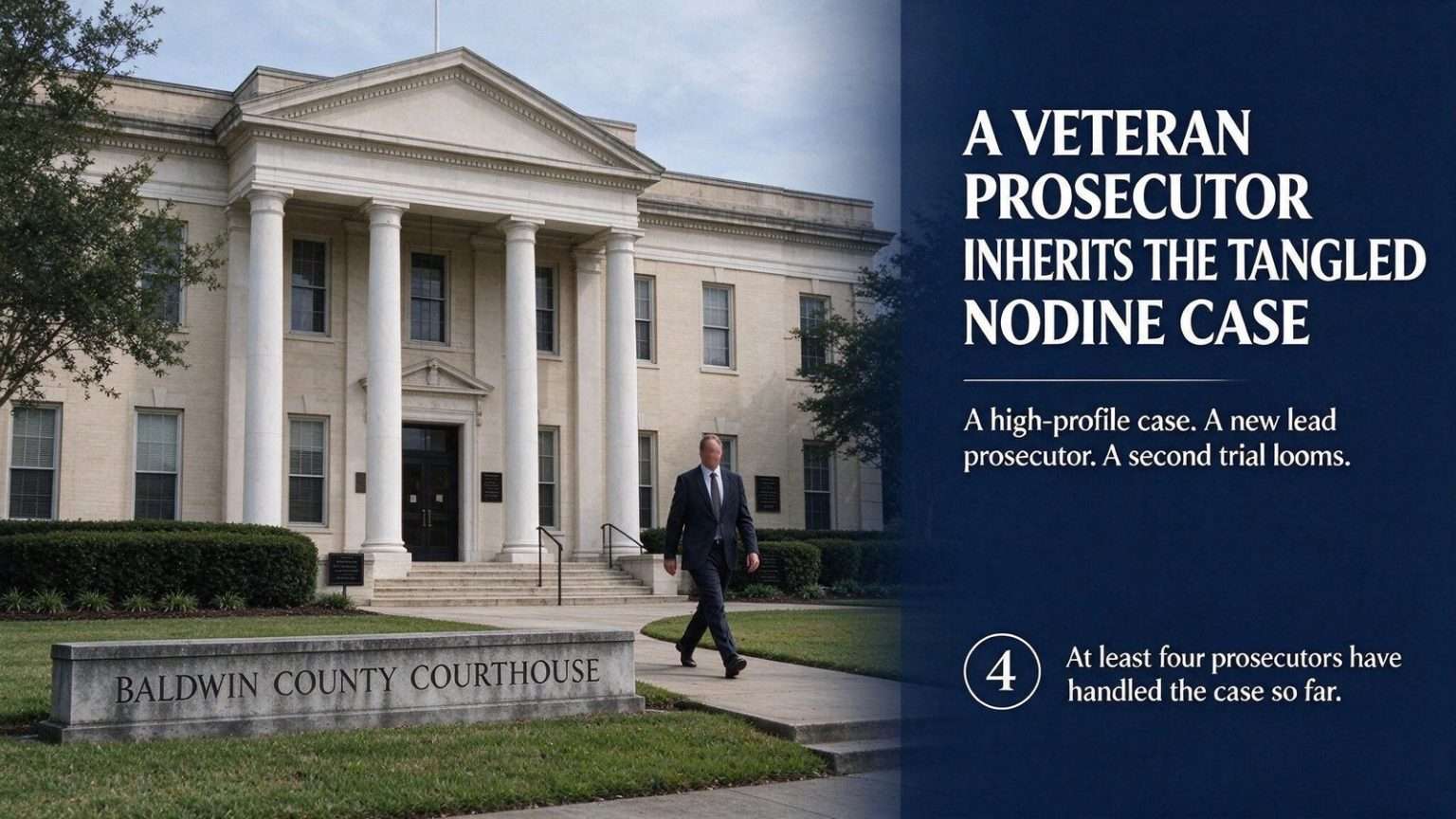
A Veteran Prosecutor Inherits the Tangled Nodine Case
Retired prosecutor David Whetstone became the latest to take up the tangled Nodine file, named a special prosecutor by the attorney general to pursue a murder theory despite a grand jury's reduced charge.
Prosecuting a murder case is rarely easy, but the effort to try former Mobile County Commissioner Stephen Nodine in the shooting death of his paramour had grown extraordinarily complicated, and it drew yet another veteran attorney into a case that had already passed through many hands.
Retired Baldwin County prosecutor David Whetstone became at least the fourth prosecutor to touch the Nodine file, tapped by Attorney General Luther Strange to head the prosecution for the state. On the defense side, nine or more attorneys had, to varying degrees, been involved in representing Nodine at different stages of the proceedings. Whetstone’s task, observers said, resembled unscrambling scrambled eggs — an effort to impose order on a record built by predecessors who had advanced shifting theories, secured two different indictments, and taken the case to a jury once without winning a verdict.
How it came to this
Angel Downs died on Mother’s Day of 2010 in the driveway of her townhouse along Fort Morgan Road in Gulf Shores, with neighbors reporting Nodine’s truck leaving the scene within seconds of the gunshot. Fort Morgan Road is one of the busiest corridors on the island end of Gulf Shores, lined with condominiums, rental townhouses and vacation traffic, and a fatal shooting in a residential driveway there drew immediate attention from police, neighbors and the news media alike.
Then-District Attorney Judy Newcomb moved swiftly, taking the case to a Baldwin County grand jury that indicted Nodine for murder, contending that he fired the gun that killed Downs. The defense argued that the evidence and Downs’ own history pointed instead to suicide, setting up the sharply opposed theories that would define the litigation from that point forward.
The case went to trial in Baldwin County, where jurors heard weeks of testimony about the shooting, the relationship between the two, and the physical evidence gathered from the townhouse and the truck. The jury deadlocked, reportedly 9-3 in favor of guilt, and a mistrial was declared. A deadlocked jury means no verdict on any count, and under Alabama law a mistrial caused by a hung jury leaves the state free to try the defendant again on the same charges.
Newcomb’s successor, Hallie Dixon, painstakingly revisited the case after taking office and ultimately oversaw a grand jury that returned a new indictment — this one charging misdemeanor criminally negligent homicide rather than felony murder. The downgrade was a dramatic shift, and it signaled that the new administration viewed the evidence in a materially different light than its predecessor had.
The starkly different theories advanced under the two prosecutors created tricky legal terrain for Whetstone to navigate when he inherited the file.
A rotating cast in a high-stakes case
Prosecutions change hands for ordinary reasons more often than the public realizes. District attorneys are elected or appointed, and a change in administration can mean a fresh review of every pending case. Prosecutors also recuse themselves when personal or professional conflicts arise, and when a local office steps aside, the Alabama Attorney General’s Office can assign the prosecution to one of its own attorneys or appoint a special prosecutor from outside.
That is the mechanism that brought Whetstone into the case. The Attorney General’s Office regularly handles cases in which a district attorney cannot or will not proceed, and it has the authority to designate experienced outside counsel to carry the state’s burden at trial. Strange’s decision to tap Whetstone, a former district attorney with decades of felony trial experience in the same courthouse where the case would be tried, was a bid for stability after a stretch of turnover.
Whetstone had spent his career as one of the longest-serving prosecutors on the Gulf Coast, handling major felonies in Baldwin County through a period when the county’s population and its criminal docket grew year after year. His familiarity with the Baldwin County court system, its judges and its juries was presumably part of his appeal to the Attorney General’s Office, because the case demanded not just legal judgment but an understanding of how a local jury might weigh evidence that had already been argued over, re-indicted and litigated for months.
A murder theory without the trigger
Whetstone signaled that he intended to pursue the earlier murder charge as a special prosecutor, resurrecting the theory the case had been built on under Newcomb. While not conceding that Nodine had not fired the handgun, he maintained there was enough evidence for a jury to conclude that he did, and that the law also allowed a jury to find felony murder for conduct that brought about a death even if the defendant never pulled the trigger.
He pointed to Alabama’s criminal code, under which a person can be guilty of murder for causing a death through the commission of certain other criminal acts. The doctrine, often called felony murder, treats a death that occurs during the course of specified felonies as murder even where the killing itself was not intended. Its application depends heavily on exactly what conduct the indictment charges and what the evidence shows happened in the final moments of the victim’s life.
The distinction matters enormously at trial. Murder in Alabama is a Class A felony carrying the most serious penalties in the criminal code, while criminally negligent homicide is a misdemeanor, punishable by a far shorter potential sentence. A jury instructed only on the misdemeanor charge could return a verdict measured in months or a few years; a jury instructed on murder could return one measured in decades. That gulf explains why the difference between the two indictments was not a technicality but the central fact of the case’s second act.
It also explains why Whetstone’s decision to pursue the murder theory required legal groundwork. Moving from a misdemeanor indictment back toward a felony murder prosecution raises questions about how the charging document is framed and what theories the state may argue at trial. Prosecutors in his position typically work through pretrial motions to establish exactly what the jury will be asked to decide.
The defense’s side of the ledger
The defense position had been consistent since the first indictment: that Angel Downs’ death was a suicide, not a homicide, and that the physical evidence and her personal history supported that conclusion. Over the course of the litigation the defense had raised challenges to the investigation and to the state’s theory, and the hung jury suggested at least a substantial minority of one Baldwin County panel found the defense case persuasive.
Representing a former county commissioner facing a murder charge is a heavy assignment, and the defense side of the case had seen its own churn, with nine or more attorneys taking part at various points. Multiple lawyers on a defense team is not unusual in a major case — the work of reviewing thousands of pages of reports, consulting experts on forensics and ballistics, and preparing for trial is enormous — but the turnover added one more layer of complexity to a file that was already difficult to master.
For the defense, the new prosecutor’s arrival cut both ways. A fresh set of eyes might view the case the way Dixon’s office had, or it might double down on the original theory, as Whetstone indicated he would. Either way, the defense would face a prosecutor with deep familiarity with the courthouse and decades of felony trial experience across the street’s witness box.
What comes next in court
Practically, the case would proceed the way major felony prosecutions do: arraignment on the operative charges, discovery of the state’s evidence, a round of pretrial motions that could shape or trim the theories the jury hears, and eventually a second trial in Baldwin County Circuit Court in Bay Minette. Timelines in cases of this complexity rarely move quickly, and each change in prosecution generally resets some portion of the preparation calendar as new counsel gets up to speed on a record two other offices helped build.
The trial itself would likely again center on the same evidence the first jury heard: the scene in the driveway, the timing of the truck’s departure, the handgun, and the dueling portraits of Downs’ final moments. What would change was the framework the state asked the jury to apply.
Why the case matters along the Gulf Coast
High-profile prosecutions test public confidence in the criminal justice system in ways ordinary cases do not. When a case passes through multiple prosecutors’ offices, produces two different indictments for the same death, and ends its first trial without a verdict, residents on both sides of Mobile Bay inevitably ask whether the system is following the evidence or the politics. The appointment of a veteran outsider was, in part, an answer to that question — an attempt to reassure the public that the case would be handled on its merits by someone with no stake in the earlier decisions.
The case also underscored how deeply the lives of Baldwin County and Mobile County officials can intertwine. Nodine had served on the Mobile County Commission, the three-member body that governs unincorporated Mobile County and controls significant road, drainage and infrastructure spending across the county’s west side and beyond. His absence from that office left constituents without their district’s vote on county business and marked a striking fall for a politician who had been a familiar figure in Gulf Coast public life.
Gulf Shores, where Downs lived and died, is a city whose identity is built around tourism, beaches and the steady growth of year-round residential neighborhoods along corridors like Fort Morgan Road. A homicide in a townhouse driveway there resonated because it landed in a community where violent death is rare and where the summer crowds, the condominium towers and the quiet residential streets exist side by side.
The long shadow of a hung jury
A hung jury is one of the most difficult outcomes in criminal law because it resolves nothing. The state does not win, the defense does not win, and the victim’s family is left without an answer. The law allows a retrial, but a second trial is expensive for the county, grueling for witnesses who must testify again, and uncertain for everyone involved. Statistics and reporting on hung juries consistently show they are uncommon but hardly rare in contested homicide cases, where jurors must be unanimous to convict or acquit.
For Whetstone, the arithmetic of that first jury — reportedly 9-3 in favor of guilt — offered both encouragement and warning. A substantial majority had leaned toward conviction, which suggests a compelling case for the state’s theory; but unanimity is the standard, and the holdout votes meant the defense had found jurors the state could not persuade. The new prosecution team would have to study what happened in the first deliberations and decide what to emphasize, what to clarify and what to abandon.
For the community, the appointment of a fourth prosecutor was a reminder of how long and winding the road from indictment to resolution can be. Cases with this many layers — two indictments, a mistrial, multiple offices, a crowded defense table — tend to take years off the lives of everyone connected to them, from the attorneys to the witnesses to the family of the woman at the center of it all.
What remained certain was that the case would be tried again, in the same courthouse, before a new panel of Baldwin County jurors, with a prosecutor whose career had been built in that building now carrying the state’s file. Whether the fifth attempt at a verdict would fare better than the first was, as observers noted, the only question left worth asking.