Coastal Lawmakers Vow to Block a Jefferson-County-Only Special Session
South Alabama legislators warned that Gov. Bentley's proposed special session on Jefferson County's debt was dead on arrival unless it also addressed the coastal homeowners insurance crisis.
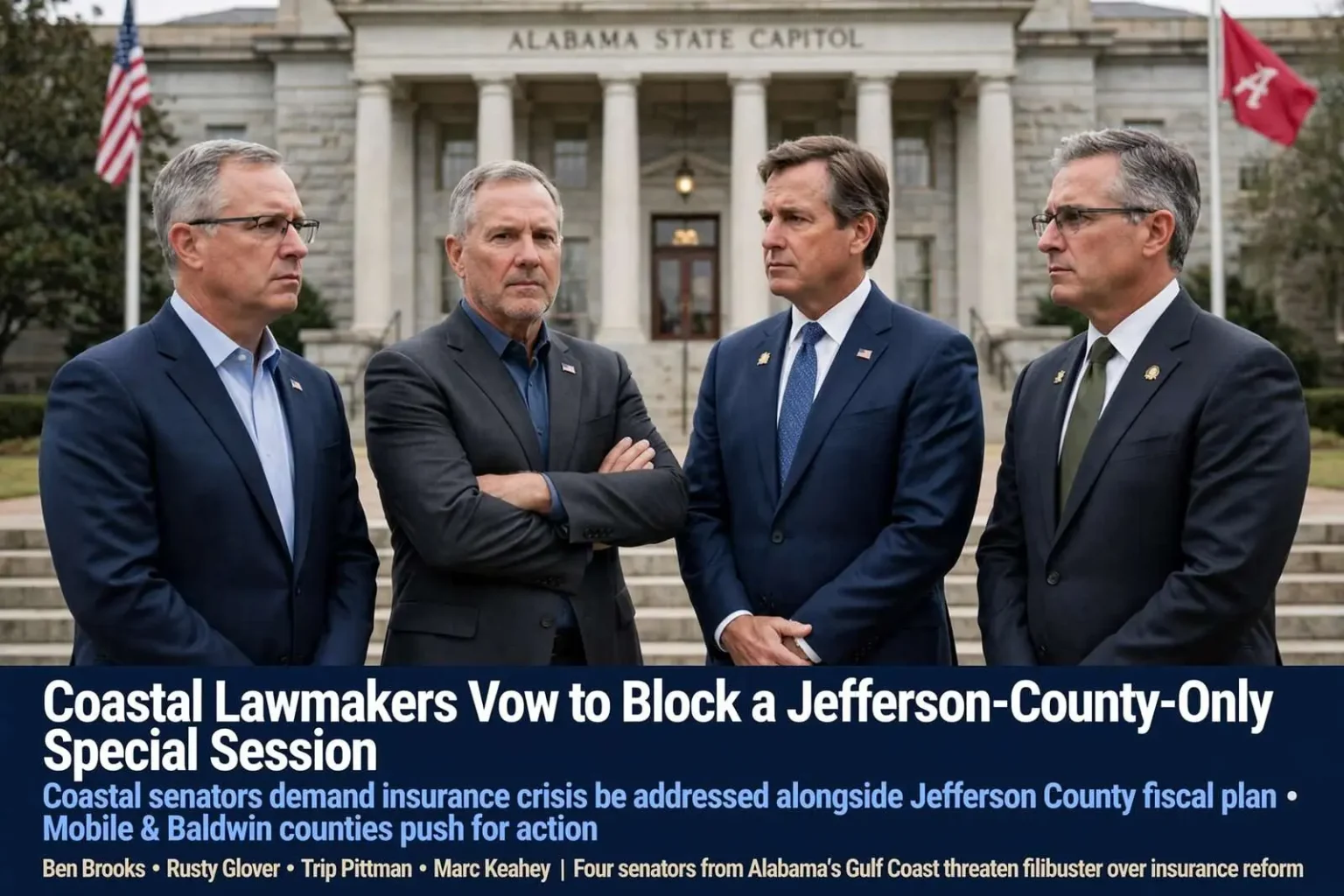
Gov. Robert Bentley’s proposal for a special legislative session devoted solely to Jefferson County’s financial troubles appeared dead on arrival among coastal Alabama lawmakers, who insisted that any session also confront the homeowners insurance crisis that had burdened Mobile and Baldwin counties for years. The clash set up one of the defining legislative standoffs of the new administration: whether the state’s attention and capital would flow to the fiscal emergency in its largest county, or whether the legislature would be forced to deal with the slow-burn crisis along the Gulf that had driven insurance premiums to punishing levels.
State Sens. Ben Brooks, Rusty Glover, Trip Pittman and Marc Keahey sounded a common theme, arguing that coastal insurance issues deserved to share top billing with the red ink threatening the state’s largest county. The four senators, whose districts together span Mobile and Baldwin counties and a swath of southwest Alabama, made clear that their votes — and their stamina on the Senate floor — could not be counted on for any agenda that treated the coast’s problems as an afterthought.
Grave concerns over the debt
Brooks said he had grave concerns about a session focused only on the hole Jefferson County had dug for itself, especially if the solution obligated the state for some $2 billion of the county’s debt, an amount he noted exceeded an entire year’s general fund revenue in Alabama. The size of the exposure was the heart of his objection: a state with chronic budget shortfalls of its own could not casually absorb a contingent liability larger than everything it spends annually on schools, Medicaid, prisons and public safety combined.
Language assigning the state a moral obligation for that debt struck him as troubling. Moral obligation, he said, meant guarantee as far as he was concerned. In the vocabulary of public finance, a “moral obligation” bond is one the issuer has not legally committed to repay but has publicly signaled it will back if necessary — and Brooks’s point was that in practice, once the state has lent its name to a debt, refusal to pay becomes a matter of reputational consequence. A moral obligation, in other words, is a legal guarantee waiting for the right crisis to become an actual one.
For the state to take on such a burden was cause for grave concern, Brooks said, invoking other struggling communities. What happens, he asked, when a small corner of the state has a problem, or when a town like Prichard struggles financially, or when other communities surface with needs no one has yet heard about? The question had teeth: Prichard, just north of Mobile, had become a statewide emblem of municipal fiscal collapse, its pension obligations dragging it toward bankruptcy and its payroll disputes reaching federal court. If Jefferson County could command a special session and state assistance, every other distressed government in Alabama could reasonably ask why not them.
A threat of a filibuster
Glover was even more emphatic. The problems in Jefferson County, he said, paled in comparison to what his constituents faced with the high cost of homeowners insurance, and any special session must begin with insurance reform. Only after meaningful reform passed, he said, would he even consider Jefferson County’s problems. If it took a filibuster to kill a session that ignored the coast, he added, so be it, warning that his constituents would be insulted if he pursued any other course.
The filibuster threat was not an idle one in the Alabama Senate, where a single determined senator can tie up the body for days. Glover’s message was that coastal legislators held both a principled grievance and a procedural weapon, and that any governor hoping to move a Jefferson County rescue through the Senate would first have to deal with the members whose districts were bleeding insurance dollars.
The coast’s decade-long squeeze
Pittman called the escalating cost of homeowners and business insurance the most serious issue facing the two coastal counties, one that affected nearly anyone who owned property there. His framing captured why the issue refused to go away: unlike a county debt crisis, the insurance burden touched every homeowner, every church, every small business and every prospective newcomer in Mobile and Baldwin counties, reshaping household budgets and the region’s economic competitiveness one premium renewal at a time.
The crisis dated to the back-to-back hurricanes of the mid-2000s. Hurricane Ivan tore into the Gulf Coast in September 2004, and Hurricane Katrina followed a year later, and in their aftermath the insurers that had written property coverage across coastal Alabama began retreating — canceling policies, refusing new business, or demanding premium increases that ran into the hundreds of percent for properties near the water. State Farm’s decision to stop writing new homeowners policies in Alabama and to non-renew thousands along the coast left tens of thousands of families scrambling, and the shrinking private market pushed more property owners into the Alabama Insurance Underwriting Association, the state’s insurer of last resort, whose rates were themselves rising.
The consequences rippled outward. Real estate agents reported buyers walking away from coastal properties when they learned what coverage cost. Banks factored insurance into mortgage affordability, shrinking what families could borrow. Businesses that might have expanded along the coast weighed premiums against other states. And for retirees who had moved to Baldwin County’s communities, the dream of affordable Gulf living collided with annual bills that in some cases rivaled property taxes. The problem was not concentrated in beachfront mansions; it reached miles inland, to homes in west Mobile and communities along the Eastern Shore that had never filed a hurricane claim in their lives.
What the coast wanted from Montgomery
Coastal lawmakers had spent years assembling proposals: creation of a state-funded catastrophe fund to absorb some of the risk that private insurers no longer wanted, tax credits for homeowners who hardened their roofs against storm damage, incentives for insurers to write new coastal business, and reforms to the insurer of last resort that would keep its rates from cascading. A special session the previous year had taken up some coastal insurance measures, and the question was whether the follow-through would continue or evaporate now that Montgomery’s attention had shifted to Birmingham’s fiscal mess.
The fundamental tension was political geography. Jefferson County’s problems — a sewer debt crisis born of a bond-financed construction program, a corrupt financing process and rising rates that crushed county finances — were real and enormous, and a county government default carried implications for every Alabama municipality that ever planned to sell a bond. But the county’s troubles were somebody’s fault, in a way that invited blame; the coast’s insurance crisis was an act of weather and national insurance economics, in a way that invited sympathy. Coastal senators argued that a legislature willing to convene for Birmingham’s self-inflicted wound ought to be willing to convene for the Gulf’s, and to put the state’s limited resources behind the problem that touched more of its citizens directly.
Keahey and the broader coastal coalition
Keahey, whose district stretched across southwest Alabama from Washington County through Choctaw, Clarke, Wilcox and neighboring counties, added a rural dimension to the coastal argument. The homeowners insurance crisis was not confined to the beach; it reached deep into rural southwest Alabama, where premiums had climbed even as incomes stagnated, and where a retired couple on a fixed income had no more ability to absorb a doubled premium than a dockside condominium owner. A special session that ignored the issue would be ignoring his constituents too, the senator made clear.
Together, the four senators represented nearly all of Alabama’s Gulf Coast territory, and their solidarity transformed the insurance issue from a regional complaint into a legislative veto. A governor’s agenda in the Alabama Senate requires coalitions, and any Jefferson County package would need votes from across the state — including the coastal delegation. Their position meant the county-only session Bentley had in mind would begin its life without the votes to function.
What Jefferson County’s crisis meant for the state
The county’s predicament had become the largest municipal fiscal failure in American history. Decades earlier, Jefferson County had undertaken a massive sewer modernization program under federal court order, financing billions of dollars in construction with bonds sold through a process later stained by corruption — county commissioners convicted, a prominent Birmingham mayor gone to federal prison, and investment banks that had structured the debt with interest-rate swaps that exploded when the credit markets seized. As rates reset upward, the county’s sewer debt service ballooned, commissioners refused to triple sewer rates, and the county slid toward a bankruptcy filing that would dwarf anything Alabama government had seen.
That is the backdrop against which proposals to assign the state a share of the debt — as much as $2 billion in some formulations — had emerged. Proponents argued that a state guarantee would let the county refinance at sustainable rates, avoid the catastrophic costs of bankruptcy litigation, and protect the credit ratings of every other local government in Alabama. Opponents like Brooks countered that the state would be socializing the mistakes of Birmingham bond lawyers and Wall Street banks, and that the precedent would hang over every future fiscal crisis in every corner of the state.
The standoff’s likely course
The arithmetic of the Alabama Senate made the coastal position formidable. The governor sets the call of a special session — literally, the list of subjects the legislature is permitted to consider — but he cannot compel the Senate to complete its work. A bloc of senators determined to filibuster a narrow agenda can prevent the passage of anything, as previous governors had learned at great cost. Glover’s threat invoked that tradition directly: a session on Jefferson County alone would face organized coastal resistance from the first gavel, and the legislature would leave Montgomery with nothing accomplished but the confirmation of regional grievances.
For the governor, the path of least resistance was to broaden the call to include coastal insurance measures — an acknowledgement that the state’s fiscal agenda, whatever its center of gravity, had to be national in a state whose largest county was insolvent and whose coast was economically throttled. Whether insurance reform could pass, in what form and with what cost to the treasury, remained to be negotiated. But the message from Brooks, Glover, Pittman and Keahey was unambiguous: the coast had paid its premiums in political capital for years, and it intended to collect.
For residents of Mobile and Baldwin counties, the fight in Montgomery was not an abstraction. Every premium bill that arrived at a coastal doorstep was the practical consequence of a market that had abandoned the region, and every senator who stood on the floor and linked insurance reform to any Jefferson County deal was doing exactly what constituents had demanded for years — refusing to let the coast’s decade of hardship be traded away for a rescue of somebody else’s mistakes.