Sheriff’s Office Seeks $778,000 Federal Grant to Prepare for a Permanent Prichard Police Takeover
Mobile County officials are pursuing a Department of Justice hiring grant that would fund four new deputies if Prichard disbands its police department and hands law enforcement duties to the Sheriff's Office permanently.
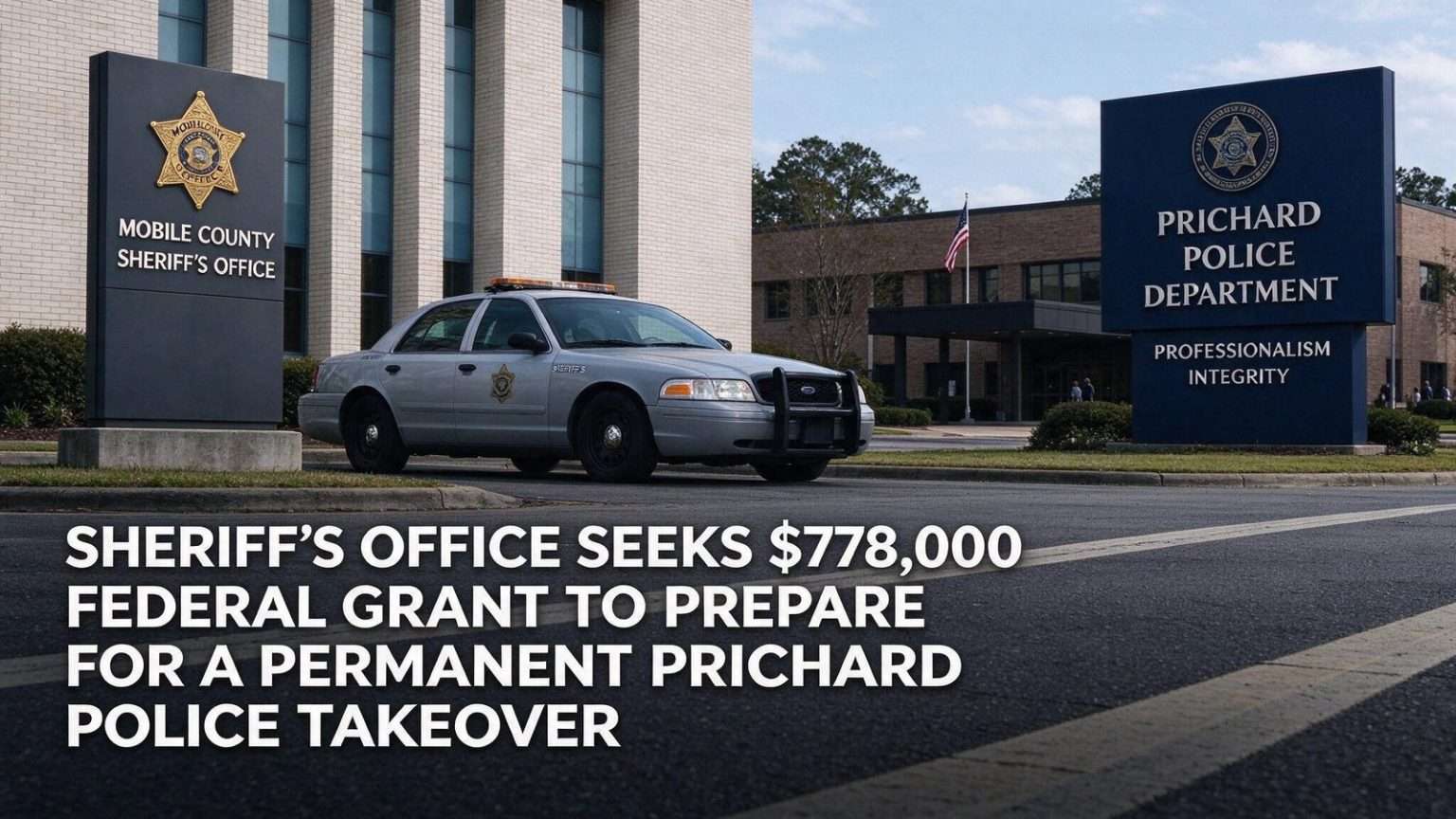
The Mobile County Sheriff’s Office is moving to secure federal money that would help pay for additional deputies should its temporary control of the Prichard Police Department become permanent, an acknowledgment that the county is preparing for a scenario in which Prichard no longer has a police force of its own.
The agenda for the Mobile County Commission’s Thursday morning work session included an application for $777,813.36 in U.S. Department of Justice funding. The money would come through the COPS Office Hiring Program, a longstanding federal initiative that helps local agencies add sworn officers, and would require the county to contribute a local match of $194,453.34.
Why the County Is Applying Now
Chief Deputy Frank Cassady told commissioners the Sheriff’s Office wants the funding in hand because it may need it. The agency has managed day-to-day operations at the Prichard Police Department since June, after the arrest of officer Emanuel Naman Dotch on multiple charges including bribery and evidence tampering.
Cassady said the grant would cover the cost of four deputies, and framed the application as a matter of timing rather than a commitment. “If Prichard does end up closing their police department and we have to take over, this will help alleviate some of the cost of the employees that we would have to hire to take over Prichard,” he said. “If Prichard does not fold and we end up giving it back to Prichard, we could always not accept the award, but the grant closes on the 19th. If we don’t apply now, we can’t come back later once we find out the future of Prichard.”
That deadline pressure explains the unusual posture of the request. The county is not declaring that a permanent takeover will happen. It is simply refusing to let a federal funding window close while the question remains unresolved.
The Staffing Math
Cassady was blunt about capacity. There is “no way,” he said, that the Sheriff’s Office could handle both its existing county-wide responsibilities and Prichard’s law enforcement duties without hiring new personnel.
Prichard is a city of roughly 19,000 residents with its own call volume, its own patrol needs and its own investigative caseload. Absorbing that workload into an agency already responsible for unincorporated Mobile County and the county jail is not a matter of redrawing beats on a map. It requires bodies.
- Patrol coverage must be maintained around the clock across additional geography.
- Investigations in Prichard carry over and require detectives.
- Overtime costs accumulate quickly when a department runs short-staffed.
- Recruitment and training for new deputies take months, not weeks.
When commissioners pressed him, Cassady said he could not estimate how much overtime pay the Sheriff’s Office might incur while covering Prichard’s law enforcement duties in the interim. That uncertainty is itself part of the argument for pursuing outside money.
The Broader Investigation
The Sheriff’s Office presence in Prichard grew out of a federal corruption investigation. U.S. Attorney for the Southern District of Alabama Sean Costello has said investigators are examining whether other officers at the Prichard Police Department worked alongside Dotch. That inquiry produced a second arrest.
On the afternoon of Wednesday, July 8, sheriff’s deputies took officer Jihad Hasan Irby into custody on charges of extortion and bribery, allegations similar in character to those Dotch faces. The FBI-led corruption investigation remains active, and officials have said additional charges or arrests are possible.
What a Disbandment Would Mean
Municipalities in Alabama are not required to operate their own police departments. A city can contract with, or simply cede policing to, the county sheriff. What would make Prichard’s case notable is its size and the circumstances driving the decision.
Dissolving a police department is a consequential and largely irreversible step. Officers lose their jobs. Equipment, evidence and records must be transferred. Residents lose a locally accountable chief and gain a countywide elected sheriff who answers to a much larger constituency. Supporters of consolidation argue it delivers professional standards, better training and economies of scale. Critics counter that it can dilute a community’s voice in how it is policed.
City and county leaders have been weighing options for months, including a possible long-term contract under which the Sheriff’s Office would provide policing services to Prichard.
Prichard’s finances have been strained for decades; the city filed for Chapter 9 municipal bankruptcy in 1999 and again in 2009.
Next Steps
The Mobile County Commission could vote on the grant application during its regular meeting on Monday, July 13. Because the federal application window closes July 19, the commission has effectively no room to defer the item and revisit it later.
Approving the application does not obligate the county to accept the money. As Cassady noted, the award can be declined if Prichard reconstitutes its department. What the vote does accomplish is preserve the county’s options at a moment when Prichard’s future policing arrangement remains genuinely unsettled.
Update: Commission Approves $777,813 Grant Application, Requires $194,453 Local Match
The Mobile County Commission has approved the Sheriff’s Office’s application for a U.S. Department of Justice COPS Hiring Program Grant worth $777,813.36, which would require a 25% local match of $194,453.34.
If awarded, the grant would cover 75% of the cost of hiring four additional deputies over three years. Frank Cassady of the Mobile County Sheriff’s Office told commissioners the funding is meant as a hedge against the possibility that the county takes over policing in Prichard permanently.
“With the uncertainty of the future of Prichard, if Prichard does end up closing the police department and we have to take over, this would help alleviate some of the cost,” Cassady said.
He added that if Prichard retains its own police department, the Sheriff’s Office could decline the funding: “If we don’t apply now, we can’t come back later once we find out the future of Prichard.”
Under the COPS Hiring Program’s rules, agencies that accept an award must keep the grant-funded positions for at least 12 months after the three-year federal funding period ends, paying for them with local money.