Elberta Man Faces Manslaughter Charge After Fatal Motorcycle Collision
Charges against an Elberta driver were upgraded to manslaughter after a motorcyclist died from injuries suffered in a County Road 83 crash.
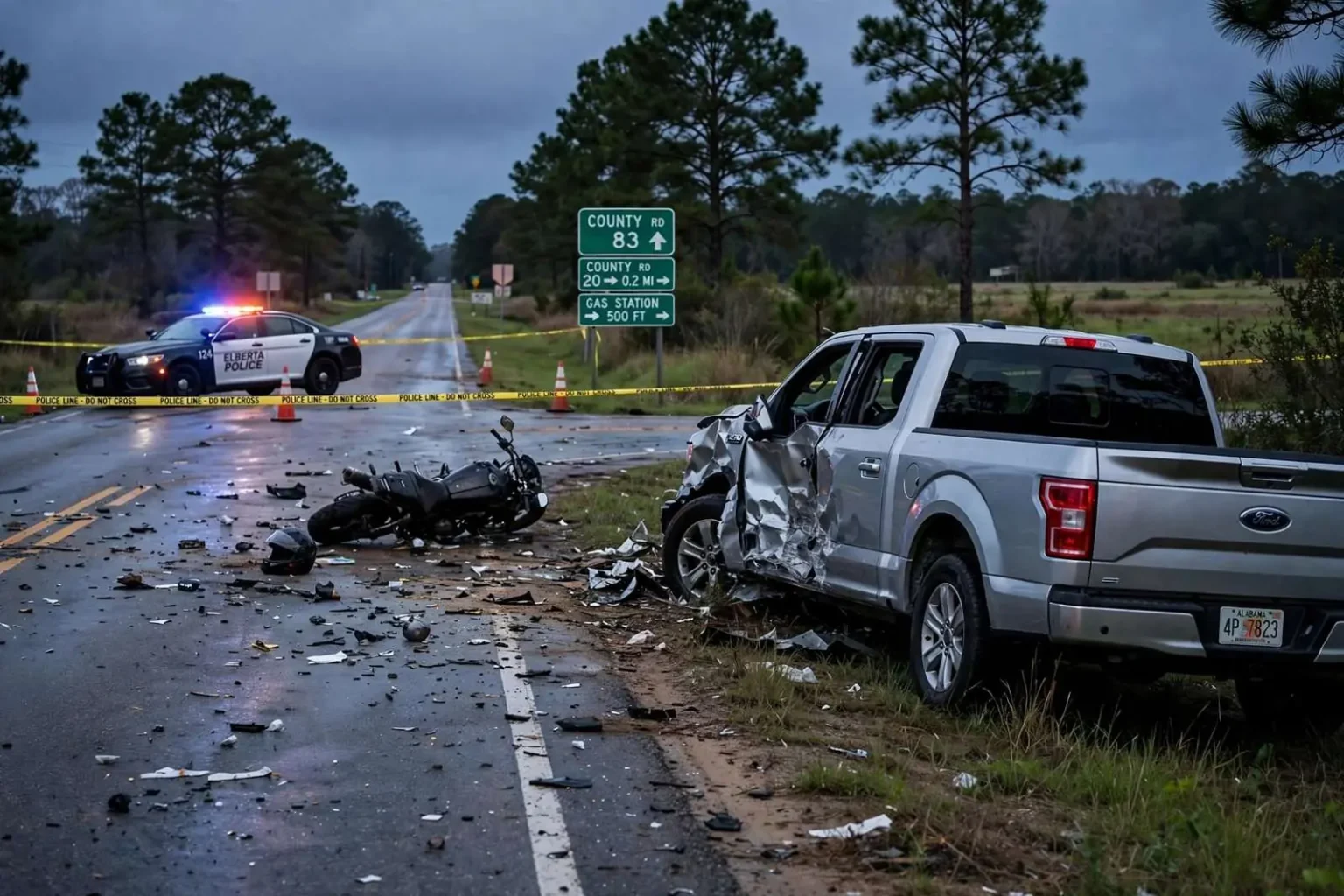
Charges against an Elberta man have been elevated to manslaughter following the death of a motorcyclist injured in a two-vehicle wreck on County Road 83 earlier this year, according to the Elberta Police Department.
Richard Albright, 58, who lives in Elberta, was initially arrested on a DUI charge at the scene of the May crash. After the victim, 57-year-old Steven Watkins of Pensacola, Florida, later died from his injuries, police upgraded the case against Albright to include manslaughter and first-degree assault charges. He was booked into Baldwin County Corrections and was later released on a $50,000 bond.
The escalation of charges is a familiar sequence in Alabama crash cases. Prosecutors generally wait for the final medical outcome before deciding how to charge a driver whose conduct caused injuries, because the difference between assault and homicide charges turns on whether the victim survives. When Watkins died, the case shifted from an injury prosecution to a death prosecution, and the charges were refiled accordingly.
How the Crash Happened
According to investigators, the crash occurred on a Saturday evening as Albright was driving a pickup truck westbound on County Road 83 with a passenger. At the same time, Watkins was riding a motorcycle eastbound on the same road with a passenger, 49-year-old Carol Greenwood, also of Pensacola.
Police say the wreck happened when Albright attempted a left turn from the westbound lane toward a gas station near the intersection of County Road 83 and County Road 20. An Elberta police sergeant said Albright turned directly into the path of the oncoming motorcycle, and the motorcycle struck the passenger side of his pickup truck.
Left turns across oncoming traffic are among the most dangerous maneuvers on two-lane rural roads, and they are particularly dangerous for motorcyclists. A rider approaching a vehicle that is slowing to turn has little time to judge whether the driver has seen the motorcycle, and a bike that has no evasive room left will strike the turning vehicle at nearly full closing speed. What would be a fender-bender between two cars becomes a catastrophic impact for anyone on two wheels.
Watkins was taken to a hospital in Pensacola for treatment, where he later died from his injuries, according to police. Greenwood, his passenger, was also transported to the hospital to be treated for injuries sustained in the crash, though authorities said she was not seriously hurt. Albright’s passenger similarly avoided serious injury.
The Charges and the Court Process
With the upgraded charges, Albright now faces manslaughter and first-degree assault counts alongside the original DUI charge. In Alabama, manslaughter typically involves causing a death recklessly, and DUI-related fatalities can support homicide charges when a driver’s impairment is tied to the death. First-degree assault, in this context, reflects the serious injuries involved in the collision. The case now moves through the Baldwin County court system, where prosecutors will present the evidence to a grand jury and any trial would take place in county circuit court.
The $50,000 bond sets the conditions of Albright’s release while the case proceeds. Bond in Baldwin County felony cases is set to ensure a defendant’s appearance in court, and release on bond means the case will be worked through the standard pretrial process — evidence exchange, motion practice and, if no plea agreement is reached, trial. Investigators have not indicated whether additional charges are expected as the case moves forward.
Elberta sits in the southern stretch of Baldwin County, one of Alabama’s fastest-growing counties, where years of residential growth have collided with a road network built for farm traffic. County Road 83 runs through that changing landscape, carrying a mix of local commuters, agricultural vehicles and, increasingly, visitors moving between the inland communities and the beach towns to the south. Intersections like the one at County Road 20, where gas stations and driveways meet a highway that once had little development along it, are where much of that friction plays out.
A Familiar Pattern on Baldwin County Roads
The case highlights a familiar and sobering pattern in fatal crashes along Baldwin County’s rural highways, where left turns across oncoming traffic on two-lane roads remain one of the more common causes of serious motorcycle collisions.
Safety data across the Gulf Coast region consistently shows that motorcycle fatalities cluster on exactly this kind of road: two lanes, moderate speed limits, commercial driveways and side roads feeding in at intervals, and evenings when visibility works against everyone. Riders from Pensacola and Baldwin County communities ride County Road 83 and the roads around it year-round, and weekend evenings bring heavy motorcycle traffic to the area, particularly in spring and fall when the weather draws riders out in numbers.
For drivers, the lessons from crashes like this one are unglamorous but consistent: look twice before turning across a lane of traffic, assume an approaching vehicle may be a motorcycle that is closer and faster than it appears, and never make the turn on a guess. For riders, the parallel advice is to treat every oncoming vehicle that slows near a driveway or side road as one that may turn, and to keep speed and following position adjusted for that possibility.
What Comes Next for the Case
From here, the case follows the standard arc of a Baldwin County felony prosecution. The district attorney’s office will review the police investigation, the toxicology results from the night of the crash, and the medical evidence connecting Watkins’ injuries to his death. Grand jury action formally determines the charges that proceed to trial, and defendants facing manslaughter counts in Baldwin County typically move through arraignment, pretrial hearings and plea negotiations over a period of months.
Outcomes in such cases vary widely. Some defendants enter plea agreements to reduced charges with prison or split sentences; others go to trial, where juries weigh impairment evidence, witness accounts of the turn, and the circumstances of the crash. Manslaughter convictions in Alabama carry sentences of up to 20 years in prison, and DUI-related deaths often factor into sentencing as an aggravating consideration. Whatever the outcome, the families involved face years of court dates after a single evening’s decision.
The ripple effects extend beyond the courtroom. Watkins and Greenwood had traveled from Pensacola, and their families now navigate a prosecution in another state’s courts. Albright’s passenger, who escaped serious injury, remains a witness in the case. And in Elberta, the crash became the latest entry in the community’s long awareness of what its main roads can do.
Motorcycle Safety on the Gulf Coast
Crashes of this kind recur often enough along the Gulf Coast that motorcycle organizations and state safety offices return to the same themes every riding season. Alabama requires motorcycle endorsement on a driver’s license, and the state’s rider-safety courses teach the defensive habits — lane positioning, eye movement, speed management near intersections — that give riders a chance when a car turns in front of them.
But engineering and enforcement carry part of the burden too. Communities along Baldwin County’s growing corridors have added turn lanes, lighting and signalization at high-volume intersections over the years, and local police departments like Elberta’s patrol the rural routes where speeding and impairment most often turn routine mistakes into fatal ones. DUI enforcement, in particular, remains the sharpest tool available for preventing crashes like the one on County Road 83.
For now, a Pensacola family is planning a funeral, a Foley-area man is out on bond awaiting felony charges, and a Baldwin County courtroom will eventually sort out responsibility for a left turn that took a rider’s life. The case stands as one more reminder of how quickly an ordinary Saturday drive on a two-lane Alabama road can turn permanent.
The Human Side of the Numbers
Behind the charge sheet, the crash illustrates how quickly lives reorganize around a single intersection. Watkins was 57, an age when riders often have decades of experience on two wheels, and he was riding with a passenger who survived him. His death adds him to the toll of motorcycle fatalities that Baldwin County and its neighbors have recorded along rural corridors in recent years, each one producing the same cascade — a hospital run that becomes a death notification, a DUI arrest that becomes a homicide charge, and two families tied together by a road neither will forget.
Local emergency crews know the pattern well. Volunteer fire departments and county medics along the county’s southern corridors respond to crashes like this on a regular basis, and the distance to trauma care — in this case a hospital in Pensacola across the state line — is part of every rural crash outcome. Injured riders depend on how quickly someone calls 911, how quickly a helicopter or ambulance can move, and how much damage the first minutes of care can limit.
For the Elberta community, the case also underscores the work its small police department does with limited resources. A town the size of Elberta investigates its own fatal crashes with help from county and state partners, and the resulting prosecution depends on the scene work done in the first hours — measurements, witness statements, photographs and toxicology. What those officers recorded on that Saturday evening will now shape everything that happens in a Baldwin County courtroom.