McMillan Leads Agriculture Commissioner Ticket, Credits Mobile and Baldwin
Stockton's John McMillan led the Republican field for Alabama agriculture commissioner in the June 1 primary and said his home counties on the coast supplied the margin that carried him into a runoff.
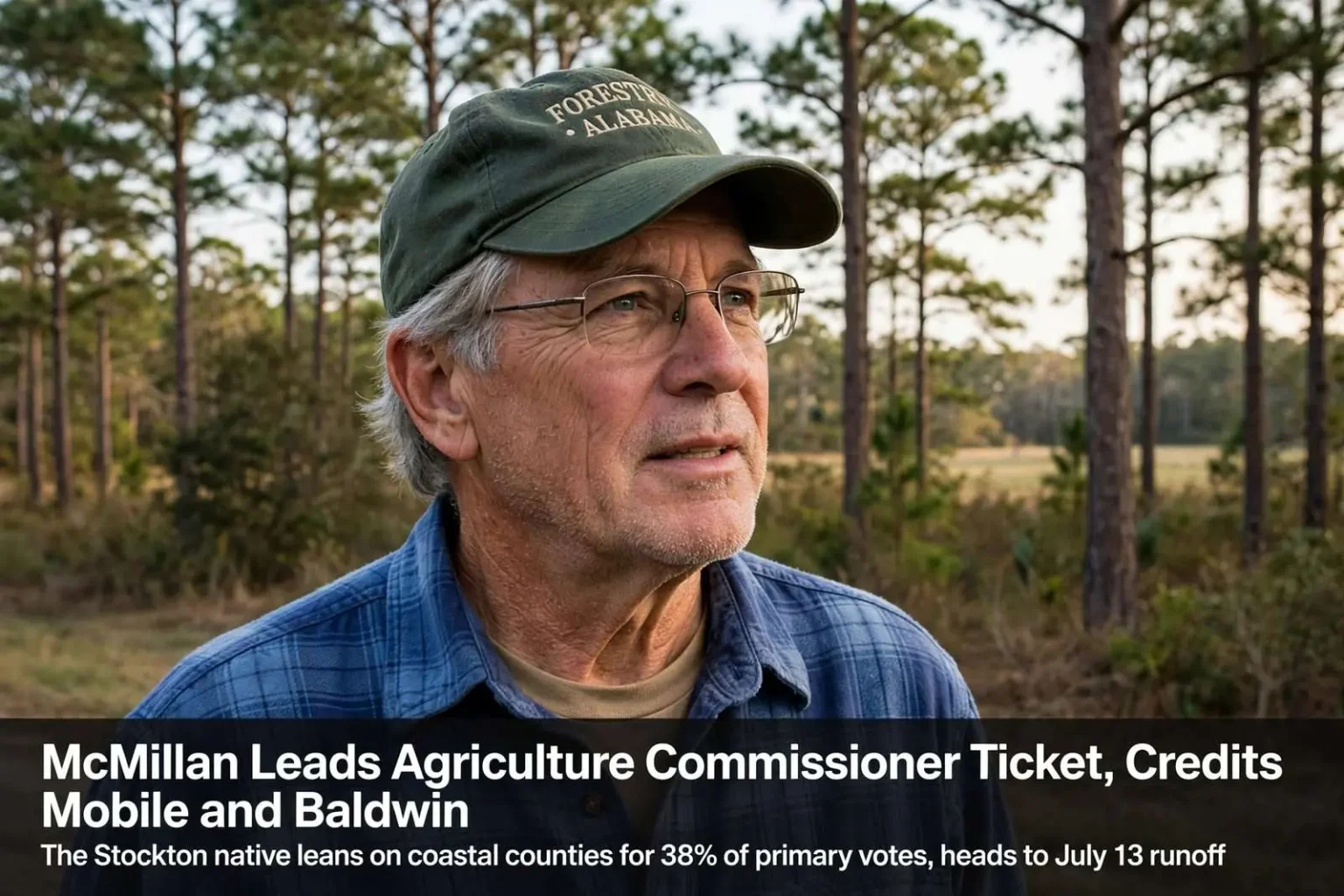
John McMillan of Stockton led the Republican ticket for Alabama agriculture and industries commissioner in the June 1 primary and said the votes that put him there came, disproportionately, from home. McMillan drew about 38 percent of the vote in a multi-candidate field, short of the majority needed to avoid a July 13 runoff against Dorman Grace.
The Coast Delivered
Asked what carried him, McMillan pointed to the two counties at the bottom of the state. “Baldwin and Mobile were unbelievable — 10.1 percent and 11.4 percent of my votes,” he said.
That concentration is striking in a statewide race. Together, the two coastal counties supplied better than a fifth of McMillan’s total, a reflection both of his roots in northern Baldwin County and of the organizational work he had done across the Mobile Bay area over a long campaign. In Alabama statewide politics, where candidates usually lean on a home region plus a scattering of support elsewhere, a fifth of the vote from just two of the state’s 67 counties is an unusually deep well.
Stockton, the small community in northern Baldwin County that McMillan calls home, sits in the timber country that shaped his public life. Home-region loyalty of that kind is a familiar force in Alabama races, where voters take pride in supporting a neighbor, but loyalty alone does not produce a 20-plus percent share across two counties. It has to be organized, and McMillan’s long familiarity with the civic networks of the Mobile Bay area — from farm bureaus to forestry associations to county party committees — gave him channels most statewide candidates lack.
Two Years of Running
McMillan, a former state legislator and longtime figure in Alabama forestry and conservation circles, had been campaigning for the better part of two years, and by his own account was outspent several times over. “I have been going almost two years, outspent several times over, hoped to make the runoff and mighty happy to lead the race,” he said.
That arithmetic — relentless personal campaigning against better-funded opposition — is the classic down-ballot path in Alabama. Races for agriculture commissioner rarely attract big television budgets, and the candidates who win them tend to be the ones willing to shake hands in every county, at every co-op opening, cattlemen’s meeting, and forestry field day, for years at a stretch. McMillan’s forestry background gave him a natural reason to appear at exactly those gatherings, and the June results suggest the work compounded.
He allowed that a runoff had its advantages. “One on one comparisons are somewhat easier,” he said — a single opponent being easier to draw contrasts against than a scattered field. In a crowded primary, a candidate’s message blurs against four or five others; in a runoff, every appearance and advertisement lands in a head-to-head frame, and the front-runner’s task becomes defining the choice for voters who may know neither name well.
A Complaint About the Coverage
McMillan said the endorsement he received from a major state newspaper had been helpful. He was less charitable about newspapers that endorsed his runoff opponent, saying some of them neither interviewed nor returned calls from other candidates in the race.
The gripe was a common one in Alabama’s down-ballot statewide contests, where candidates for offices like agriculture commissioner, treasurer and public service commissioner struggle for any attention at all — and where an editorial board’s nod can move a meaningful number of votes precisely because so few voters know the candidates. When a newspaper endorses in such a race without interviewing the field, candidates argue, the endorsement reflects staff convenience as much as merit, and it hands one campaign credibility the others never had the chance to contest.
Editorial boards, for their part, face genuine constraints. A newsroom covering a governor’s race, a congressional delegation, and a dozen local contests cannot devote equal attention to every down-ballot office, and endorsements in low-profile races often rest on the reporting already available. But the asymmetry stings candidates like McMillan, who spent two years building a case no one wrote down.
What the Job Actually Does
The office McMillan was chasing touches Alabama life far more than its low profile suggests. The Department of Agriculture and Industries inspects grocery stores and gas pumps, enforces weights and measures, administers pesticide and fertilizer regulation, runs the state’s farmers markets program, monitors animal health, and polices the labels and scales that keep commerce honest between farm and table. For a state where agriculture and forestry together anchor huge swaths of the rural economy, the commissioner’s decisions ripple from the wetlands of south Baldwin County to the row-crop counties of the Tennessee Valley.
Forestry, in particular, gives the office a Gulf Coast connection. Alabama’s timber industry — one of the largest in the country — depends on forest health programs, fire protection, and market development that intersect with the department’s work, and a candidate whose career was built in forestry and conservation circles speaks that language fluently. McMillan’s legislative service added the other half of the job description: the department’s budget and its many statutory duties all pass through the Statehouse, where relationships decide outcomes.
The Runoff Ahead
The July 13 runoff sets up a test of the June math. McMillan enters as the leader, with the coast behind him and a field of former opponents’ supporters up for grabs; Grace starts with whatever geographic and institutional base carried him into the runoff. Turnout, as always in Alabama runoffs, will be a fraction of the primary’s, which narrows contests to the most committed voters and rewards the campaign that can identify and retrieve its June supporters.
Whoever prevails will advance to face the Democratic nominee in November, in a race that — like most for this office — will be fought quietly, on the strength of agricultural networks and word of mouth rather than airtime. For McMillan, the June results already made the argument he had been making for two years: a long campaign, a deep home base, and a willingness to be outspent can still lead a statewide race. “Hoped to make the runoff,” he said, “and mighty happy to lead the race.”
The coastal counties that delivered a fifth of his June total will be watching to see whether their neighbor can finish what their votes started — and northern Baldwin County, which has sent its share of figures to state office, will be counting that as a hometown story either way.
The Geography of a Statewide Base
McMillan’s coastal concentration is worth placing in context. Baldwin County has grown into one of Alabama’s political strongholds, consistently delivering heavy margins for Republican candidates, and a Baldwin native competing statewide starts with an advantage candidates from other regions must spend money to approximate. Mobile County, larger and more competitive, is harder to dominate — which is why McMillan’s Mobile share approaching his Baldwin share stands out. It suggests his two-year campaign built genuine organization in the city and county, not merely inherited his home county’s reflexive loyalty.
The June 1 primary also came at a moment of transition for Alabama’s Republican electorate, with competitive down-ballot races drawing voters’ attention below the top of the ticket. In such fields, a candidate’s identifiable constituency — timber, agriculture, a home region — becomes the shorthand voters use to sort unfamiliar names. McMillan’s forestry identity made him legible to voters across south Alabama in a way a generic campaign cannot manage.
His use of the two-year campaign to cover ground personally also matches how agriculture commissioner races have traditionally been won in Alabama. The office’s constituents — farmers, cattlemen, foresters, agribusiness operators — are organized into associations and cooperatives that meet constantly, invite candidates regularly, and remember who showed up. Television can introduce a name; it cannot replace two years of county fairs.
Runoff Math and the Weeks Ahead
Between June 1 and July 13, both runoff campaigns would work the state’s political map with limited resources. Endorsements from defeated primary opponents, the editorial page momentum McMillan cited, and each campaign’s ability to reactivate its primary voters typically decide these contests more than any late advertising push. A 38-to-second-place lead is meaningful but not commanding; Alabama runoff history includes plenty of front-runners who watched their June margins dissolve when a rival’s supporters consolidated.
For voters in Mobile and Baldwin counties, the runoff offered a rare chance to see a home-region candidate compete for statewide office in a year when the coast’s political weight was growing. McMillan’s own framing of his base — “Baldwin and Mobile were unbelievable” — doubled as a promise to the region that its influence would carry into whatever office he ultimately held.
However the runoff ended, the June primary had already settled one question: a two-year campaign, run largely under the radar and outspent at every turn, could still lead a statewide ticket on the strength of organization, identity, and a home region that turned out. In Alabama’s down-ballot politics, that is the whole playbook — and McMillan, by his own accounting, had executed it to the letter.