Axis Man Shoots Neighbor During Backyard Confrontation, Then Calls 911 Himself
A Mobile County man shot his neighbor during a backyard dispute in Axis and immediately called 911 to report the shooting himself.
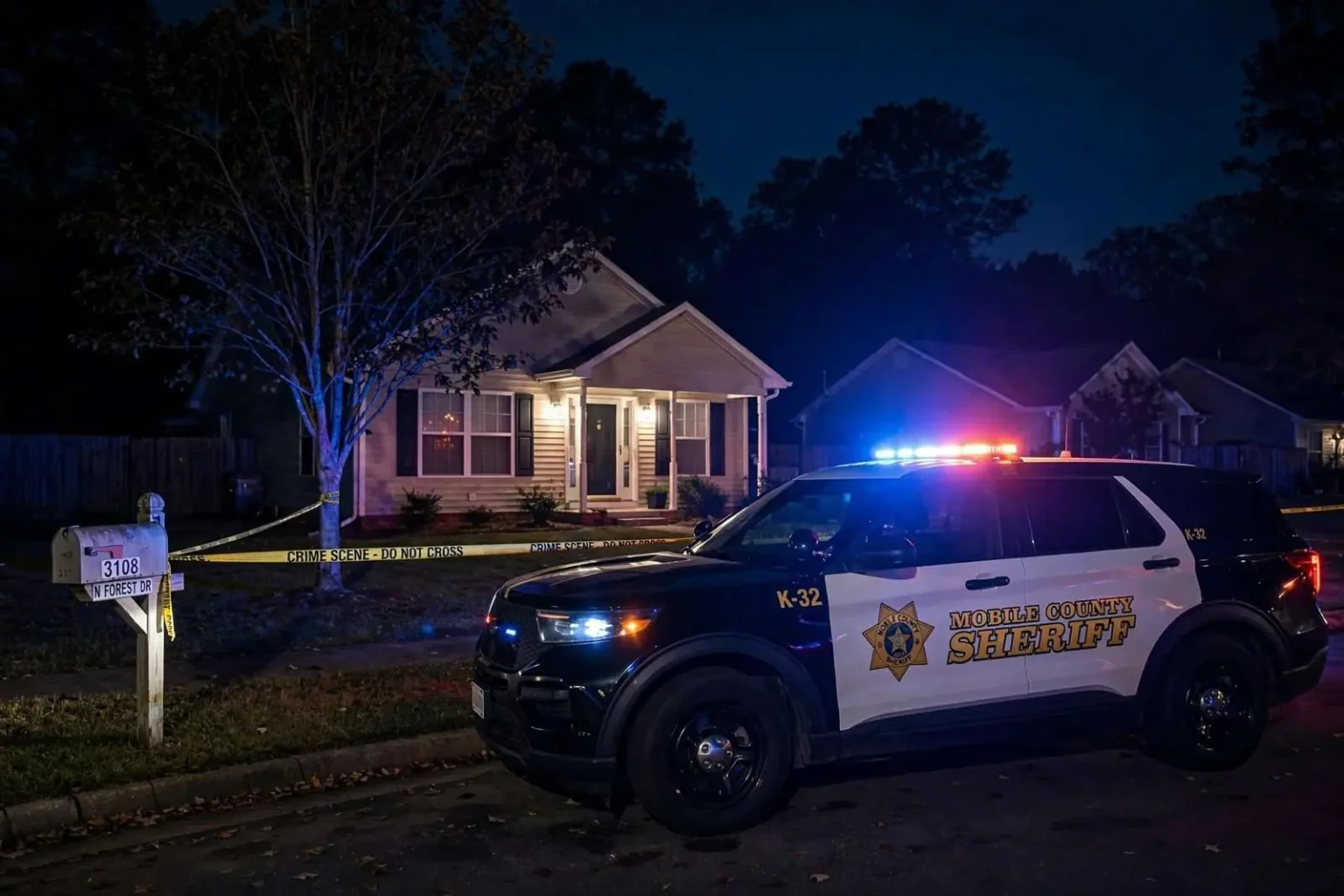
A confrontation between neighbors in the Axis community ended with a gunshot wound and a self-reported call to 911, according to the Mobile County Sheriff’s Office. Authorities say the incident unfolded at a home on North Forest Drive after a resident, Michael Glenn, heard noise outside his house and discovered his neighbor, 54-year-old Darrell Ellison, in his backyard.
According to a sheriff’s office spokesman, when Glenn went outside and told Ellison to leave the property, Ellison instead advanced toward him while mumbling incoherently. Despite repeated requests for Ellison to stop approaching, deputies say he continued moving toward Glenn, at which point Glenn fired a shot that struck Ellison in the right arm.
Rather than fleeing the scene, Glenn immediately contacted emergency dispatchers to report what had happened, according to the sheriff’s office account of the incident. That self-report, investigators note, is often among the first details weighed in any use-of-force case, both because it brings help to the injured party faster and because it preserves the shooter’s account while evidence remains fresh.
Deputies find Ellison inside his own home
When deputies arrived to check on Ellison, they reportedly found him back inside his own home, running bath water and continuing to speak in a way that did not make sense to responding officers. He was subsequently taken to a local hospital for treatment of his gunshot wound, with his condition described as survivable from the outset given the location of the injury.
The deputies’ observations of Ellison’s condition that night became part of the case file, since the account of a wounded man found running bath water and speaking incoherently bears directly on the question of what happened in the neighbor’s yard minutes earlier. Medical records from his hospital treatment, along with any toxicology results, will figure in the review that follows.
The sheriff’s office said no arrests were made following the shooting, and the case has instead been forwarded to the Mobile County District Attorney’s Office for review, a common step in self-defense or use-of-force shootings where investigators want prosecutors to weigh in before deciding whether charges are warranted.
How Alabama handles self-defense claims
The referral process reflects how Alabama law structures these cases. State law allows a person to use force, including deadly force, against another when they reasonably believe it necessary to prevent imminent death or serious physical harm, and Alabama statutes further provide that a person attacked in a place they have a right to be has no duty to retreat before using defensive force. Whether a particular shooting fits those standards is a judgment that belongs to prosecutors and, ultimately, to courts rather than to the deputies at the scene.
Investigators in cases like this one gather a specific body of evidence: the physical layout of the yards, distances involved, any shell casings or property damage, 911 recordings, witness statements and the medical findings on the wounded party. The shooter’s account, given immediately after the incident, is compared against the physical evidence, and the wounded person’s condition and statements are weighed alongside it.
The Mobile County District Attorney’s Office reviews the complete file and decides among several outcomes: presenting the case to a grand jury, filing charges directly, declining to prosecute, or requesting further investigation. In shootings where a homeowner claims defense against an advancing intruder, the review typically centers on whether the shooter’s belief in imminent harm was reasonable given everything known about the encounter.
The background records in the case
Records reviewed in connection with the case show that Ellison has an extensive criminal history in Mobile County, including prior charges for marijuana possession, possession of drug paraphernalia, public intoxication, first-degree robbery and driving under the influence. Glenn, by contrast, has no criminal record on file, according to the sheriff’s office.
Prior records are not determinative in a self-defense review, but they inform the context that prosecutors and, potentially, juries consider. A first-degree robbery charge on a record is a felony of the most serious class short of homicide, and its presence among Ellison’s prior charges gives the encounter’s escalation a significance it would not otherwise carry. Glenn’s clean record likewise becomes part of the profile that investigators assemble around the shooter.
What the records cannot do, on their own, is answer the central question: what reasonably appeared to be happening in that backyard in the moments before the shot was fired. That question will drive the district attorney’s review, and everything else in the file serves it.
The Axis community and neighbor disputes
The Axis area, located in the northern part of Mobile County, has occasionally seen similar neighbor disputes escalate, and cases like this one typically hinge on whether investigators and prosecutors determine that the shooter reasonably believed he faced a threat of serious harm before using deadly force. The community, a small unincorporated settlement along the corridor north of Saraland near the Mobile River industrial belt, is the kind of place where neighbors live within earshot of one another and where property lines carry daily significance.
Rural and semi-rural communities across Mobile County see their share of property-line conflicts, noise complaints and stray-animal disputes, and deputies respond to those calls with the understanding that most are settled without violence. The cases that end in gunfire are distinguished by the suddenness of the escalation, and this incident’s account, of a resident discovering a neighbor in his yard at night and facing him as he advanced, fits the pattern that self-defense law anticipates.
An unarmed but advancing person raises the legal complexity that use-of-force cases are known for. Alabama’s standards require a reasonable belief of imminent serious harm, and courts have long recognized that a determined advance by a person who appears impaired or irrational can create such a belief even without a weapon, particularly at night and at close range. Prosecutors weigh the shooter’s size and age, the distances involved and any opportunity to withdraw.
What happens next
The case now moves at the district attorney’s pace. If the office elects to present the matter to a grand jury, citizens will hear the evidence and decide whether an indictment is warranted; if prosecutors decline charges, the file closes with a letter documenting the reasoning. Either path can take weeks, and the sheriff’s office has said the investigation remains available for further work if the review requests it.
For the two households on North Forest Drive, the immediate aftermath is already settled: one neighbor was treated and released from a local hospital for an arm wound, and the other remains free while the system decides whether the shot he fired was a crime or a lawful act of defense. The distance between those two outcomes, in Alabama law, is measured by reasonableness, and the file now sits with the office charged with making that call.
The 911 call Glenn placed will be among the most closely examined pieces of evidence in the file. Dispatch recordings preserve not just what a caller says but the timing, tone and immediate aftermath of an incident, and defense lawyers and prosecutors alike treat the self-report as a window into the caller’s state of mind in the minutes after a shooting. A calm, immediate report to authorities supports the account of someone who believed he had acted in defense and wanted help; the alternative, fleeing or concealing, would have cut the other way.
Medical care for a gunshot wound to the arm is typically straightforward compared with torso injuries, and Ellison’s transport to a local hospital followed the standard path for a survivable wound. His behavior found by deputies, the bath water running and the incoherent speech, will likely prompt toxicology screening as a routine part of the hospital record, and those results will inform the district attorney’s understanding of Ellison’s condition that night.
The distinction between an arrest at the scene and a referral for review is a deliberate feature of how Alabama handles potential self-defense cases. Deputies who arrest a shooter before the evidence is complete can complicate the later proceedings, and the convention of forwarding the file for prosecutorial review allows the legal system to weigh the justification question with everything in hand. Residents who call 911 after a defensive shooting are often advised by attorneys to expect exactly this process: cooperation, investigation, and no immediate arrest.
North Forest Drive and the surrounding Axis area sit in the band of unincorporated Mobile County where the sheriff’s office is the primary responder, a geography that shapes response times and investigative logistics. Rural county calls like this one draw on the same detective resources as suburban cases, and the office’s decision to document the encounter thoroughly before forwarding it reflects the standards that use-of-force reviews demand.
Neighbor-on-neighbor shootings occupy a distinct category in prosecutors’ files. Strangers involved in shootings often lack any history that explains the encounter, but neighbors bring years of accumulated context, grievances and familiarity, and investigators must separate what was known before that night from what reasonably unfolded during it. The fact that the two men were neighbors means investigators will canvass other residents for prior disputes, both to build context and to test the account of an isolated, sudden confrontation.
Alabama’s self-defense framework has drawn national attention in recent decades, particularly since the state codified the absence of a duty to retreat for people attacked where they have a right to be. For homeowners, the practical effect is that the backyard, porch and driveway carry the same protective framework as the interior of the home, a legal reality that shapes how encounters like the one on North Forest Drive are judged.
Whatever the district attorney’s office decides, the outcome will be documented and, in the event of charges, tested in court where both men’s accounts would face a jury. If prosecutors decline, the sheriff’s file closes the case as a justified or non-criminal shooting. Either way, the episode on North Forest Drive stands as the kind of case Alabama’s self-defense statutes were written for, where a homeowner, a backyard and a split-second decision meet the law’s demand for reasonableness.