Mobile Federal Judge Clarifies Marriage Ruling Applies Statewide
A Mobile-based federal judge clarified that her ruling striking down Alabama's same-sex marriage ban applies to probate officials in all 67 counties.
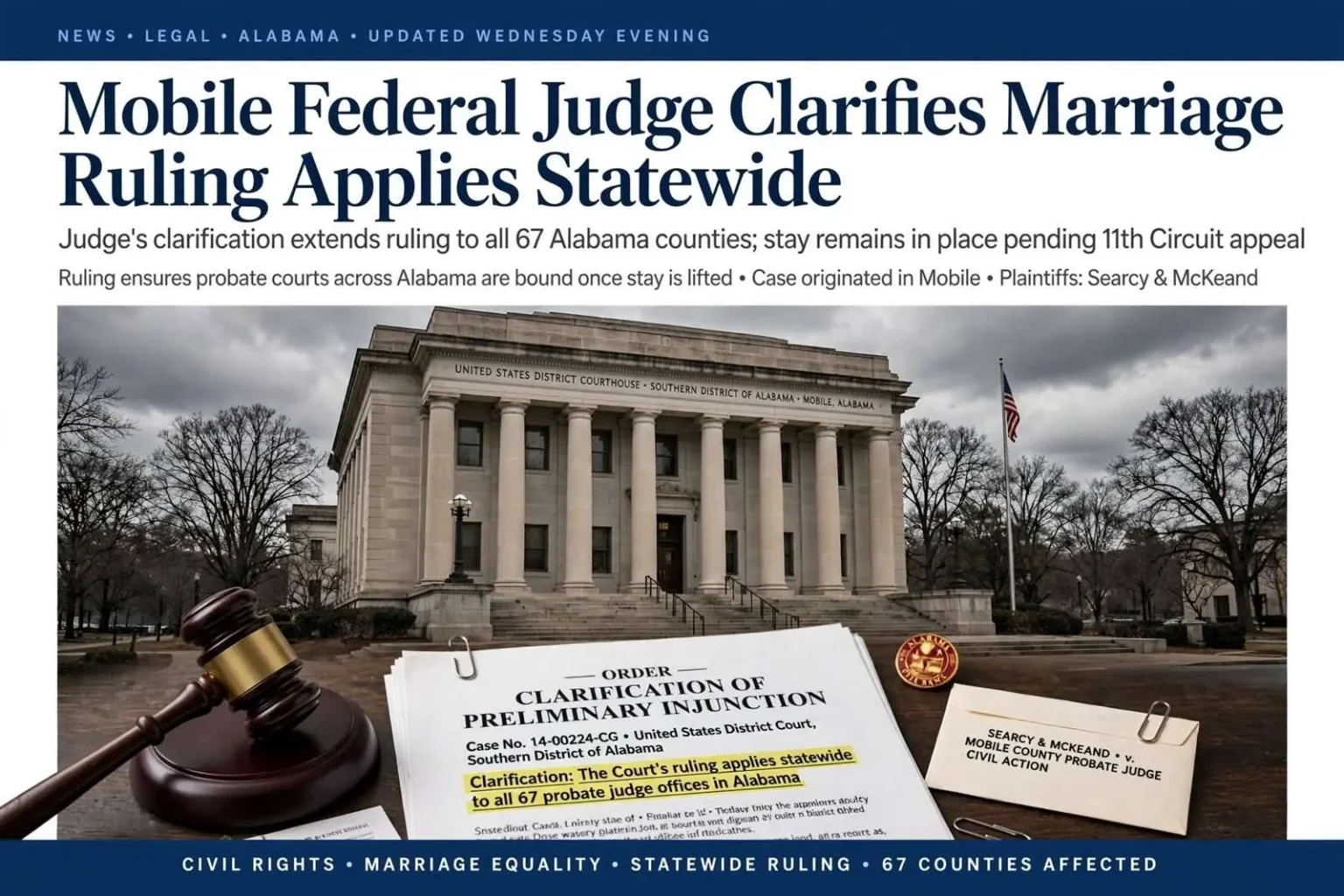
A federal judge based in Mobile made clear this week that her landmark ruling striking down Alabama’s ban on same-sex marriage is not confined to a single defendant, but applies to probate officials statewide. U.S. District Judge Callie V.S. “Ginny” Granade, whose courtroom sits in Mobile, issued the clarification after attorneys for the plaintiffs raised concerns that the Alabama Probate Judges Association had suggested her ruling bound only the state Attorney General’s Office.
The dispute was a technical one with sweeping practical stakes. If a federal injunction binds only the named defendant, then a constitutional ruling can be nullified in practice by the simple expedient of other officials declining to act — each probate judge, in this case, waiting for his or her own lawsuit before issuing a marriage license. Granade’s order was designed to foreclose that argument before it could take hold across Alabama’s 67 counties.
Granade’s order made plain that her judgment was never meant to apply narrowly. She wrote that while a stay remains in place, neither the named defendant nor probate courts anywhere in Alabama are currently obligated to act on the judgment. But if that stay is lifted, she said, the ruling’s finding that Alabama’s marriage statute and related constitutional amendment violate the U.S. Constitution’s Due Process and Equal Protection guarantees applies broadly.
By Wednesday evening, the probate judges’ association said it agreed the order extends to all 67 Alabama counties. The concession ended any ambiguity about how the state’s licensing officials would read the ruling once enforcement began, and it marked a strikingly quick retreat from the narrower interpretation the association had advanced only days before.
A Case That Began in Mobile
The case traces directly back to Mobile. Plaintiffs Cari Searcy and Kim McKeand, a Mobile-area couple who married in California in 2005, filed suit after Mobile County Probate Judge Don Davis denied Searcy’s request to legally adopt the son the two women had raised together since birth, who was 9 years old at the time of the ruling. Because Alabama law recognized only McKeand as the child’s legal parent, Searcy had no formal parental rights despite raising the boy from infancy — no authority to authorize his medical care, no claim on his behalf in an emergency, no legal existence as his mother.
The adoption denial, not the marriage ban itself, was what put Alabama’s statute before a federal court. But the two questions were legally intertwined: Alabama’s constitutional amendment and the statutes built on it defined marriage as between one man and one woman and refused recognition to valid out-of-state same-sex marriages, and that refusal was the direct legal basis for denying Searcy’s parental claim. Granade’s original ruling made Alabama the 37th state, along with the District of Columbia, to permit same-sex marriages, finding the state’s ban unconstitutional under the Due Process and Equal Protection clauses of the Fourteenth Amendment.
Days later, Granade issued a related ruling in favor of two other Mobile residents, James Strawser and John Humphrey, who had sued without a lawyer after being denied a marriage license. The parallel case, brought pro se and resolved on essentially the same reasoning, demonstrated that the constitutional question would not stay confined to one family’s adoption dispute — the ban itself was unconstitutional, and the court said so twice within a week.
The Stay and the Appeal
Granade agreed to pause enforcement of her order for 14 days so the state could pursue an appeal before the Atlanta-based 11th U.S. Circuit Court of Appeals. The brief stay is standard practice when a district court strikes down a statewide law, giving appellate courts and higher authorities the chance to intervene before officials must comply. Alabama’s Attorney General’s Office had pushed for the ruling to remain on hold until the U.S. Supreme Court weighed in and settled the question nationally, and did not immediately comment on Granade’s latest clarification.
That request reflected a wager every party to the litigation understood. The Supreme Court had already agreed to hear the question of same-sex marriage in the Ohio-based case later known as Obergefell v. Hodges, with a decision expected by the end of the term in June. If the high court ruled as Granade had, Alabama’s ban would fall everywhere at once; until then, the state hoped to avoid enforcing a change its officials opposed. The strategy had one obvious flaw: if the Supreme Court upheld state bans instead, Alabama would win — but if the Court followed the direction of every federal appeals court to rule on the question since United States v. Windsor, the stay would only postpone the inevitable.
Attorneys for Searcy and McKeand welcomed the update. One of their lawyers said the order was consistent with the judge’s earlier rulings and expressed hope that probate judges across the state would follow it once it took effect. Co-counsel pointed to the possibility that Alabama residents could recover court costs and legal fees from probate judges who declined to comply once the stay lifted — a warning with teeth, since fee-shifting under federal civil rights law can make refusal to follow a settled injunction an expensive proposition for county offices and their insurers.
The Florida Precedent
The dispute over how broadly a federal marriage ruling should apply echoed a similar fight that had recently played out in Florida. Granade’s order specifically referenced a Florida federal judge’s earlier clarification that his own ruling applied statewide rather than to a single county, reasoning that a court’s injunction against one party does not erase the underlying constitutional obligation for others.
The parallel was precise. In Florida, as in Alabama, the initial ruling had named a specific official, and officials in the state’s other counties had briefly contemplated a patchwork in which licenses would be available in some jurisdictions and not others. The Florida court’s clarification — and the eventual decision of that state’s probate officials to comply uniformly — offered Alabama’s judges a template for how the question would resolve, and Granade cited it as the better reading of the law.
The Mobile-rooted case continued to draw statewide attention in the days that followed, as Alabama’s Supreme Court chief justice weighed in publicly, arguing state officials were not bound to follow the federal order — a stance that drew its own ethics complaint. The clash set up a months-long confrontation between state and federal authority over marriage licenses in Alabama, with Mobile County, the birthplace of the litigation, positioned at the center of it.
Why Probate Judges Held the Keys
The focus on probate judges was not incidental. In Alabama, marriage licenses are issued exclusively by the office of the probate judge in each of the state’s 67 counties, an arrangement that scattered the practical effect of any marriage ruling across 67 separate offices rather than concentrating it in a single state agency. A ruling that bound only one judge would, under that structure, leave couples able to marry in one county and unable to marry in the next — precisely the situation the Florida litigation had confronted and the situation Granade’s clarification was written to prevent.
The Mobile County Probate Court, the office at the heart of the case, is among the busiest in the state, and its handling of the coming compliance question would be watched as the signal for the rest of Alabama. Judge Don Davis, whose denial of Searcy’s adoption petition had started the litigation, occupied the unenviable position of being both the named actor in the case and the official whose county would feel the ruling’s effect first.
What the Ruling Meant for Families
For the families at the center of the case, the clarification’s practical meaning was concrete. Searcy and McKeand had spent nearly a decade as a family in every sense but the legal one, and the adoption question that began the lawsuit concerned the most ordinary of parental tasks: signing school forms, consenting to medical treatment, securing the child’s future if something happened to the recognized parent. The marriage ruling resolved the underlying discrimination that had made the adoption denial possible, even as the adoption case itself continued through the courts.
The statewide scope also mattered for couples far from Mobile. Alabama’s same-sex couples live in every county, including rural counties where no couple had yet organized to sue. A narrow ruling would have required each couple to find a lawyer, file a case and win a judgment before marrying in their home county. A broad one meant that when the stay lifted, the courthouse doors would open everywhere at once — the difference between a constitutional right in theory and one available at the local probate office.
The Road Ahead
The 14-day stay meant the county-by-county compliance question would reach its test within weeks, not months. Probate judges now had a written clarification, an association statement accepting its statewide reach, and the knowledge that non-compliance after the stay carried financial exposure. What they did not yet have was the last word from their own state’s leadership, whose resistance was escalating rather than subsiding.
The chief justice’s intervention, whatever its legal effect, ensured the controversy would remain in the headlines as the stay ran out. Federal courts had now spoken twice from Mobile, the plaintiffs had their clarification, and the machinery of compliance — 67 probate offices, one appeal, and a pending Supreme Court term — was set in motion. What remained uncertain was only how, and at what cost, Alabama’s officials would accommodate a constitutional ruling they had done everything short of complying with to contest.