Second Mobile Couple Wins Right to Marry in Federal Court Ruling
A federal judge ruled in favor of a second Mobile-area same-sex couple days after striking down Alabama's ban on gay marriage as unconstitutional.
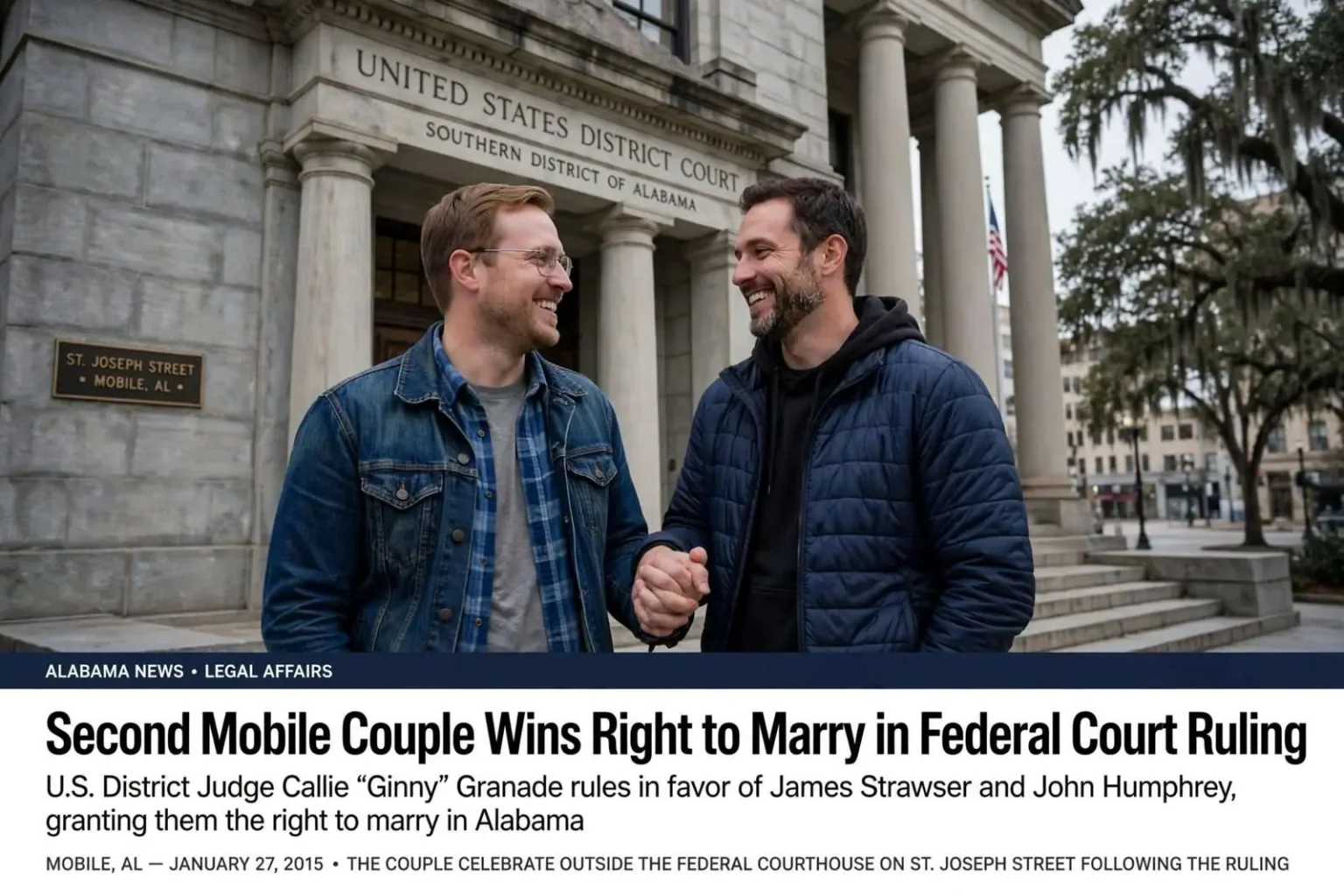
A second same-sex couple with ties to Mobile has won a federal court ruling allowing them to marry in Alabama, just days after a landmark decision struck down the state’s ban on gay marriage. U.S. District Judge Callie “Ginny” Granade ruled in favor of James Strawser and John Humphrey, granting them the same relief she had extended earlier in a separate case involving another Mobile-area couple. The back-to-back rulings placed Mobile at the center of a legal fight that had been building across Alabama for years, and they signaled that the federal courthouse on St. Joseph Street had become the decisive arena in the state’s long-running dispute over marriage.
The Strawser and Humphrey decision arrived with unusual speed for a case that began modestly. The two men filed their federal lawsuit in September, well before Granade’s initial ruling declaring Alabama’s same-sex marriage ban unconstitutional. At the time they filed, no federal judge in Alabama had yet ruled on the question, and the couple’s prospects were far from certain. Humphrey said he had not been overly confident when they filed, given Alabama’s conservative political leanings and the fact that the couple pursued the case without a formal legal team of their own. Unlike the coordinated, well-funded challenges that had unfolded in other states, this was a lawsuit built by two residents of Mobile who believed the law was on their side and were willing to ask a federal court to say so.
That underdog posture made the outcome all the more striking. Humphrey said he was ecstatically pleased after the ruling and had not realized it would come so soon. Cases challenging state marriage laws had dragged on for years in some parts of the country, winding through district courts, appellate panels and sometimes back again before reaching a final answer. Strawser and Humphrey had filed their case expecting a long fight, and instead found themselves among the couples whose lawsuits helped define the issue for the entire region.
Two cases, one constitutional principle
Granade’s ruling in the Strawser and Humphrey case mirrored her earlier decision, though she noted the facts differed slightly. In the earlier case, Alabama had refused to recognize a same-sex marriage performed in another state. In this case, the state had refused to issue Strawser and Humphrey a marriage license in Alabama in the first place. Granade found that the same constitutional reasoning applied either way.
The distinction mattered more than it might first appear. Recognition cases and license cases reach the marriage question from opposite ends. When a state refuses to recognize a marriage lawfully performed elsewhere, it is asked to acknowledge a union that another state’s laws already created. When a state refuses to issue a license at all, the couple never gets to the starting line. By treating the two situations alike, Granade’s rulings closed off the argument that Alabama might one day be compelled to honor out-of-state marriages while remaining free to deny new ones. In her view, the constitutional defect was the same: the state could not withhold the protections of marriage from same-sex couples, whether they had married in Mobile or somewhere else.
That logic carried practical weight for couples across southwest Alabama. Mobile County sits on one of the busiest stretches of the Gulf Coast, and its residents travel constantly — for work along the coast, for family ties across state lines, for military service. A rule that recognized marriages only when they happened to be performed elsewhere would have created a patchwork in which the validity of a couple’s relationship changed with a road sign. Granade’s decisions rejected that approach and treated the question as a single, uniform federal one.
For Strawser and Humphrey, the ruling transformed a personal grievance into a matter of established federal law. They had not merely won an exemption for themselves; they had won a declaration that the state’s refusal to issue them a license was unconstitutional, the same declaration Granade had made for the earlier Mobile-area couple. Two cases, filed months apart, had now produced the same judicial answer from the same judge.
A careful pause before the ruling takes effect
As she had done previously, Granade delayed her ruling from taking effect until Feb. 9, giving the state time to seek intervention from the 11th U.S. Circuit Court of Appeals while the U.S. Supreme Court prepared to take up the broader same-sex marriage question later that year. The delay was a familiar feature of high-stakes constitutional rulings. When a federal court strikes down a state law, judges routinely pause the effect of the order so that appeals can be organized without throwing daily government operations into confusion.
The pause also reflected the unusual position Alabama occupied at that moment. The state’s ban on same-sex marriage had been embedded not only in statute but in the state constitution, the product of a statewide vote years earlier. Overturning such a law is one of the most consequential steps a federal district judge can take, and Granade’s two-week window gave every party — the state, the couples, and the courts above her — a chance to respond deliberately rather than react in a scramble. Marriage licenses, once issued, create lasting legal rights, and judges are typically cautious about letting them issue while a case is still on appeal.
The 11th U.S. Circuit Court of Appeals, which hears appeals from federal courts in Alabama, Georgia and Florida, was the state’s first potential stop. The Alabama Attorney General’s Office said it would appeal, setting up a path in which the state would ask the Atlanta-based appeals court to block Granade’s orders while the litigation continued. Depending on how quickly that court acted, the state could also ask the U.S. Supreme Court to intervene — the same court that had already agreed to decide the broader constitutional question later that year.
That larger Supreme Court case loomed over everything happening in Mobile. Federal judges across the country had been reaching similar conclusions about state marriage bans for months, and the Supreme Court’s decision to take up the question meant the entire issue would get a final, nationwide answer. Whatever happened on appeal in the 11th Circuit, Granade’s rulings would be read against the backdrop of that pending decision. If the Supreme Court sided with the couples, the appeals would become largely academic. If it did not, the state’s arguments would get new life.
For the couples involved, the Feb. 9 date carried its own meaning. Strawser and Humphrey said they planned to head to the Mobile County Probate Court on Feb. 9 to apply for their marriage license. The probate court is where marriage licenses have long been issued in Mobile County, the county office that handles everything from estates to deeds to the paperwork that turns a private commitment into a legal marriage. For a couple that had been denied a license at that same office, the plan to return on the day the ruling took effect was both practical and symbolic — the same counter, the same county, a different legal landscape.
From an online meeting to a Mobile home
Behind the court filings was a story familiar to countless couples of their generation. The two had met online and eventually began living together in Mobile after Humphrey relocated from Gulfport. The move tied their lives to the Gulf Coast: Humphrey left behind a city on the Mississippi side of the sound to build a home on Mobile Bay, joining a region where families, churches and neighborhood ties run deep and where decisions about marriage are as much personal as legal.
Strawser’s path to Mobile ran longer. Originally from Columbus, Ohio, he said he moved to the Mobile area roughly a decade earlier to help care for his ailing mother. That decision — relocating more than seven hundred miles to look after family — rooted him in the Gulf Coast long before the lawsuit existed. By the time the two men filed their case, Mobile was not an abstract backdrop to their story.
Their decision to sue grew out of that home life rather than out of activism. With no formal legal team of their own, they navigated a federal lawsuit at the same time they managed ordinary responsibilities — work, household, family. Humphrey’s account of the filing made clear how improbable the step felt at the time. Alabama’s political climate offered little encouragement, and couples elsewhere had needed organized legal support to get similar cases off the ground. Strawser and Humphrey simply filed, and in doing so became part of a wave of lawsuits that reshaped the legal map of the Southeast.
What the ruling means for Mobile County couples
The immediate effect of the ruling, once it took effect, would be felt most directly at the Mobile County Probate Court. Probate judges and their staff are the officials who actually issue marriage licenses in Alabama, which means the practical consequence of any marriage ruling arrives as instructions to those offices. A federal court order in favor of a couple binds the officials in their case and, more broadly, establishes the legal rule that other couples can rely on when they walk in and ask for the same treatment.
The ruling made Mobile a focal point in Alabama’s broader legal fight over same-sex marriage, as multiple couples with local ties pursued cases in the months leading up to the U.S. Supreme Court’s eventual nationwide ruling on the issue. That concentration was no accident. Federal courts are organized by district, and residents of southwest Alabama who wanted to challenge the state’s ban had one obvious forum: the Southern District of Alabama, headquartered in Mobile, where Granade sits. As word spread that the court had ruled once and then again for local couples, other families facing the same denial had both a roadmap and a reason to file.
For the region’s gay and lesbian residents, the practical stakes were concrete. A marriage license determines who can make medical decisions at the hospital, who inherits without a will, who can access a spouse’s benefits, and who is treated as family when it matters most. Couples who had spent years building protections through powers of attorney, joint ownership documents and careful planning would, if the rulings stood, be able to simply marry — the same step their neighbors had always taken.
— recognition and issuance — in a single coordinated step, leaving the state to appeal one consolidated question rather than two separate ones. That alignment simplified what could have been a sprawling appeal and made it easier for observers, officials and other couples to understand exactly where the law stood.
A state brace for what comes next
The Alabama Attorney General’s Office said it would appeal, and state officials had signaled for months that they intended to defend the ban at every level. The appeal would test whether the 11th Circuit — and, if necessary, the Supreme Court — would adopt Granade’s reasoning or reinstate the ban while the broader case moved forward. Either way, the deadlines were compressed: the rulings took effect Feb. 9, the Supreme Court was expected to rule later that year, and every interim decision in between would be measured against the likelihood of a final national answer.
Strawser and Humphrey, for their part, kept their focus close to home. Their plan was not a victory tour but a trip to the probate court on Feb. 9 — the day the ruling took effect — the same day the ruling took effect — to do what couples across the country had done for generations: apply for a marriage license, in their own county, under the laws of their own state.
What happened in Mobile over those few weeks was part of a larger national reckoning, but it played out in distinctly local terms — a Gulfport man who moved across the bay, an Ohio native who came south to care for his mother, a probate court downtown, and a federal judge who found that the constitutional principle was the same whether a state refused to recognize a marriage or refused to perform one at all. As the Supreme Court prepared to take up the question later that year, the couples of Mobile County had already made their own contribution to the answer.