Mobile, Baldwin Counties Receive Nearly $3.9 Million in Federal Homelessness Grants
Mobile City and County along with Baldwin County were awarded close to $3.9 million in federal homeless assistance funding in early 2015, HUD announced.
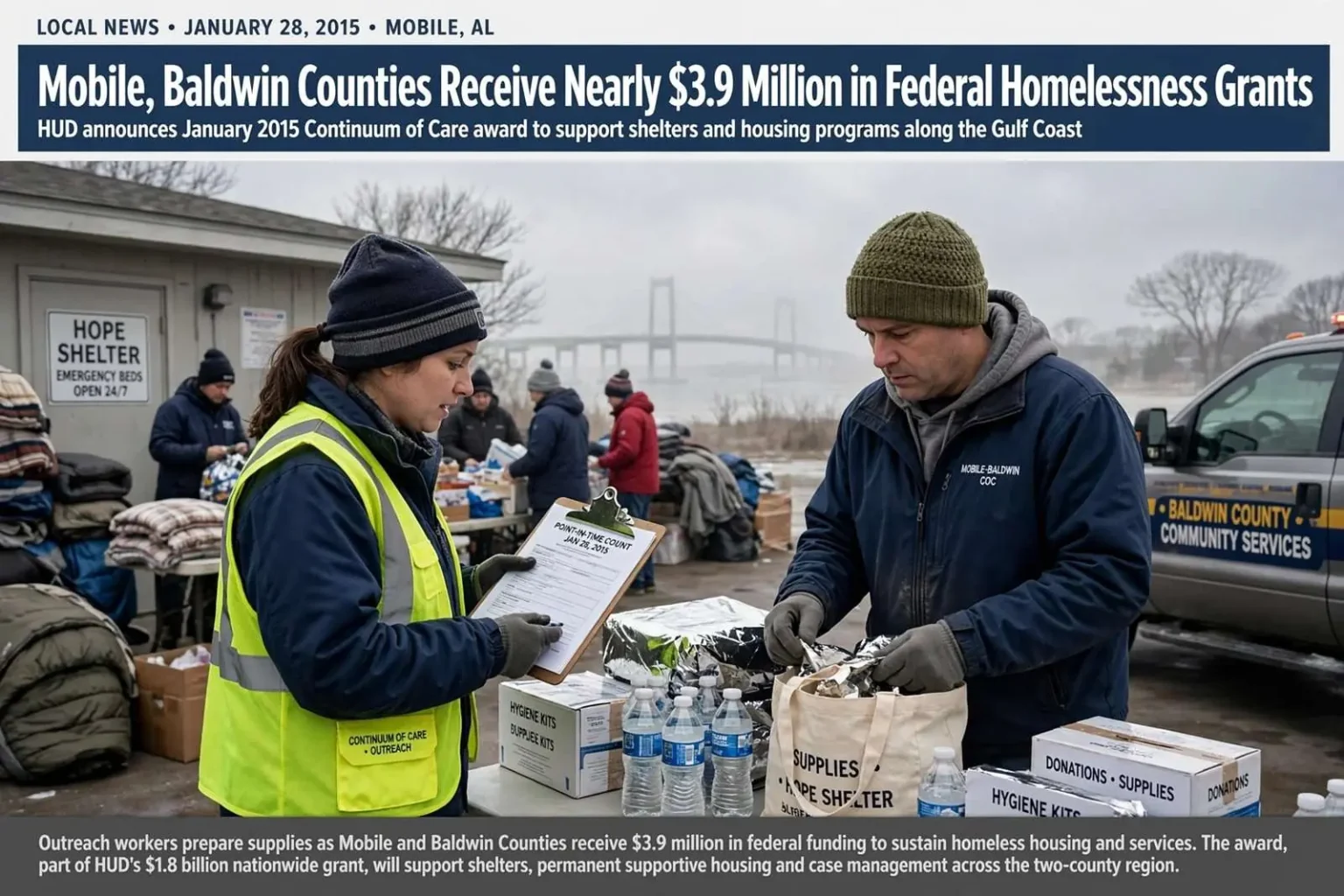
The U.S. Department of Housing and Urban Development announced in late January 2015 that Mobile City and County, together with Baldwin County, would receive close to $3.9 million in federal Continuum of Care grant funding to support local homeless housing and service programs. The announcement, made in the depths of winter when shelters across the Gulf Coast run at their fullest, set the funding floor for the region’s homeless response system for the year ahead.
The award was part of a larger $1.8 billion round of nationwide funding that HUD distributed to roughly 8,400 homeless housing and service programs across the country. Alabama as a whole received more than $16.8 million, spread across several regional entities that coordinate homeless services, from the Tennessee Valley to the wiregrass. The Mobile City and County/Baldwin County region’s share, just under $3.9 million, was the second-largest allocation among Alabama’s coordinated care areas, trailing only the Birmingham, Jefferson, St. Clair and Shelby County region—a reflection of the central Gulf Coast’s standing as one of the state’s most populous urban corridors.
How Continuum of Care funding works
Continuum of Care funding is designed to help local agencies provide permanent supportive housing, rapid rehousing and other services aimed at moving people experiencing homelessness into stable housing. The program, administered by HUD under federal housing law, has become the principal federal engine for homelessness funding, and it deliberately routes money through regional coalitions rather than individual cities so that planning happens across entire housing markets rather than within municipal boundaries.
Most of the money awarded to Alabama communities, including the Mobile-Baldwin region, came in the form of renewal grants for programs already operating in the area, rather than brand-new initiatives. That structure matters enormously on the ground: renewal dollars keep apartment-based supportive housing units leased, case managers employed and shelter operations running, and a program that loses its renewal can fold entirely. Renewal amounts generally stay flat year to year unless a community’s fair market rents increase, in which case HUD may add a modest amount, typically no more than a few thousand dollars, to help cover rising housing costs.
For providers along the central Gulf Coast, even those small adjustments carry real weight. Rents in Mobile and Baldwin counties had been climbing alongside the broader recovery in the coastal housing market, and when rents rise faster than grant amounts, programs are forced to absorb the difference—scrambling for local donations, trimming services or shrinking the number of units they can keep subsidized for the people who need them most.
The count that drives the dollars
Homeless advocates who work with these grants note that the funding levels an area receives are tied directly to local point-in-time counts, the annual one-night tally of people experiencing homelessness that HUD uses to gauge need and allocate resources. The count, conducted nationwide in the last ten days of January, sends trained volunteers and outreach workers into shelters, transitional housing programs, soup kitchens and the streets to record how many people are without a fixed, adequate nighttime residence.
Mobile’s 2015 point-in-time count was scheduled to take place over a morning and overnight period just days after the grant announcement, giving local coalitions a fresh snapshot of homelessness levels heading into the new funding cycle. A thorough count requires coordination among shelters, law enforcement, outreach teams and volunteers, and it produces the data that advocates cite when they press state and federal officials for resources—numbers that shape next year’s applications just as surely as this year’s shaped the current awards.
Advocates caution that point-in-time counts almost certainly understate the problem. Families doubled up with relatives, people cycling between motel rooms and couches, and individuals sleeping in cars or in wooded campsites beyond easy reach of survey teams can all slip through, meaning the official tally functions more as a consistent baseline for tracking trends than a precise census of everyone in need.
A network behind the numbers
The Continuum of Care model relies on a network of nonprofit agencies, local governments and housing authorities working together within a defined geographic area to apply for and administer HUD funds. The collaborative approach requires agencies that might otherwise compete for the same donations to coordinate applications, divide responsibilities and report outcomes jointly—a structure that rewards cooperation and gives HUD a single accountable partner in each region.
In the Mobile-Baldwin region, that network includes emergency shelters, transitional housing providers and permanent supportive housing operators that serve everyone from single adults to families with children facing housing instability along the central Gulf Coast. The service ladder runs from street outreach and emergency beds through transitional programs to permanent housing with attached case management, and the federal dollars threaded through the continuum touch nearly every rung of it.
The two-county pairing surprises some residents, since Mobile and Baldwin counties sit on opposite sides of Mobile Bay and are connected by a single interstate bridge-and-tunnel corridor. But homelessness does not respect the water. Service providers have long treated the bay area as one housing market, and Baldwin County’s growth has brought with it rising rents and pockets of housing instability from Bay Minette to Gulf Shores that its smaller municipal governments cannot address alone.
Why steady funding matters
While the bulk of Alabama’s new project dollars for 2015 went to a rapid rehousing initiative in the Birmingham area, the steady renewal funding flowing into Mobile and Baldwin counties represented a continuation of years of federal investment in the region’s homeless response system. Rapid rehousing, which uses short-term rental assistance and services to move households quickly back into apartments, has become the favored new program model nationally, but established shelter and supportive housing programs remain the backbone of the system in most communities.
Local officials and service providers have said consistent renewal funding is critical, since a single gap in Continuum of Care dollars can force shelters and housing programs to scale back services for vulnerable residents with few other safety nets. Unlike some federal programs, Continuum of Care grants generally cannot be backfilled quickly from other sources, and the population they serve—people with disabilities, chronic health conditions, or long histories of housing instability—often has no realistic alternative if a program closes its doors.
The economics are stark for the region. A single night in emergency shelter costs a fraction of the emergency room visits, jail bookings and hospitalizations that frequently accompany untreated homelessness, which is why business leaders and public officials along the Gulf Coast have increasingly joined advocates in supporting housing-based approaches as both a humane and a fiscally sensible policy.
What it means for the coast
The announcement offered South Alabama communities a reminder of how federal housing dollars flow through a regional structure that groups Mobile, its surrounding county and neighboring Baldwin County together, pooling resources to address homelessness across the coastal area rather than treating each jurisdiction separately. For a family that loses housing in Spanish Fort or a veteran sleeping in a camp near Prichard, the practical effect is the same: the same coordinated network of outreach workers, shelter beds and housing programs stands behind the whole two-county area.
Coming as it did in late January, the award also landed at the moment of greatest strain on local services. Cold snaps along the Gulf Coast, rare as they are, push shelters past capacity and drive outreach teams into extended hours, and the annual count itself demands volunteer labor precisely when providers are busiest. The federal dollars arriving in the same weeks as the count gave the region’s coalitions both fresh resources and fresh data as they planned the year’s work.
For residents of Mobile and Baldwin counties, the nearly $3.9 million translates into a continuation of the services many never see: rental assistance that keeps a family off the street, supportive apartments for people with disabilities, case managers who shepherd households from crisis to lease. And for the agencies that provide them, the renewal grants brought another year of certainty in a funding environment where stability itself is the scarcest resource.
Behind the regional structure stands a federal framework that has evolved considerably over the decades. The Continuum of Care program grew out of homeless assistance legislation first passed in the late 1980s and was reshaped in 2009 to encourage communities to adopt coordinated entry systems, in which a single streamlined intake process matches each household with the most appropriate available program. Mobile and Baldwin County’s providers adopted that coordinated approach like communities across the country, replacing a fragmented system in which a person in crisis had to navigate a different door and waiting list for every single agency.
The grant round also underscored the competitive discipline the program imposes. Because continuums nationwide submit ranked applications against one another, communities are scored on their data quality, their performance in returning people to housing and their success at reducing returns to homelessness. The Mobile-Baldwin region’s consistent showing in national award rounds has depended on local agencies documenting outcomes carefully and demonstrating to HUD reviewers that federal dollars invested on the central Gulf Coast produce measurable results—households housed, shelter stays shortened and people kept from falling back into homelessness once they land on their feet again.