Prichard Council Approved Electronic Bingo Ordinance in 2009
The Prichard City Council approved an electronic bingo ordinance in September 2009, setting off debate over revenue, pensions and the measure’s legality.
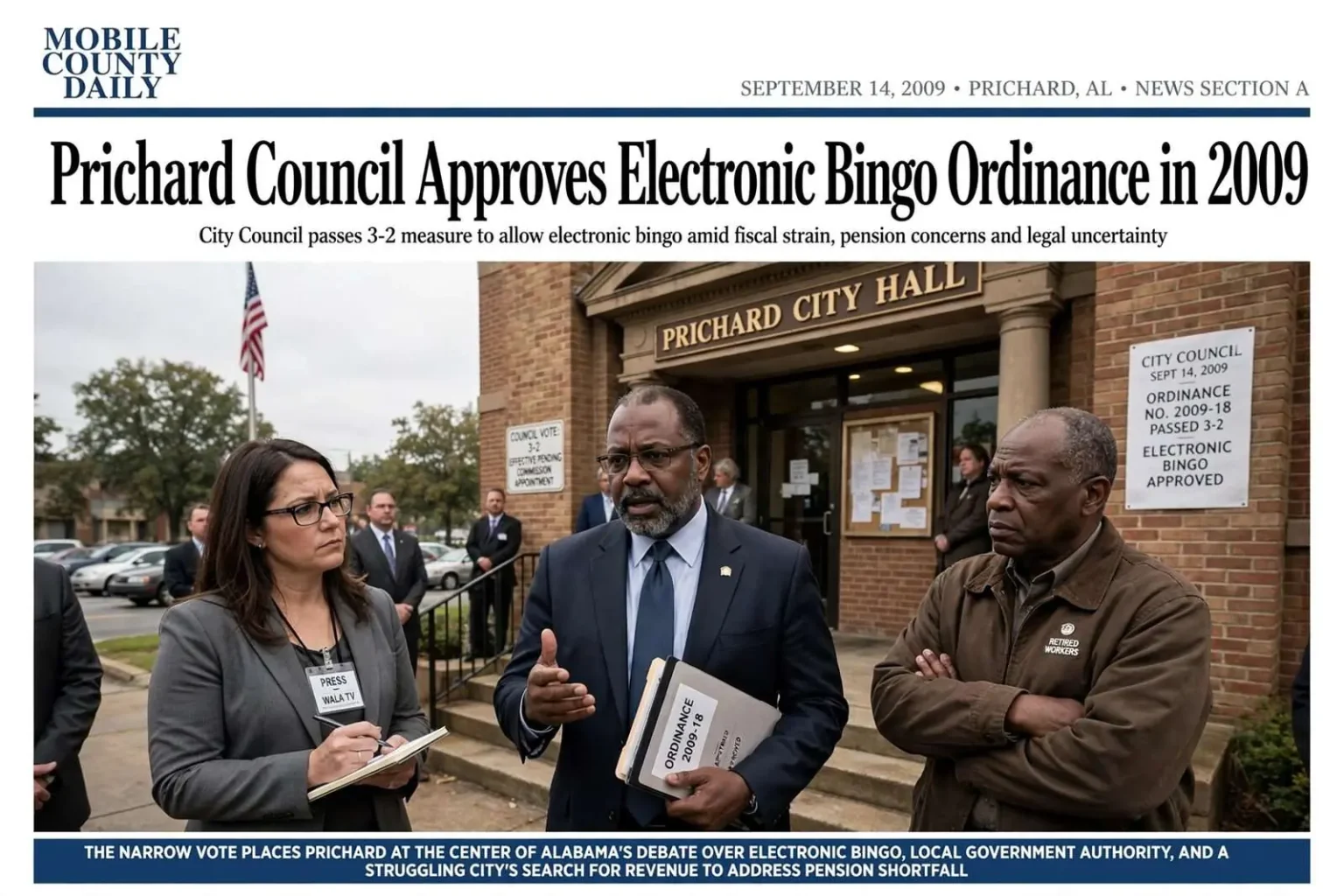
The Prichard City Council approved an ordinance allowing electronic bingo in September 2009, opening a debate over potential city revenue, pension pressures and the measure’s legality. The vote placed one of Mobile County’s most financially pressed cities squarely inside the biggest political fight in Alabama at the time — a statewide struggle over electronic bingo, gambling law, and who had the authority to permit it.
The council approved the ordinance by a 3-2 vote, a narrow margin that reflected how contested the question remained even among the city’s own elected leadership. The ordinance laid out a framework under which electronic bingo operations could operate within the city limits, with the city positioned to collect revenue tied to the activity and supporters framing it as a tool for pulling Prichard out of a deep financial hole.
Supporters said electronic bingo could bring jobs, revenue and more stability to the city’s property-tax base at a time when Prichard faced serious financial challenges. The city of roughly 28,000 residents northwest of Mobile had spent years struggling with a shrinking tax base, aging infrastructure, and the long-running strain of retirement obligations — circumstances that made any proposal promising new revenue worth a serious hearing, whatever its controversies.
Arguments Over Revenue and Retirement
Mayor Ron Davis said the city needed new economic activity and that electronic bingo could be part of the answer. For Prichard’s leadership, the appeal was straightforward: money raised inside the city limits that could fund services without raising taxes on residents, many of whom lived on fixed incomes. The question was never simply whether bingo would operate, but what the city would get from it and whether the city could lawfully benefit.
Retired city employees, who had been concerned about the pension fund, followed the discussion closely. Prichard’s pension obligations were the city’s most visible financial wound — a funding shortfall that would eventually force wrenching decisions about retirement benefits and help define the city’s finances for years. Anything that promised new revenue was measured, by retirees and council members alike, against the demands of that underfunded system.
The ordinance directed potential bingo revenue to the city’s general needs rather than specifically to the pension fund. Davis said he did not recommend dedicating it to a single purpose, an approach that kept the money flexible — available for police, fire, sanitation, or whatever the budget required most — while other speakers argued that new business investment would be more beneficial to the community than gambling. The debate over dedication versus flexibility captured a broader tension: revenue that arrives with strings attached can solve one problem while leaving the rest untouched.
Legal Questions Remained
Council member Troy Ephriam said the ordinance was legally contentious and could be challenged. The concern was grounded in Alabama’s fragmented gambling law, where the legality of electronic bingo turned on questions that courts had been wrestling with for years — whether a given machine was truly the bingo played with paper cards and a caller, or a slot machine in disguise, and whether local governments had the authority to authorize games the state itself had not clearly sanctioned.
Mobile County District Attorney John Tyson said the use of electronic bingo machines in places such as Prichard violated state law and stated that his office would act if the machines were introduced. The district attorney’s position put the city on notice that approval by the council would not be the last word: any operator who opened a hall under the ordinance would do so in the shadow of potential prosecution.
Against that uncertainty, the council moved to the administrative phase. The next procedural step was to appoint a bingo commission, the body that would handle the licensing and regulation of any operations the ordinance contemplated — and, in practice, another forum where the city’s legal and policy questions would have to be answered before the first machine ever ran.
The Broader Alabama Fight
The debate reflected a broader Alabama dispute over electronic bingo, local authority and the limits of gambling-related revenue strategies. Through the late 2000s, electronic bingo halls operated across parts of the state under an uneasy patchwork of local amendments, attorney general opinions, and court rulings, while the legislature repeatedly failed to settle the question with a statewide law or a vote of the people. Cities and counties with local constitutional amendments authorizing bingo believed they were on firm ground; prosecutors and state officials disagreed, sometimes loudly.
Prichard’s ordinance fit the pattern of municipalities trying to use that ambiguity to their advantage. A string of communities across Alabama had approved or considered electronic bingo ordinances in those years, viewing the halls as a revenue source that voters’ existing local amendments arguably permitted. The counterargument — from district attorneys, the governor’s task force on gambling, and eventually the courts — was that machines styled as bingo but playing like slots were simply illegal gambling devices wherever they stood.
For cities like Prichard, the stakes were compounded by economics. The 2009 recession had hollowed out municipal budgets across the country, and small cities with limited commercial bases had few levers to pull. Gambling revenue represented one of the only plausible new income streams that did not require raising taxes, attracting industry, or cutting services — which explains why the idea drew three votes even with the district attorney’s warning hanging over it.
Pensions and the City’s Finances
The pension question gave the bingo debate its urgency. Prichard’s retirement system had fallen years behind its obligations, and the city’s retirees had watched previous councils search for answers through budget cuts, litigation, and restructuring. The failure to earmark bingo money for the pension fund did not end the connection between the two issues; it simply reflected the mayor’s judgment that the city’s general survival came first, with every dollar flexible to meet whichever need was most pressing.
Observers of the debate noted the irony that a city in no position to turn down revenue was also in no position to absorb a legal fight. Operating bingo halls in defiance of the district attorney’s stated position could have exposed the city to enforcement action and litigation costs that dwarfed the expected proceeds. The ordinance, in other words, was as much a wager on the courts as a revenue plan.
An Uncertain Aftermath
This article records the ordinance vote and the competing views expressed in September 2009. It does not state whether electronic bingo operations ultimately opened in Prichard or how later legal challenges were resolved — questions that belong to the record of the years that followed, as state task force raids, court rulings, and legislative standoffs reshaped electronic bingo across Alabama.
What the September 2009 vote preserved is a snapshot of the argument at the city level: a council split 3-2, a mayor pointing to economic necessity, retirees watching for relief that might not come, a district attorney promising enforcement, and a community weighing the price of new revenue against the risk of a legal fight it could ill afford.
That snapshot has outlasted the moment because the tension it captured — between local fiscal desperation and state legal authority over gambling — defined an entire era of Alabama politics, and Prichard’s ordinance vote stands as one of its clearest local expressions.
How Electronic Bingo Reached the Ballot of Alabama Politics
To understand why a single 3-2 council vote in Prichard mattered, it helps to recall how electronic bingo arrived in Alabama’s political bloodstream. Bingo had been authorized in various counties through local constitutional amendments, many written decades earlier for charity games played with paper cards and daubers. As technology evolved, operators introduced electronic machines that played rapidly, paid automatically, and looked to critics like the slot machines Alabama law had never permitted. Supporters insisted the machines were simply bingo played faster; opponents called them slots with a bingo face.
That dispute ran through every institution the state had. Attorney generals issued conflicting opinions; task forces raided halls in some counties while operations continued openly in others; courts issued rulings that narrowed the question without closing it. Legislatures debated statewide votes and compact bills that never quite passed. Into that vacuum stepped cities and counties, each forced to decide for itself whether to authorize, tolerate, or prohibit the machines — and each decision invited a second decision from prosecutors and judges.
Prichard’s ordinance was written for that environment. By routing implementation through a bingo commission and emphasizing regulation, the city attempted to build a defensible administrative framework around an activity whose legality no one could guarantee. The narrow vote acknowledged the risk: three council members were willing to bet the city’s argument was strong enough, while two concluded the legal exposure outweighed the revenue.
What Revenue Meant to a City Like Prichard
The financial arithmetic behind the vote deserves its own accounting. Prichard in 2009 carried the burdens common to older, smaller cities in the South: a population that had declined from its mid-century peak, a commercial base thinned by decades of retail migration toward bigger highways, infrastructure demands that exceeded revenue, and — uniquely painfully — a pension system whose obligations had outrun the city’s ability to fund them.
Against that ledger, the prospect of bingo revenue offered something rare: money that did not come from Prichard’s own residents. Gaming revenues in cities that hosted bingo halls were projected to flow from visitors and players, transferring outside spending into local coffers. For a city that had exhausted the usual levers — property taxes already strained, sales tax bases limited, state and federal grants competitive and unpredictable — that framing made the ordinance attractive despite its legal fragility.
The counterargument, voiced by speakers who preferred business investment to gambling, rested on a longer view: that enterprises which create lasting jobs and property value would do more for the city than revenue streams vulnerable to shutdown, and that building the budget on a legally contested activity invited a double collapse — first the courts, then the revenues.
The Record of September 2009
What September 2009 left behind was a complete outline of the American municipal gambling debate in miniature. The vote itself — 3-2 — told one story about a divided city. The mayor’s argument about economic necessity told another. The retirees’ attention to the pension question told a third: that in struggling cities, every revenue debate is also a retirement debate, because the obligations of the past compete directly with the services of the present.
The district attorney’s warning told a fourth story, about the limits of local government in a state where gambling authority was contested at the highest levels. And the ordinance’s routing of revenue to general needs rather than the pension fund told a fifth, about the practical judgments leaders must make when new money arrives with more questions than answers.
History’s verdict on the era would be rendered elsewhere — in courtrooms and legislative chambers — but the Prichard council’s September vote remains the clearest local record of how that era looked from a city that needed the money, debated the idea honestly, and split its own leadership in the process.