Mobile’s Republican Establishment Lines Up Behind Luther Strange’s Bid for Attorney General
A blue-chip Mobile host committee prepared to stage a September 2009 reception for Luther Strange, who was challenging incumbent Republican Attorney General Troy King in the coming primary.
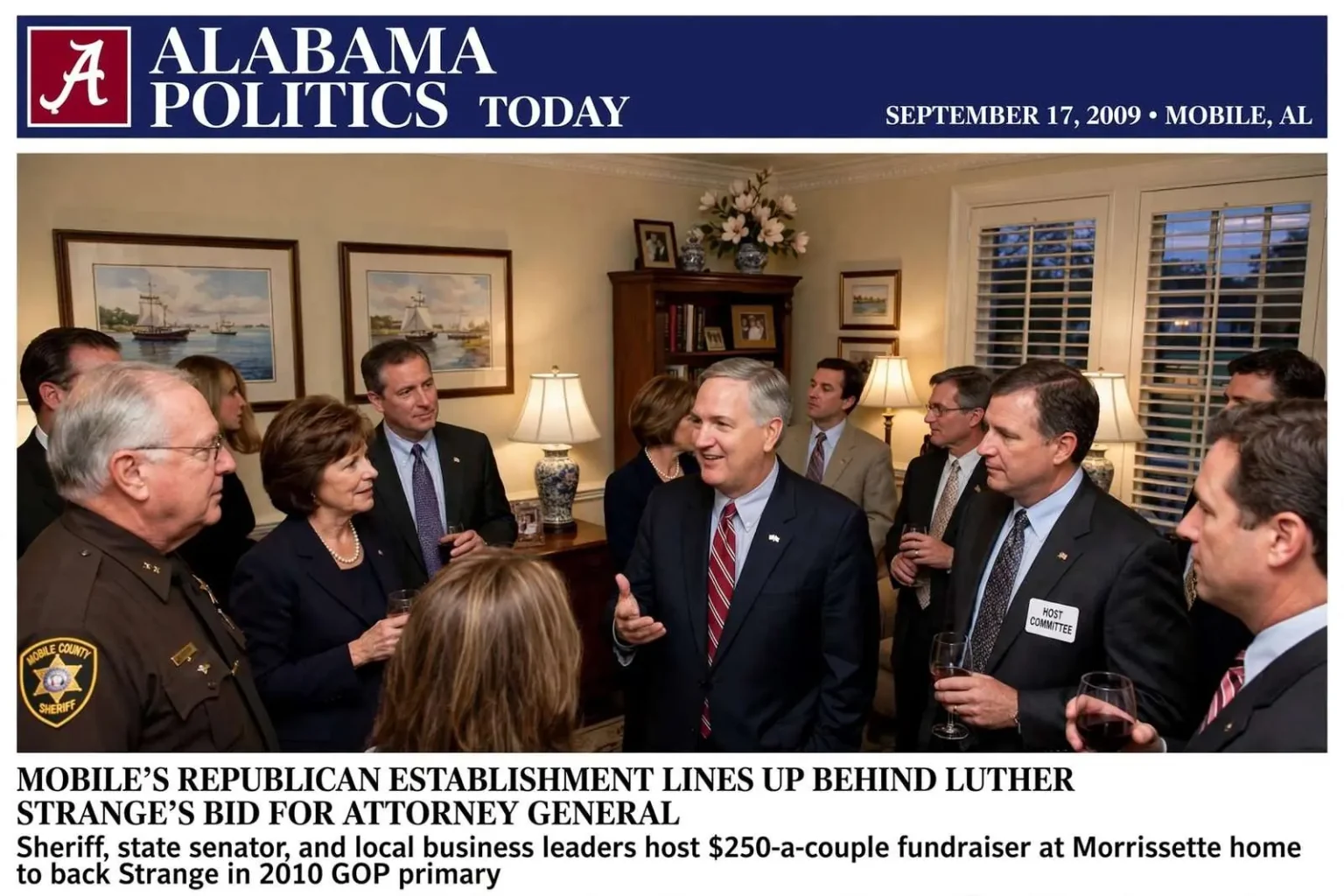
The contest that would decide who spoke for Alabama in court came to a Mobile living room in September 2009, as a large and pointedly establishment host committee prepared to raise money for Luther Strange’s campaign to unseat the sitting Republican attorney general, Troy King. The reception was set for 5:30 to 7 p.m. Thursday, Sept. 17, at the home of Mr. and Mrs. Harris Vaughn Morrissette. Tickets were $250 per couple.
That a contested primary for statewide office would be fought partly in private homes across Mobile’s most established neighborhoods surprised no one who followed Alabama politics. The state’s campaigns are financed and organized house by house, and the invitation list for a single evening reception can say more about a candidate’s standing than any poll taken a year before the vote.
Serving as co-chairs with the Morrissettes were Mr. and Mrs. Goodman Ledyard and Mike Lee. The pairing put the event under the direction of hosts whose names carried weight in Mobile’s legal, financial and social circles, and it signaled that the Strange campaign intended the evening to be a serious fundraising occasion rather than a symbolic stop.
A roster with reach
The host committee, at the $1,000 level, drew from nearly every quarter of Mobile’s Republican and business leadership. Among those listed were Sheriff Sam Cochran; Sen. Ben Brooks and his wife; Mobile City Councilwoman Connie Hudson and her husband, Dennis Hudson; state Rep. Steve McMillan of Baldwin County and his wife; Randy Delchamps; Chess Bedsole; Fred Stimpson; Celia Wallace; Doug Anderson; Clifton Inge Jr.; and John White-Spunner.
The list reached into every institution that matters in Mobile County politics. Cochran held the county’s top law enforcement office. Brooks represented Mobile in the state Senate. Hudson sat on the City Council and would become one of the most durable figures in county-wide politics. McMillan brought a Baldwin County anchor, extending the committee’s reach across the bay. The rest of the roster — Delchamps, Bedsole, Stimpson, Wallace, Anderson, Inge, White-Spunner — mapped the city’s business families, its GOP donor class and its network of civic leadership in a single page.
The presence of the sitting sheriff on a fundraising committee for a challenger to a sitting attorney general was, in its quiet way, the most telling line on the page. Law enforcement officials in Alabama rarely take sides in a contested primary for the state’s top legal office unless they have concluded that the incumbent is vulnerable. A sheriff’s name on the letterhead is not an endorsement by accident; it is a calculation, made in full view of the incumbent’s own allies.
For the Strange campaign, the roster accomplished several things at once. It supplied the evening’s fundraising base, it gave the candidate a photographed wall of local credibility to carry into the primary, and it told statewide donors and officeholders that Mobile’s establishment — or a decisive portion of it — had picked a side thirteen months before the vote.
The King problem
Troy King had been appointed attorney general by Gov. Bob Riley in 2004 and won a full term in 2006. By 2009, however, his relationship with the governor’s office had ruptured, most visibly over gambling enforcement, where King’s approach to electronic bingo operations diverged sharply from the aggressive stance of Riley’s task force. The dispute over electronic bingo — the machines at the center of Alabama’s decades-long legal war over gambling — had split the state’s Republican leadership into camps, with Riley’s task force raiding and threatening the casinos while the attorney general’s office took a markedly more cautious line.
That split created an unusual opening: a Republican incumbent facing a Republican challenger with the backing of much of the party’s donor class. Primary challenges to sitting attorneys general are rare; primary challenges to one who has lost his own party’s governor, sheriff network and donor base are practically unheard of. King’s vulnerability was thus structural as much as personal — the machinery of the state GOP was drifting toward anyone who would run against him.
Strange, a Birmingham attorney who had run unsuccessfully for lieutenant governor in 2006, moved into that opening. His pitch turned on professionalism and on the argument that the attorney general’s office should be run without the political freelancing that had come to characterize his opponent’s tenure. The message was calibrated for exactly the audience the Mobile reception would gather: donors and officeholders who wanted the state’s legal apparatus aligned with the governor’s office and predictable in its priorities.
The 2006 lieutenant governor campaign had given Strange statewide name identification, a donor list and the experience of running in every media market — credentials that most potential challengers to a sitting statewide officeholder lack. The gamble this time was a different office, a different opponent and, he judged, a different political moment.
Why Mobile mattered
For a Birmingham candidate, an early show of force on the Gulf Coast served a strategic purpose. Mobile County reliably delivers a large bloc of Republican primary votes, and the county’s donor network — concentrated in Spring Hill, midtown and along the Eastern Shore — has long been able to write checks at a scale that alters the arithmetic of a statewide race. A candidate who can fill the Morrissettes’ living room with a hundred names has, in effect, secured a beachhead.
Statewide campaigns in Alabama live and die by the math of a handful of population centers, and Mobile County is among the largest. A candidate who consolidates the county’s establishment early denies it to every rival, converts its donors into a recurring revenue stream, and — just as important — acquires the local validators whose support persuades undecided voters in the neighborhoods where the committee members’ names are known.
The event also fit a familiar pattern in Mobile’s political calendar that autumn. The same networks that gathered for Strange were, in adjacent weeks, being asked to turn out for a governor’s race with a crowded Republican field, and many of the names on his committee appeared on those invitations too. In a county where the same few hundred people fund most of the campaigns, the contest is often less about persuading donors than about reaching them first.
That early-reach dynamic compounds. A donor who has already committed to one campaign is unavailable to a rival, and the 2010 cycle’s crowded top-of-ticket races meant the county’s finite check-writing capacity would be allocated months before the primary. Strange’s September reception was, in that sense, a claim on the county’s resources ahead of the field.
The road to the primary
Organizers directed those seeking more information to contact Goodman Ledyard by email or by telephone at 251-338-1300 or 251-402-6222. The detail — two phone lines and a personal email on the invitation, rather than a campaign office — marked the event as the product of the candidate’s local committee rather than his Birmingham headquarters, which is how Alabama campaigns have always preferred to present their house parties.
The Republican primary was set for June 2010, with the winner heavily favored in a state that had not elected a Democratic attorney general since the 1990s. That arithmetic shaped the entire contest: the primary, not the general election, was where the attorney general’s office would actually be decided, which is why a challenger’s standing within the Republican donor class mattered more than any appeal to the broader electorate.
For Mobile’s Republicans, the September reception was an early declaration of where the county’s money, and much of its influence, intended to go. The gamble on the challenger — over an incumbent attorney general, in a party where loyalty is a currency — reflected the depth of the split between King and Riley’s operation, and the confidence of a county establishment that its read on a statewide race was as good as anyone’s.
Whatever the outcome the following June, the evening at the Morrissette home captured how Alabama’s statewide campaigns are actually built: not in television studios or mass rallies, but in living rooms, on invitation lists, and through the quiet decisions of sheriffs, senators and council members whose names on a host committee tell the state where a race stands.
What the office decides
The stakes of the attorney general’s race reach well beyond the personnel dispute that produced it. The office renders binding legal opinions on questions that reach every county courthouse and state agency, defends the state’s laws in federal court, directs the criminal appeals docket, and — most consequentially for the era’s politics — decides when and how the state’s gambling laws are enforced. A change in who holds the office can change, almost overnight, which machines are legal, which casinos are raided, and whether the state joins or resists the federal lawsuits of the moment.
In a state where the electronic bingo question was being fought simultaneously in local constitutional amendments, in the courts and in task-force raids, the attorney general’s enforcement posture was the variable that determined the war’s course. That is why the 2009 schism between the governor and the attorney general mattered to more than the two men: every casino operator, every county commission that had authorized bingo, and every donor on either side of the dispute had a direct financial and legal stake in the 2010 primary’s outcome.
The office’s other functions gave the Strange campaign its “professionalism” argument a concrete shape. Advocates for the challenger pointed to the strings of legal opinions, personnel turnover and public feuds that had marked the incumbent’s tenure, and argued that the state’s top legal office required steadier management — an argument aimed less at the primary electorate than at the lawyers, business leaders and officeholders whose support organizes a campaign.
An autumn of positioning
The Mobile reception was one marker in a longer season of positioning across the state. Challengers to a sitting statewide officeholder must build a campaign before the incumbent’s own party is willing to abandon him, and each early endorsement, each host committee and each fundraising date in the year before the primary serves as evidence for the next donor that the campaign is viable.
The committee roster’s breadth gave Strange exactly that evidence. A candidate backed by a sheriff, a state senator, a city councilwoman and a Baldwin County legislator could plausibly claim support from law enforcement, the Legislature, city government and the business community at once — a coalition that spans the constituencies a statewide Republican primary requires.
The $250 ticket price and the $1,000 host level were calibrated to the occasion. The lower tier fills the room and spreads ownership of the event across the community; the host tier supplies the committee that lends its names and its rolodexes. Together they are the standard architecture of an Alabama house-party fundraiser, and the Strange campaign’s version of it in September 2009 was executed on a scale that advertised the campaign’s seriousness to everyone watching the race take shape.
By the time the June 2010 primary arrived, the networks assembled that September evening in Mobile had done the work such evenings exist to do: they had funded the campaign, validated it locally, and signaled to the rest of the state that the sitting attorney general’s own party had moved on. The living room on that Thursday evening was where the race for the state’s top legal office effectively began.