State Investigators Treated 2009 Foley Roadside Death as Homicide
State investigators said a death first reported as a crash on County Road 55 in Foley in September 2009 was being investigated as a homicide.
State investigators said a death initially reported as a vehicle wreck in Foley in September 2009 was instead being treated as a homicide. The case, which began with a standard early-morning crash call in Baldwin County, changed shape entirely once investigators examined what was actually in front of them.
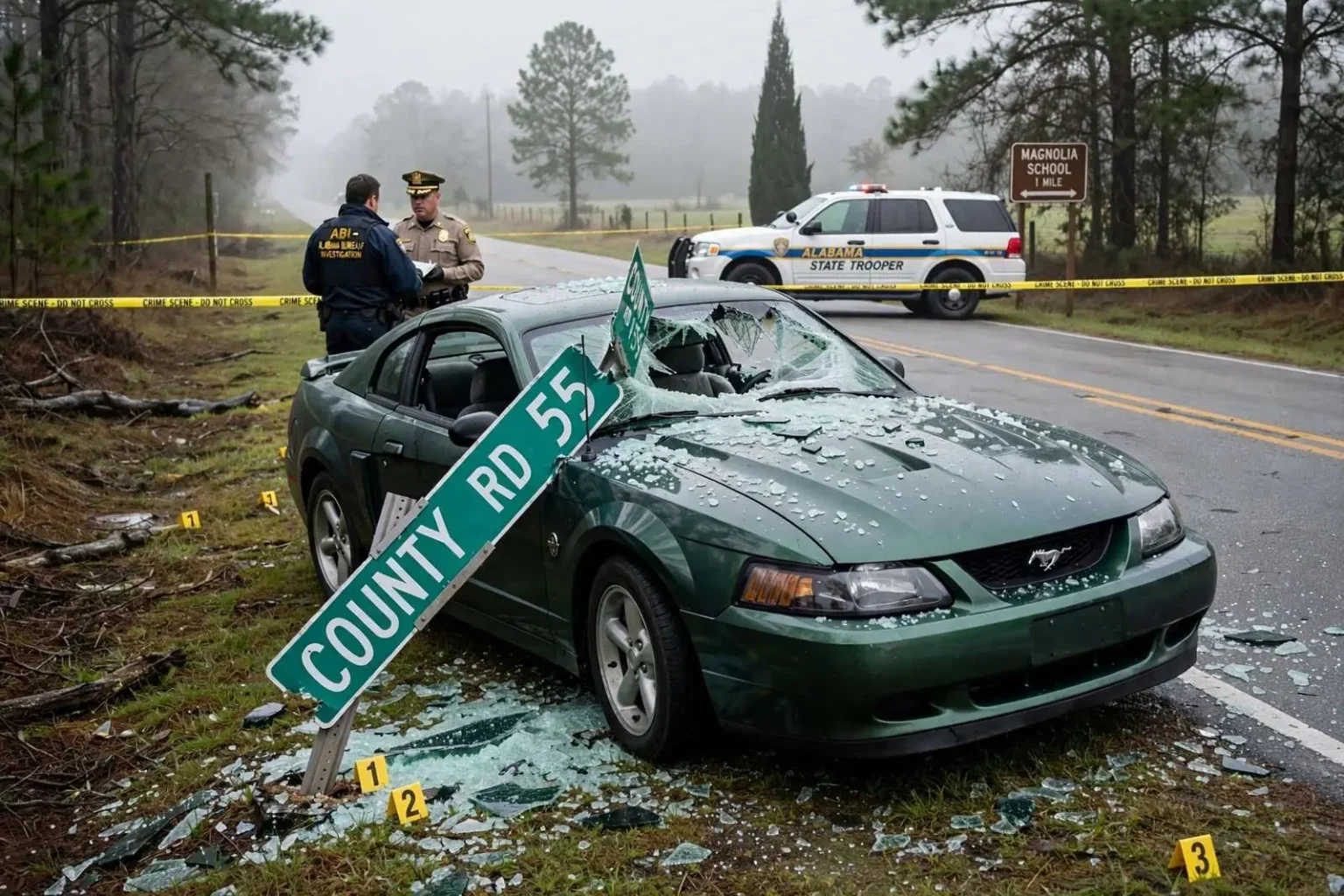
Alabama State Troopers responded early on a Saturday morning to a call on County Road 55 near Magnolia School. At the scene, they found the driver of a 1999 green Ford Mustang dead. What could have been recorded as another rural roadway fatality instead became a homicide investigation, and the difference between those two outcomes came down to evidence that did not match the story the scene was expected to tell.
The response chain itself is worth understanding, because it explains how the case unfolded the way it did. State troopers handle crash response and investigation on Alabama’s highways and rural county roads, including stretches like County Road 55 south of the Foley city grid. Fatal crashes trigger a specific protocol: the scene is secured, the vehicle is examined, and investigators reconstruct what happened before the roadway is reopened. That protocol exists precisely to catch the cases where a “wreck” is not a wreck.
From crash scene to crime scene
A preliminary review determined that the death had not been caused by a traffic collision, leading troopers to call the Alabama Bureau of Investigation. Investigators said a street sign had been thrown through the vehicle’s front windshield and had struck the driver in the head.
The detail that broke the case open — a road sign inside the car, driven through the glass — is the kind of physical evidence that cannot be reconciled with a traffic accident. Crash investigators are trained to look for the mechanics of a collision: point of impact, debris fields, vehicle damage consistent with contact. A windshield breached from outside by a heavy metal object, with no corresponding crash dynamics, points to something else entirely. Recognizing that, troopers did what the protocol directs and handed the scene to the state’s investigative arm.
The Alabama Bureau of Investigation, the criminal investigative division of the state’s law enforcement agency, handles exactly this kind of referral — cases that begin as something else and turn out to be crimes, as well as homicides in jurisdictions that need state-level support. Once ABI took over, the location stopped being a crash site and became a crime scene: the Mustang was treated as evidence, the roadway around it was processed for trace evidence, and the questions investigators asked shifted from how the car came to rest to who was near it when the driver was struck.
The setting added to the difficulty. County Road 55 near Magnolia School runs through the patchwork of rural Baldwin County — school property, woodlots, and residential parcels spaced widely enough that witnesses are few and distances are long. A nighttime incident on a road like that may leave no passerby witnesses at all, which places the burden of proof on physical evidence and canvassing.
The victim
At the time of the report, authorities had not publicly identified the victim. They described the person as a 22-year-old Hispanic man while the investigation continued.
The withholding of a name in an active homicide case is standard practice: next-of-kin notification comes first, and investigators weigh what an early release of identity would do to witnesses and to the investigation itself. The description released — a young man, 22 — told the public the essential fact without compromising that process, and the identity question remained open as the case moved forward.
His death, in the account investigators assembled, was not random roadway violence but an act with a specific mechanism: a sign, thrown hard enough to punch through a windshield, striking the driver with fatal force. The object itself — street hardware, the kind of fixture that marks intersections across Baldwin County — became the central piece of evidence, and its path from roadside to inside the vehicle defined the investigation’s central question.
Charges reported at the time
Officials said 19-year-old Jonathan Hadley was being held in the Baldwin County Jail on a murder charge. Authorities also said his father, Albert Hadley, then 39, had been charged with filing a false police report.
Those charges were allegations announced during an active investigation, not convictions. That distinction matters, and the reporting of the case preserved it deliberately: a charge is the state’s opening position, filed on the strength of evidence assembled in the case’s first days, and it is tested — and sometimes overturned — in the court proceedings that follow. The murder charge against the 19-year-old alleged his role in the driver’s death; the false-report charge against his father alleged that a report filed with authorities in connection with the matter was knowingly untrue.
The Baldwin County Jail, the detention facility serving the county’s courts, held the younger Hadley as the case proceeded. From the jail booking to the courtroom, the case would pass through the Baldwin County judicial system, where the charges would be prosecuted, defended, and resolved on their evidence.
This historical account reflects the information released by state investigators at the time. Later court records would be needed to establish the final disposition of the cases — whether convictions followed, on what counts, and with what sentences — and this account makes no claim beyond what investigators announced in September 2009.
Why the case drew attention
The case drew attention because the initial dispatch involved a reported wreck, but investigators later concluded that the circumstances required a homicide investigation. That arc — from routine call to homicide scene — is what made the case a talking point in Baldwin County and an example cited in discussions of how death investigations are supposed to work.
Rural roadway deaths are among the hardest cases to classify at first contact. A vehicle stopped in or near a roadway with a deceased driver presents a ready-made explanation — the driver lost control, the car left the road, the injuries came from the crash. Dispatchers assign the call by what the caller reports, and the first responders work the scene as assigned. The system’s integrity depends on what happens next: an investigator willing to look past the working theory when the evidence contradicts it.
That is what distinguishes this case from the thousands of calls troopers answer each year. The preliminary review — the first structured examination of the vehicle and scene — surfaced the thrown sign, and the sign could not be squared with a collision. Rather than forcing the evidence to fit the original call, the troopers escalated: the Alabama Bureau of Investigation took over, and the case proceeded on its actual facts.
It illustrates the role of troopers and state investigators in reexamining a scene when early evidence conflicts with an apparent traffic-crash explanation. The handoff from crash response to criminal investigation is not a failure of the first response — it is the designed product of it. Protocols exist so that the first look at a scene generates the physical record the second look will need, and the Mustang’s windshield, preserved and documented, became exactly that kind of record.
The investigative machinery behind the handoff
The division of labor that resolved the Foley case runs through every Alabama county. Troopers bring crash reconstruction: the measurement, photography, and vehicle examination that establish what physically happened. ABI brings criminal investigation: interviews, canvassing, forensic coordination, and the development of the case that a prosecutor must ultimately take to a grand jury and a trial. Neither role substitutes for the other, and the speed of the Foley handoff — same morning, same scene — shows the system working as drawn.
The murder charge announced within the investigation’s early days indicates how much evidence the scene yielded. Physical evidence of the kind investigators described — the sign, the windshield breach, the driver’s wound — gives a case its foundation, and the swift filing suggests the investigative team was able to connect that foundation to the people charged. The companion charge against the father, for filing a false police report, points to the parallel inquiry every homicide investigation runs: not just what happened at the scene, but who said what to authorities, and when the account first given diverged from the facts.
Foley and Baldwin County in 2009
Foley sits at the center of Baldwin County’s fast-growing southern half — a city that has long balanced its agricultural roots around a thriving downtown with the residential growth that has spread across the county in recent decades. County Road 55 near Magnolia School lies within that mix, close enough to town to see regular traffic yet rural enough that a parked car with a dead driver might wait a while before anyone wondered about it.
A homicide by thrown object — bizarre as the mechanism sounds — naturally unsettles a community of that size. Residents along the road had reason to ask what had happened at their intersection; the school nearby gave the location a familiar landmark that appeared in every telling of the case. For the county’s Spanish-speaking community, the victim’s description as a 22-year-old Hispanic man who went publicly unnamed gave the case a particular weight, as families wondered whether someone’s missing relative was the answer investigators were still confirming.
The case also left behind a lesson in how information reaches the public in an active investigation. The initial report — wreck on County Road 55 — was followed by the corrected account: not a wreck, a homicide; not an accident victim, a 22-year-old man struck by a thrown street sign; not one charge, but two, against a 19-year-old and his 39-year-old father. Each correction came from investigators, and each moved the public record closer to what the evidence showed.
What the courts ultimately did with those charges is a matter for the court records that followed September 2009. What the case demonstrated at the time — a crash call correctly refused as an explanation, a scene correctly upgraded to a homicide, and charges correctly framed as allegations rather than verdicts — was the quiet competence of the system that answered the phone that Saturday morning on County Road 55.