Foley House Fire Death Ruled a Homicide, Sparking Rare Major Crimes Probe
A body found in a fire-gutted Foley home has become the city's first homicide investigation in five years after autopsy results pointed to foul play.
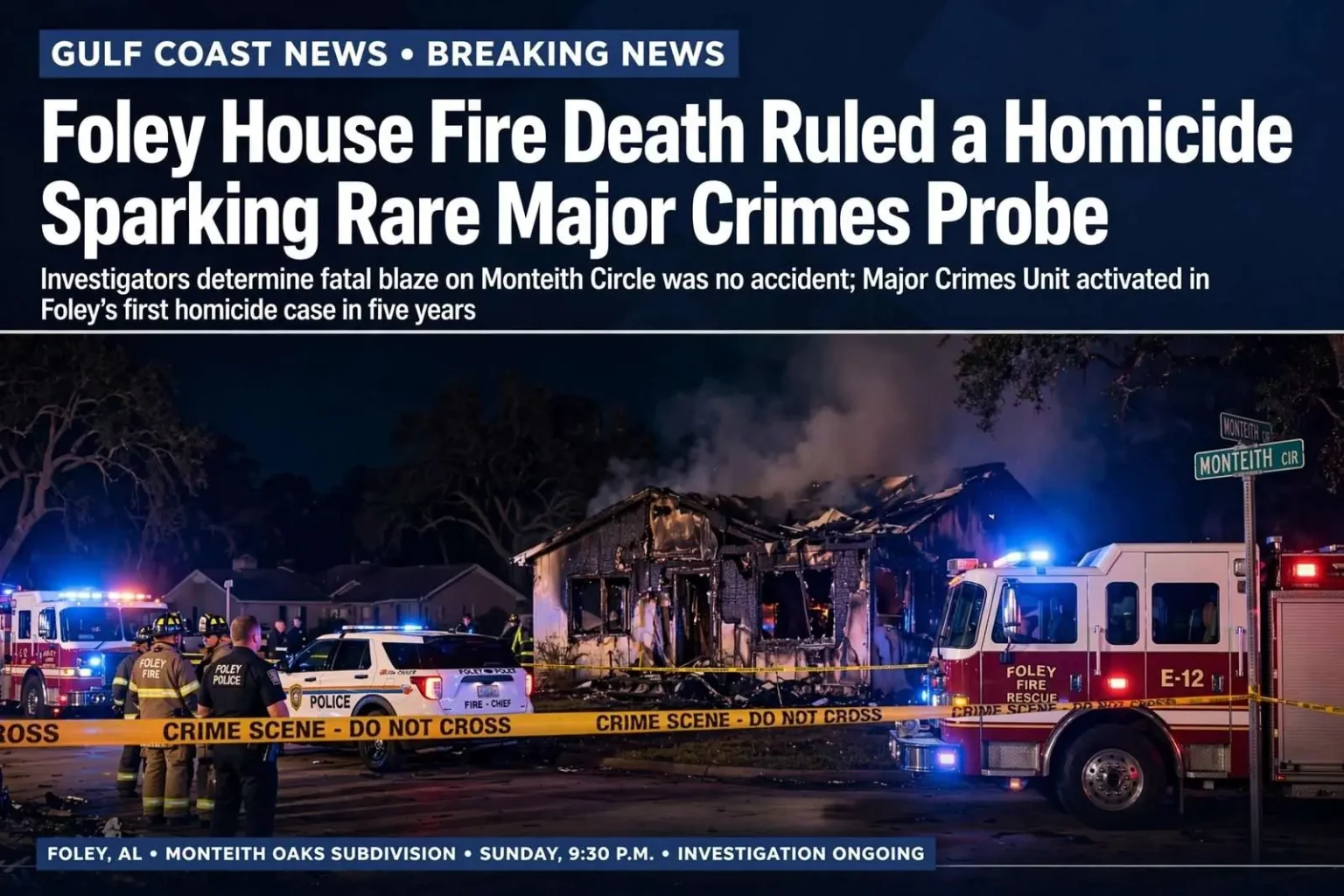
A late-night house fire in Foley has turned into the city’s first homicide investigation in five years after investigators determined that the death of a person found inside was no accident. The blaze broke out at a single-story residence on Monteith Circle in the Monteith Oaks subdivision around 9:30 p.m. on a Sunday, according to fire officials. A man jogging through the neighborhood reported seeing flames, and crews arrived within minutes to find the home already heavily engulfed.
Foley Fire Chief Joey Darby said the house was almost fully involved by the time firefighters reached it. During the response, crews discovered a body inside the home. The victim was found in a bathroom, Darby said.
Fires that reach full involvement in a matter of minutes present enormous challenges for crews, both in fighting the blaze and in preserving whatever evidence remains. South Baldwin County’s fire departments operate under mutual aid agreements that let neighboring units respond together, and a fully involved structure fire in a residential subdivision typically draws multiple engines, tankers and support vehicles. By the time the flames were knocked down, investigators faced a scene that had burned at temperatures capable of destroying ordinary clues — which makes the subsequent determination all the more striking.
From Fire Scene to Homicide Case
What began as a fire investigation shifted dramatically the following afternoon. Foley Police Chief David Wilson announced that evidence gathered at the scene, combined with autopsy findings, indicated foul play. The case was upgraded to a homicide, and Wilson requested activation of the Major Crimes Unit, a special investigations team that draws on multiple law enforcement agencies across the region.
That kind of transition is unusual and significant. Fire investigators work to rule out accidental causes — electrical faults, cooking accidents, heating equipment — before concluding that a fire was set deliberately. When a body is found, the medical examiner’s autopsy becomes the second pillar of the inquiry, documenting injuries or circumstances inconsistent with a tragic accident. Only when both lines of evidence point the same way do authorities typically reclassify a death scene as a homicide, which is why the announcement came the day after the fire rather than that night.
The Major Crimes Unit exists for exactly this moment. Small police departments rarely have the staffing to run a full homicide investigation on their own — detectives who can work interviews, forensic analysis, canvassing and case coordination around the clock for weeks. By pooling investigators from multiple agencies across Baldwin County and the broader region, the unit gives a case like this one the manpower of a big-city department while keeping local officers, who know the community, at the center of the work.
Authorities identified the owner of the house as a 70-year-old Foley man but declined to release the name of the victim, saying identification was still pending until the family could be notified and a positive identification confirmed. Officials gave no indication of the relationship, if any, between the victim and the homeowner, and they cautioned against drawing conclusions from the fire’s location alone.
The State Fire Marshal Joins In
The State Fire Marshal’s Office joined Foley police and firefighters in examining the cause and origin of the fire. The state office brings specialized training in fire scene reconstruction and arson investigation, and its involvement is standard practice when a fire death shows signs of foul play. Investigators work outward from the point of origin, looking at burn patterns, debris and the structure’s systems to establish how the fire started and how it spread through the single-story home.
In Alabama, fire deaths are investigated jointly in serious cases, and findings from the scene and the autopsy must align before prosecutors pursue charges. That process takes time — often weeks — and authorities in Foley have indicated the case will move at the pace the evidence requires rather than the calendar demands.
A Rarity in Foley
The designation carries added weight in Foley, a Baldwin County community where violent deaths are uncommon. The last homicide investigated by the city’s police department dated back to 2009, when a man was found dead in his home with trauma to his head and neck. An arrest in that case came only earlier in the year the fire occurred, when a former Foley resident was charged with murder.
The long gap between homicides says much about Foley itself. The city of roughly 15,000 people sits at the heart of south Baldwin County’s growth corridor, a few miles from the beaches of Gulf Shores and Orange Beach, and it has built its identity around its school system, its historic downtown and the succession of parks and sports complexes that draw visitors year-round. Violent crime statistics in communities like this one run far below national urban averages, and a homicide investigation commands the full attention of a police force unaccustomed to handling one.
The new case also followed another disturbing death investigated just outside Foley’s jurisdiction, in which an elderly man was killed in a case that led to a murder charge against a relative. Taken together, the incidents drew unusual attention to an area better known for its quiet neighborhoods and proximity to the Gulf beaches.
For the city’s police department, the stretch without a homicide case reflects both the community’s character and the department’s size. Small agencies structure themselves around property crime, traffic enforcement and community policing, and their detectives gain homicide experience mainly through multi-agency cooperation. The Major Crimes Unit model fills that gap, ensuring that a small city facing its rare violent death does not have to investigate alone and that evidence is collected to the standard a prosecution will demand.
How the Investigation Proceeds
With the Major Crimes Unit activated, the investigation now runs on several parallel tracks. Detectives will complete a canvass of the Monteith Oaks subdivision, looking for anyone who saw vehicles, visitors or unusual activity around the house in the days before the fire. Fire investigators will finish documenting the scene and reconstructing the blaze’s origin and path. Forensic teams will process what the fire left behind, and the medical examiner’s findings will be integrated into the case file as they become available.
Investigators asked anyone with information about the fire or the death to contact the Foley Police Department. Officials said the Major Crimes Unit’s involvement reflected the seriousness of the case and the resources being committed to identifying who was responsible.
Tips in cases like this can be left by phone or in person, and investigators urge callers to come forward even when they doubt the value of what they know. Neighbors often hold fragments of a larger picture — a vehicle seen twice, a visitor who had not been by before, an argument overheard days earlier — that only makes sense when assembled with everyone else’s observations. Detectives running a canvass will also revisit houses several times, since residents frequently remember more as the initial shock of the fire fades.
For residents of the Monteith Oaks neighborhood, the investigation’s early days brought a visible law enforcement presence and questions about a fire many had watched from a distance the night it burned. Detectives typically return to affected neighborhoods several times in the first weeks of a case, and tips from residents — even ones that seem minor — often prove decisive in homicide investigations, which is why authorities emphasize that no detail is too small to report.
What Comes Next
The immediate steps are identification and notification. Once the medical examiner confirms the victim’s identity and family members are told, police are expected to release the name and begin speaking more openly about the circumstances of the death. Until then, officials have kept details tightly held, a common practice designed to protect the integrity of the investigation and to ensure that any statements a suspect later makes can be evaluated against information only investigators hold.
Charges, if any, would follow a review of the assembled evidence, likely in consultation with the Baldwin County District Attorney’s Office. Cases that begin as fire scenes can take months to reach an arrest, particularly when they depend on laboratory work and the coordination of multiple agencies’ findings.
In the meantime, the case stands as a jarring break from the norm in a city that measures the time between its homicides in years rather than months. The five-year stretch since Foley’s last homicide investigation — and the 2009 case that preceded it — is precisely why this fire drew the response it did: a fully involved house fire, a body discovered inside and a determination of foul play have mobilized resources that a city this size could not summon alone. For now, Foley police are asking the community’s help, and the Major Crimes Unit’s work continues behind the scenes as investigators piece together what happened inside the home on Monteith Circle.