Alabama’s Oyster Shell Recycling Program Nears a Historic 31 Million Shells
The Alabama Coastal Foundation's Oyster Shell Recycling Program has collected more than 30.4 million shells since 2016 and is approaching the 31 million mark.
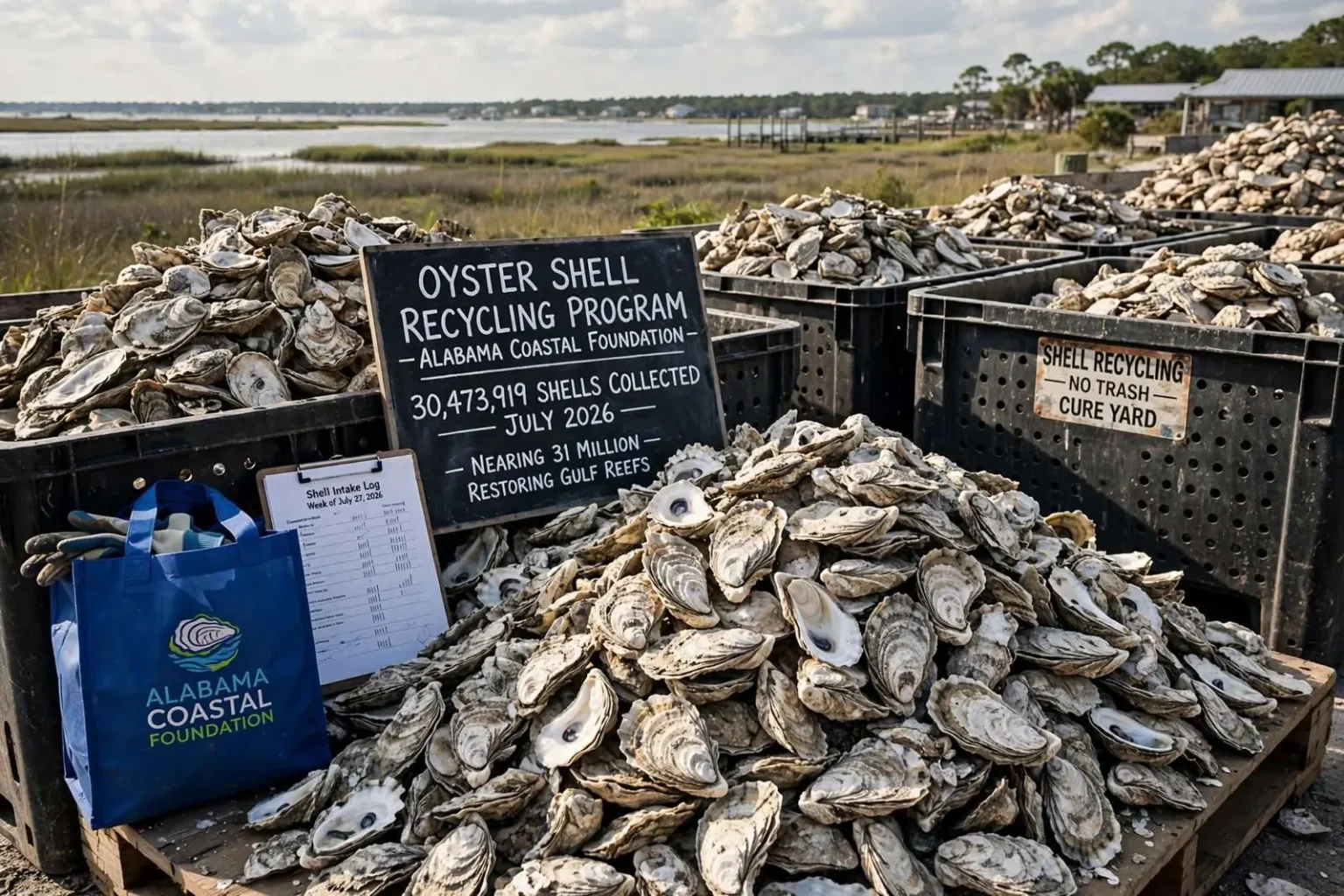
Alabama’s coastal conservation efforts are approaching a historic milestone: the state’s Oyster Shell Recycling Program is closing in on 31 million oyster shells collected. Since its launch in August 2016 by the Alabama Coastal Foundation — initially funded by a grant from the National Fish and Wildlife Foundation — the initiative has transformed what was once restaurant waste into the very foundation of coastal restoration.
As of late July 2026, the program had officially collected 30,473,919 shells, a figure measured in tons of recycled calcium that would otherwise have been buried in landfills.
Closing the loop on seafood waste
Traditionally, the seafood industry has operated on a linear model: oysters are harvested from the Gulf, served in coastal restaurants, and their empty shells are discarded into the trash. The Oyster Shell Recycling Program aims to close that loop by routing shells back to the water, where they serve a purpose rooted in simple marine biology.
Wild oyster larvae — known as “spat” — spend their first days swimming in search of a hard, durable surface to attach to and grow. In the wild, their preferred surface is almost always an older oyster shell. When shells are removed from the natural environment, new larvae struggle to find places to settle, slowing reef growth significantly. Every recycled shell becomes future reef habitat.
Participating local restaurants — including the Original Oyster House, which piloted the program in 2016, along with the Flora-Bama and Cobalt — separate empty shells from daily kitchen waste. The shells are then collected, cured on land to remove contaminants, and returned to coastal waters where they form the substrate for new reef growth.
Why rebuilding reefs matters
Rebuilt oyster reefs provide indispensable benefits to the Gulf Coast’s delicate intertidal ecosystems. The reef structures filter water, reduce shoreline erosion by absorbing wave energy, and create nursery habitat for fish, crabs and other marine life. Healthy reefs also support the wild oyster populations that sustain commercial harvests.
Diners can directly support the restoration effort by visiting participating restaurants or donating through the Alabama Coastal Foundation’s program page, which features a “Shuck a Buck” option that funds the purchase of additional shells and collection infrastructure.
An economic and cultural anchor
Beyond the ecological benefits, oysters hold a legendary status in coastal culture — the culinary soul of the Gulf Coast. For thousands of years, dating back to indigenous populations that relied on them as a primary food source, oysters have anchored the region’s identity. Today they drive a massive regional economy: the Gulf Coast accounts for nearly half of the United States’ $250 million oyster industry, and Alabama is the nation’s number-one processor of oysters.
In coastal kitchens, the oyster is celebrated as a versatile canvas — served raw on the half shell, char-grilled, baked Rockefeller-style, fried in po’boys, or stewed — from casual dockside shacks to white-tablecloth establishments.
The culinary world has been further elevated by the rise of commercial off-bottom oyster farming. Rather than replacing wild harvests, coastal oyster farms complement them by producing premium, branded boutique oysters prized for consistent sizing, deep cups and clean shells.
That culinary demand has turned coastal chefs and restaurateurs into some of the most vocal advocates for marine conservation. Recognizing that the future of their menus is directly tied to the health of the Gulf, these culinary leaders champion sustainable practices — and by ensuring every shell from the kitchen makes its way back to the bay, coastal dining remains a self-sustaining tribute to the waters that feed it.
Part of a Coastwide Shell Recycling Movement
Alabama’s program is not operating in isolation. Oyster shell recycling has grown into a widely adopted conservation strategy across the Gulf and Atlantic coasts over the past two decades, as scientists and conservation groups have increasingly recognized shell scarcity as one of the most fixable bottlenecks in oyster reef restoration. Similar restaurant-partnership recycling programs operate in Louisiana, Florida, Texas, Georgia, South Carolina and along the Chesapeake Bay in Maryland and Virginia, where organizations run comparable collection routes through seafood restaurants, cure the shells to eliminate pathogens and other organisms, and return them to designated reef-restoration sites. The Chesapeake Bay Foundation, one of the longest-running programs of this kind, has collected and recycled shells for restoration work for well over a decade, demonstrating a model that Gulf Coast organizations, including Alabama’s, have adapted to local conditions. What unites these programs is the same basic insight that drives Alabama’s effort: dredging, harvesting and coastal development have removed so much shell material from natural cycles over the past century that restoration projects can no longer rely on the ocean to replenish cultch — the technical term for the hard material oyster larvae need to settle on — without human intervention.
The Science of Curing and Placing Shell
Getting a shell from a restaurant kitchen back into the water as usable reef material involves more steps than simply hauling it to the shoreline. Freshly discarded shells carry organic tissue, bacteria and odor that make them unsuitable for immediate placement in the water, so recycling programs typically stockpile collected shell in open-air curing yards for weeks or months, allowing sun, rain and time to break down residual tissue and reduce the risk of introducing pathogens or excess nutrients into the bay. Once cured, the shell is either placed directly onto designated restoration sites, where it forms a base layer that wild spat can colonize naturally, or used in more engineered applications such as shell bags, reef balls or breakwater structures designed to reduce wave energy while simultaneously providing settlement surface. Some programs supplement recycled shell with a small amount of hatchery-raised, disease-resistant oyster larvae that have already attached to shell fragments, giving new reefs a head start before relying entirely on wild spat set, which can vary considerably from year to year depending on water temperature, salinity and the timing of oyster spawning.
Threats That Make Restoration Necessary
The pressures that have thinned Alabama’s wild oyster population over past decades are well documented and mirror challenges facing oyster fisheries throughout the Gulf of Mexico. Historic overharvesting reduced natural reef footprint long before modern conservation programs began. The 2010 Deepwater Horizon oil spill and the extensive freshwater diversions used afterward to help push oil away from sensitive marsh habitat altered salinity levels in ways that stressed oyster populations across the northern Gulf, including in Mobile Bay and Mississippi Sound. Heavy rainfall years and river flooding events have repeatedly lowered bay salinity to levels oysters struggle to tolerate, while drought years have sometimes pushed salinity high enough to favor oyster predators and parasites that thrive in saltier water. Disease pressure, warming water temperatures and continued coastal development affecting water quality round out a list of stressors that collectively explain why a resource once abundant enough to support a substantial commercial fishery now requires active, sustained restoration investment rather than simply being left to recover on its own.
Research Partners and Regulatory Context
Oyster restoration in Alabama involves more than the Alabama Coastal Foundation alone. The Alabama Department of Conservation and Natural Resources, through its Marine Resources Division based in Gulf Shores, manages the regulatory side of the state’s oyster fishery, setting harvest seasons, size limits and, in some years, closing public reefs to harvest entirely to protect populations under stress. Research institutions including the Dauphin Island Sea Lab and the University of South Alabama’s marine sciences programs have contributed scientific monitoring and research that informs where and how restoration shell is best deployed, studying factors like spat settlement rates, reef survival and the water-filtering benefits that healthy reefs provide. Federal partners, including the National Fish and Wildlife Foundation, which provided early funding for Alabama’s shell recycling program, and the National Oceanic and Atmospheric Administration, which has funded oyster reef restoration projects across the Gulf as part of broader habitat recovery efforts tied to Deepwater Horizon settlement funding, have also played a role in scaling up restoration work beyond what any single nonprofit could accomplish on its own.
Citizen Involvement as a Restoration Strategy
The restaurant-partnership model that drives Alabama’s program reflects a broader shift in how conservation organizations approach large-scale environmental restoration: rather than relying solely on agency-funded projects, many groups now build in a citizen-participation component that turns ordinary consumer behavior into conservation infrastructure. Every diner who orders oysters at a participating restaurant is, often without realizing it, contributing raw material to a reef-restoration pipeline. That model has the advantage of scaling naturally with demand — the more oysters coastal Alabama’s restaurants sell, the more shell becomes available for recycling — while also building public awareness of coastal issues among people who might never otherwise attend a conservation meeting or volunteer cleanup day. As Alabama’s program closes in on its 31-million-shell milestone, that steady, restaurant-by-restaurant accumulation stands as a reminder that large-scale habitat restoration can grow out of small, repeated actions embedded in everyday coastal life.
Looking Toward the Milestone
Reaching 31 million shells is a round-number milestone, but organizers and researchers involved in the program have generally been careful to frame the number as a marker of sustained progress rather than a finish line. Reef restoration is inherently a long-term endeavor: a newly seeded reef takes years to mature into a self-sustaining structure capable of supporting dense oyster populations, filtering meaningful volumes of water and providing the nursery habitat that fish and crabs depend on. As the count climbs past this latest threshold, the program’s continued success will depend on the same ingredients that got it this far — restaurants willing to separate their shell waste, volunteers willing to haul and cure it, and a public willing to see a routine dinner order as a small but real contribution to the long-term health of Mobile Bay and the surrounding Gulf.