Fatal Foley House Fire Draws Multi-Agency Investigation
A late-night fire on Monteith Circle in Foley killed a 70-year-old resident, prompting a joint investigation into the blaze's cause and origin.
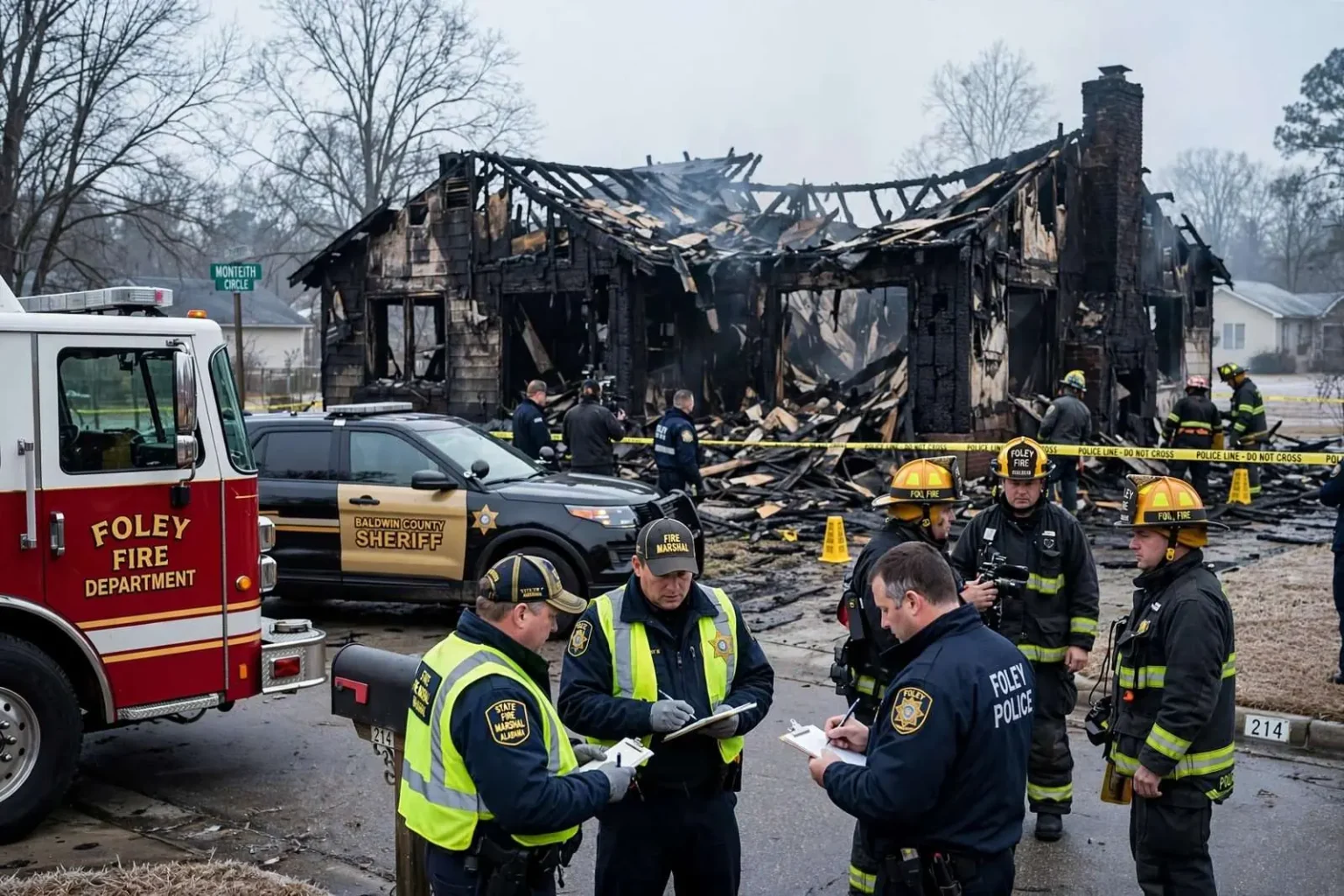
Authorities in Baldwin County spent the days before Christmas 2014 trying to determine how a fire tore through a Foley home and claimed the life of the man who lived there. The investigation, launched in the dark of a December Sunday night and resumed by daylight the next morning, brought together city firefighters, police detectives and state fire marshals in an effort to answer the two questions that matter most in any fatal fire: how it started, and who died inside.
A 9:30 P.M. Call
The blaze was reported about 9:30 p.m. on a Sunday at a single-story house on Monteith Circle, in the Monteith Oaks neighborhood off West Section Avenue, just east of the Foley sports complex. A man jogging nearby spotted the flames and called it in, giving firefighters what would turn out to be only a few minutes’ head start on a fire that had already taken hold of the structure.
Foley Fire Chief Joey Darby said crews found the structure heavily engulfed when they arrived. “It was pretty well fully involved when we got there — within five minutes — and we did find a body inside,” Darby said. The chief’s account underscored how quickly a residential fire can consume a home: from the jogger’s call to a fully involved structure, the window was a matter of minutes, leaving little chance for anyone inside to escape once the fire reached that stage.
The response that Sunday night drew on the resources of a city department that protects one of Baldwin County’s fastest-growing communities. Foley’s fire crews cover a city that has expanded rapidly southward along Highway 59 toward the Gulf, with a call volume that includes everything from beachbound traffic accidents on the corridor to structure fires in neighborhoods that barely existed a decade ago. Mutual aid from surrounding volunteer departments is a routine part of serious fires in south Baldwin County, where municipal crews are few and distances are long.
The jogger’s call set the standard sequence in motion: dispatchers taking down the address and sending the closest engine and ladder companies, firefighters spotting the glow from blocks away and radioing in a working fire, and commanders calling for additional resources before the first engine even stopped. Neighbors later described the scene — flames visible above the rooftops, hoses stretched across the cul-de-sac and crews working in the December cold as the house burned itself out under their streams.
Firefighters battling a fully involved structure face a different kind of response than a typical house fire. With flames through the roof and windows, the priority shifts from an interior attack toward knocking down the fire from outside and protecting neighboring homes, and entry to search for occupants waits until the fire is driven back enough for crews to get inside safely.
He described the remains, recovered from a bathroom, as badly burned, which made an immediate identification difficult. Investigators believed the victim was the home’s longtime resident, a 70-year-old man who had lived alone at the address for roughly a decade, according to county property records. Positive identification in such cases typically depends on dental records or forensic examination, a process that can take days and adds a painful waiting period for a victim’s family.
Neighbors on a Quiet Street
Neighbors described him as a quiet man who mostly kept to himself but would occasionally stop by to visit, and said his closest relative was a daughter in Florida. On the short cul-de-sac — the kind of street where residents know one another’s cars and routines — his absence was noticed quickly, and the loss landed with the particular weight of a death one house away.
Residents of the cul-de-sac gathered in a neighboring yard the next morning to watch the work unfold, standing in the cold as investigators in protective gear moved in and out of the burned house. Fatal fires are rare events on a residential street, and neighbors who had lived alongside the man for years had few options that morning but to watch and wait for word.
Processing the Scene
The morning after the fire, personnel from the Alabama Fire Marshal’s Office joined Foley fire and police investigators to comb through the charred remains of the house in daylight. “We’re processing the scene this morning … as far as trying to determine cause and origin,” Darby said. The state fire marshal’s involvement is standard in fatal fires, bringing specialized training in reading burn patterns, tracing a fire’s path and distinguishing accidental ignition from something more suspicious.
The work is methodical. Investigators start at the area of least damage and work toward the point of origin, examining electrical systems, heating equipment and appliances, and documenting everything photographically before debris is moved. In December, investigators also pay particular attention to heating sources — space heaters, fireplaces, aging furnaces — which figure prominently in winter fire statistics across Alabama every year.
At the time of the initial report, officials stressed that the inquiry was wide open. “It’s a completely open investigation, we haven’t ruled out anything at this point,” Darby said. That posture — refusing to characterize a fire as accidental, natural or criminal until the evidence is in — is deliberate, preserving the integrity of the scene and the eventual findings no matter which direction the evidence points.
Determining both the cause of the fire and a confirmed identity for the victim were the immediate priorities for the team on scene. Until both were established, the case could not be classified, and the parallel investigations — one forensic, one medical — had to run simultaneously, each waiting on laboratory work that takes time measured in days and weeks rather than hours.
After the Fire
Winter is the most dangerous season for house fires in Alabama and across the country. Heating equipment is a leading cause of home fire deaths in the cold months, and December brings a familiar combination of portable heaters, overloaded extension cords, aging wiring and fireplaces pressed into regular service. State fire officials renew the same warnings every year: keep space heaters three feet from anything combustible, never leave them running overnight, and make sure every level of a home has a working smoke alarm.
The risk is highest for older residents. Fire-safety researchers have long found that adults over 65 face a disproportionate share of fire deaths, a fact attributed to factors including slower mobility, prescription medications that deepen sleep and higher rates of living alone — precisely the circumstances on Monteith Circle, where a 70-year-old man lived by himself in a house he had occupied for roughly a decade.
Identification of fire victims falls to the Alabama Department of Forensic Sciences, which conducts autopsies at its regional facilities for coroners across the southern part of the state. In cases where visual identification is impossible, the office relies on dental records, medical implants and DNA comparisons supplied by families. Baldwin County’s coroner coordinates that process alongside the law enforcement investigation, and results — both the identity and the official cause of death — are typically released only when the work is complete.
County property records, which investigators consulted in piecing together who lived at the house, serve as a routine starting point in such cases. Deeds, tax rolls and utility connections establish who owns and occupies an address, giving investigators a candidate list of residents to match against dental and medical records. The same records gave reporters and neighbors the basic outline of ten years of quiet tenancy on the cul-de-sac.
The collaboration between Foley’s fire investigators, city police and the state fire marshal reflects how Alabama handles fatal fires. Municipal departments handle the response, but the fire marshal’s office brings laboratory support, specialized cause-and-origin training and the legal authority to pursue arson cases if evidence warrants. Police involvement from the first hours keeps the scene secured as a potential crime scene, preserving options that would be lost if investigators treated the fire as accidental and learned otherwise.
Fatal residential fires remain relatively rare in the Foley area, and the loss drew quiet attention from neighbors along the tight-knit street who had known the man for years. South Baldwin County’s fire departments respond to hundreds of structure fires in a typical year, but deaths inside those structures are uncommon enough that each one resonates through the community, particularly in the days before Christmas.
The case underscored how quickly a house fire can become fully involved, leaving first responders only minutes to act once flames take hold. Fire officials across Baldwin County use that arithmetic in their standing safety advice: working smoke alarms buy the minutes that make escape possible, and a fire that starts while a resident sleeps can fill a single-story home with smoke in the time it takes a neighbor to notice flames and call 911.
For the Monteith Oaks neighborhood, the investigation’s findings — whenever they came — would determine how the story ended: an accidental fire traced to a fault or a heat source, or something requiring a criminal inquiry. The scene on Monteith Circle, taped off and guarded against the cold, held the answers, and the agencies working it had the days before Christmas to begin finding them.