Anonymous donor drops gold coin in Daphne Salvation Army kettle again
For the second December running, an anonymous giver slipped a gold Krugerrand worth more than $1,300 into a red kettle at the Daphne Walmart.
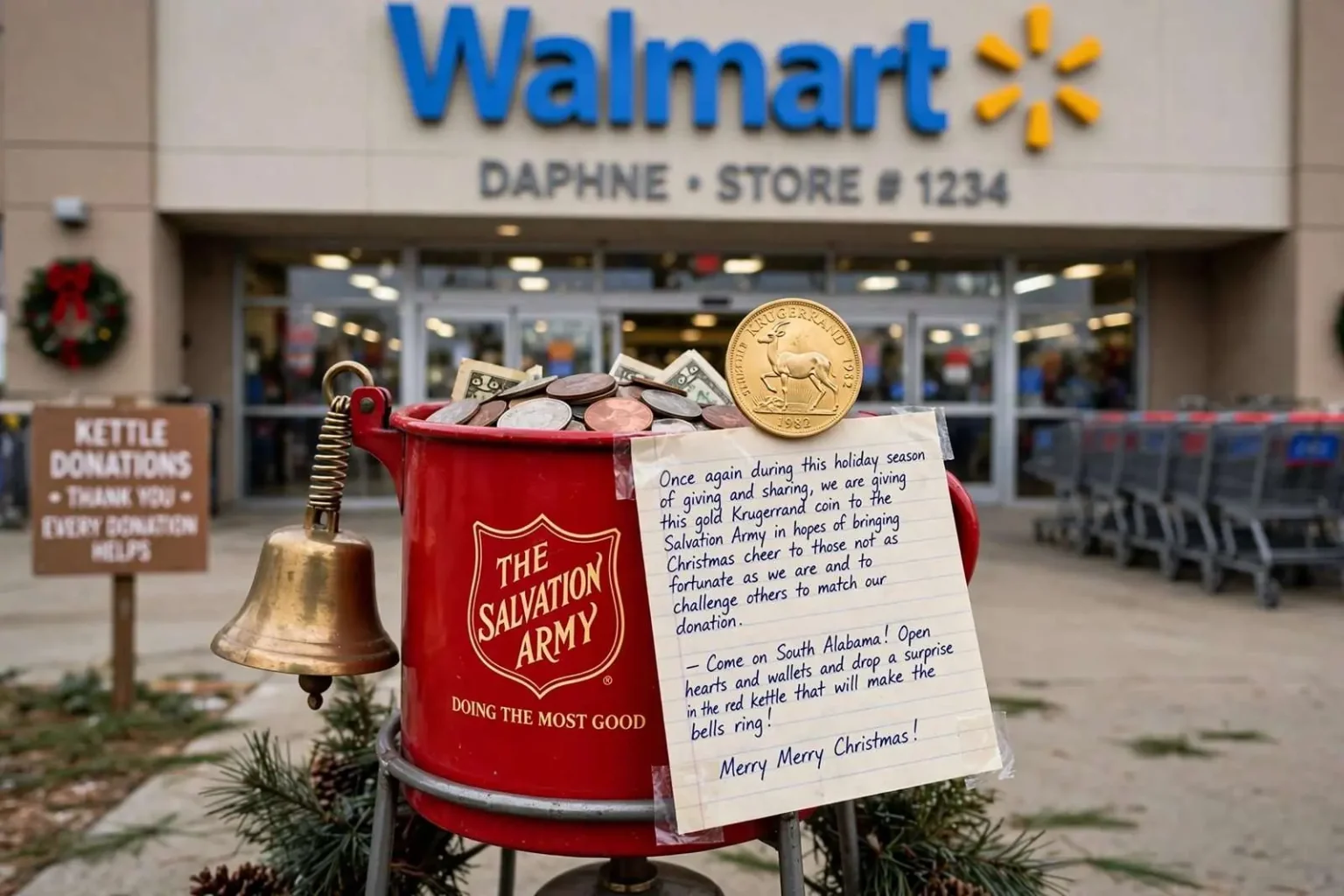
For the second holiday season in a row, an anonymous donor turned a Salvation Army collection kettle in Daphne into a small treasure chest, slipping in a gold coin worth more than a thousand dollars along with a challenge for the rest of the community to follow suit. Volunteers with the Salvation Army of Coastal Alabama discovered the surprise on a Friday morning after the coin had been dropped the night before into a red kettle stationed at the Walmart in Daphne.
The gift was a South African gold Krugerrand, minted in 1982, and it arrived taped to a handwritten note just as one had the previous December. The one-ounce gold coins, first introduced by South Africa in 1967 to put gold in the hands of private investors, remain among the most widely traded bullion coins in the world, and their value tracks the price of gold as much as their collector appeal. For a charity that spends its holiday season counting dollars and coins dropped beside bell-ringers, finding actual bullion in the kettle is something else entirely.
Kettle volunteers are accustomed to odd finds this time of year — rings, foreign currency, the occasional collector’s item — but a Krugerrand two years running has no precedent in the local organization’s recent memory. The person responsible has never come forward, and the Salvation Army has made no attempt to identify them, honoring the donor’s obvious preference for anonymity.
“We are thrilled,” said Maj. Mark Brown, the organization’s area commander, who noted that the mysterious gesture had now become something of a holiday tradition. Both coins were accompanied by messages urging other supporters to match the generosity.
Brown said the organization treats such gifts with the same care any valuable item receives. The coin is removed from the kettle, documented and appraised before being converted into cash for the charity’s programs, a process that ensures the full value of the donation reaches the families the Salvation Army serves. Last year’s coin followed the same path, and its proceeds were folded directly into the area command’s holiday and year-round assistance budgets.
A note with a challenge
This year’s note carried the same spirit as the last. “Once again during this holiday season of giving and sharing, we are giving this gold Krugerrand coin to the Salvation Army in hopes of bringing Christmas cheer to those not as fortunate as we are and to challenge others to match our donation,” it read. “Come on South Alabama! Open your hearts and wallets and drop a surprise in the red kettle that will make the bells ring! Merry Merry Christmas!”
The coin’s value was significant. Officials said the previous year’s Krugerrand, also struck in 1982, was appraised at roughly $1,350, putting this year’s gift in the same range. Combined, the two anonymous coins represent thousands of dollars directed straight into the charity’s most visible fundraiser, with every cent of it staying in the coastal Alabama region.
The timing made the donation especially welcome. Because Thanksgiving fell later on the calendar, the stretch of days available for bell-ringing between the holiday and Christmas was shorter than usual, squeezing one of the charity’s most important fundraising windows. The red kettle campaign depends on a compressed season of shopping-center appearances, and every day lost to the calendar is a day of collections the organization cannot recover. A high-profile gift arriving early in the season, officials hoped, could help the drive catch up.
“This donation is a true blessing, and the momentum it could bring to this year’s giving would mean so much to the people we serve,” said Katie Emer, the organization’s public relations director.
The gold coin was not the only unexpected find. Emer said a check for $1,000 also turned up in one of the local kettles that same morning. “We are having an exciting morning at the Salvation Army,” she said.
Two substantial gifts landing on the same Friday morning gave the local campaign a jolt that staff and volunteers said they hoped would carry through the rest of December. Large early donations tend to generate attention, and attention tends to generate more giving, as shoppers who might otherwise pass the kettle with pocket change stop to see what the excitement is about. That multiplier effect is precisely what the anonymous donor’s note seemed designed to set in motion.
Where the money goes
The Salvation Army’s red kettle campaign funds year-round programs across the region, from emergency assistance to holiday meals and toys for families in need. Money raised at kettles in Mobile and Baldwin County supports food assistance, utility and rent help, disaster response and the organization’s Christmas programs, which provide toys and meals to thousands of households along the Gulf Coast each year. The holiday drive is the charity’s largest annual fundraiser, and the results set the budget for much of the work done the rest of the year.
The kettle itself is one of the oldest fundraising traditions in American charity work, dating to 1891, when a Salvation Army captain in San Francisco set out a crab pot at the Oakland ferry landing to collect donations for a Christmas dinner for the poor. The idea spread quickly through Salvation Army posts across the country, and the red kettle with a bell-ringer alongside became a fixture outside grocery stores, discount retailers and shopping centers every December. In coastal Alabama, the tradition now spans dozens of locations in Mobile and Baldwin counties each season.
Behind each kettle stands a corps of volunteers and paid seasonal workers who ring bells in shifts, often in cold wind and rain, for weeks on end. Churches, civic clubs and businesses adopt individual kettle locations, and the competition among groups to fill their kettle fastest has become part of the local holiday calendar. The Daphne Walmart site is consistently among the area’s busiest, drawing steady foot traffic from shoppers across the Eastern Shore.
That visibility is what makes anonymous gifts like the Krugerrand so effective, charity officials say. A donation dropped into a kettle is witnessed by volunteers and shoppers, and word travels quickly through social media and local news coverage. The story of the gold coin becomes a fundraiser in itself, prompting people who might never have given to stop at the kettle the next time they shop. In that sense, the donor’s challenge note is more than sentiment — it is a fundraising strategy that costs the charity nothing and reaches exactly the audience the kettle campaign depends on.
The Salvation Army of Coastal Alabama serves both Mobile and Baldwin counties from its area command, operating shelters, feeding programs and family service offices year-round. Its staff, led by Maj. Mark Brown, oversees the kettle season alongside a network of advisory organizations and volunteer coordinators in both counties.
The windfall comes as the organization continues to emphasize the everyday nature of its work: the money dropped into a red kettle in December becomes meals served in January, prescriptions filled in March and emergency lodging whenever a family loses its home. Officials said gifts like the Krugerrand, whatever their size, ultimately support that same quiet pipeline of assistance.
Donors hoping to answer the anonymous challenge can contribute at any staffed kettle throughout the Mobile and Baldwin County area during the Christmas season. Kettles typically appear at major retailers and shopping centers from late November through Christmas Eve, and volunteers said even small gifts add up when thousands of shoppers each drop in a few dollars. Larger donors who want to follow the Krugerrand’s lead can give by check at any kettle or directly through the area command office.
Charity officials also encouraged supporters who prefer electronic giving to use the organization’s online donation options, which allow gifts to be designated to the local coastal Alabama command. Regardless of the method, the message from staff was the same one written on the note taped to last week’s coin: the need along the Gulf Coast does not end when the decorations come down, and the money raised in December carries the organization through the slower giving months of winter and spring.
For now, the identity of the Krugerrand donor remains a mystery, just as it was a year ago. What is known is the pattern: a 1982 South African gold coin, a handwritten note, a Walmart kettle in Daphne, and a public dare to the rest of South Alabama to match the gift. If the tradition holds, the Salvation Army’s red kettles may be worth watching again next December — and in the meantime, Maj. Brown and his staff are hoping the community takes up the challenge in the weeks that remain before Christmas.
“We are thrilled,” Brown repeated of the find, and with two years of gold coins behind them, volunteers along the Eastern Shore say they will be checking their kettles a little more carefully every morning this season.