Foley House Fire Death Ruled Homicide, First in Five Years
A body found in a burned Foley home on Monteith Circle has become the city's first homicide investigation since 2009 after autopsy findings.
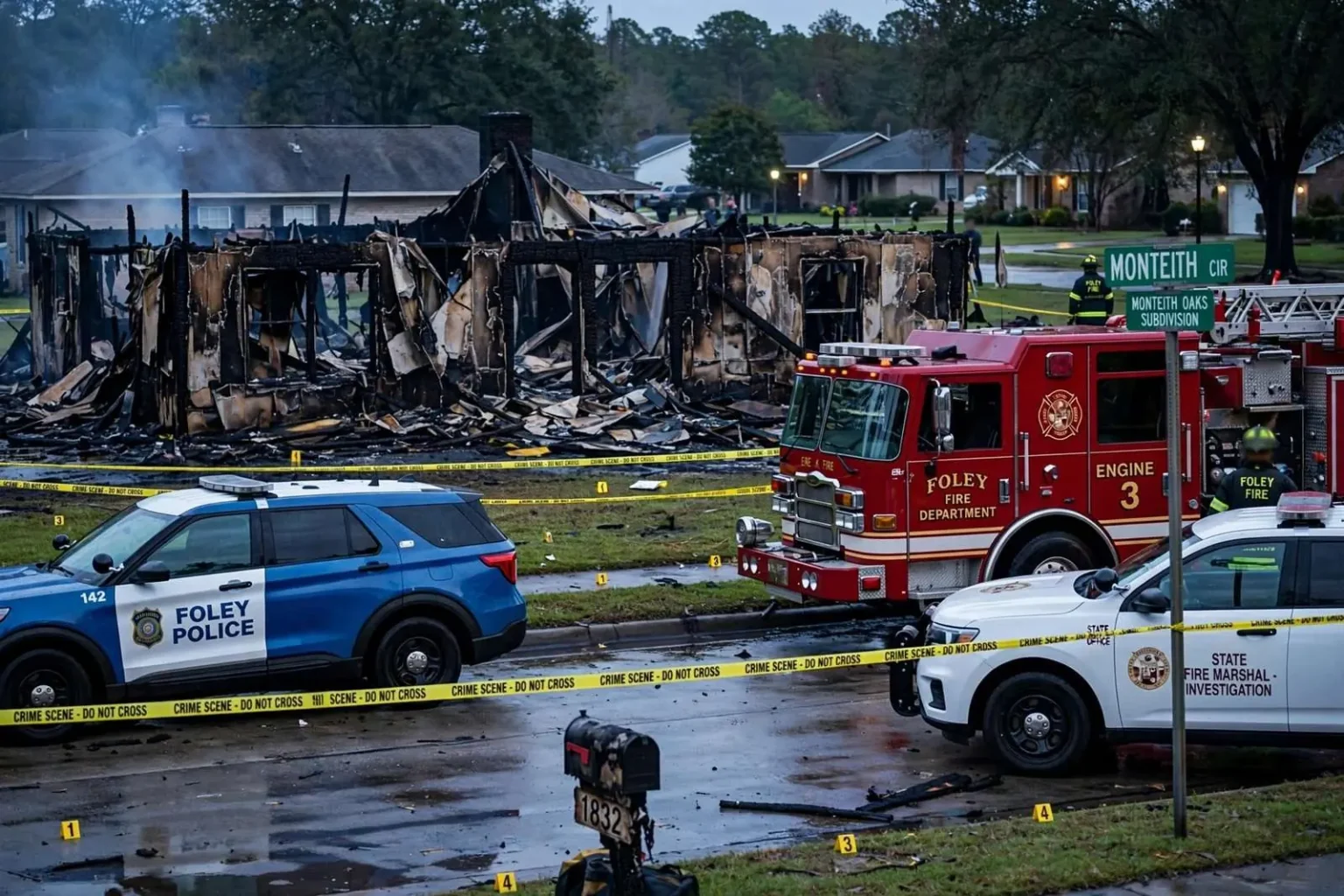
A fire that gutted a single-story home on Monteith Circle in Foley has turned into the city’s first homicide investigation in five years, after autopsy findings pointed to foul play. What began as an overnight house fire in a quiet Baldwin County subdivision has become a criminal case that has drawn together local police, fire investigators and the state fire marshal’s office, unsettling a community unaccustomed to violent death in its neighborhoods.
Foley’s police chief confirmed that investigators upgraded the case to a homicide inquiry after evidence collected at the scene and the results of an autopsy indicated the death was not accidental. The home belongs to a 70-year-old area resident, though authorities have withheld the identity of the person found inside pending notification of family members and formal identification. Officials have released few details about what the autopsy revealed, citing the open investigation, but the decision to treat the death as a homicide signals that findings at both the scene and the medical examiner’s level ruled out the accidental and natural explanations that cover most house-fire fatalities.
According to the Foley Fire Department, crews were called to the Monteith Oaks subdivision around 9:30 p.m. on a Sunday night after a passerby jogging through the neighborhood spotted the blaze and called it in. Firefighters arrived within about five minutes to find the structure already well involved in flames, the kind of established fire that leaves crews fighting for containment rather than rescue. Despite the fast response, the home was gutted, and a body was later located inside a bathroom of the home once crews could safely search the interior.
From Fire Scene to Crime Scene
The State Fire Marshal’s Office opened a joint investigation into the fire’s cause and origin alongside Foley police and fire departments starting the following morning. Cause-and-origin work is a meticulous process: investigators map burn patterns, examine the wreckage for indicators of how and where the fire started, collect samples for laboratory analysis and interview neighbors about anything unusual in the hours before the blaze. When a death occurs in a fire, every finding becomes potential criminal evidence, and the scene is treated accordingly until investigators are satisfied with what it tells them.
Once autopsy results confirmed signs of foul play, the police chief requested the activation of the regional Major Crimes Unit, a multi-agency task force that assists local departments with complex criminal investigations. The unit pools detectives from across Baldwin County and the surrounding region, giving a small department access to investigative manpower and specialized experience it could not maintain on its own. For a case involving fire, death and likely weeks of forensic work, that reinforcement is the difference between a department stretched thin and one with the depth to follow every lead.
The escalation from fire response to homicide investigation follows a sequence familiar to fire investigators across the country. Fire crews secure the scene and preserve evidence; fire investigators and the state fire marshal determine cause and origin; the medical examiner determines the manner of death; and when the two findings point in a criminal direction, police take the lead. Each handoff in that sequence must be documented carefully, because any eventual prosecution will depend on the integrity of the earliest decisions made at the scene.
An Uncommon Crime for Foley
The case marks a rare violent crime for the coastal Baldwin County city, which hadn’t investigated a homicide since 2009. That earlier case, which remains a point of reference for longtime residents, involved a man found dead in his home with trauma to his head and neck; a suspect was later arrested and charged with murder years afterward. The long gap between homicide cases reflects the character of a city that has grown rapidly from its railroad-town roots into a retail and tourism hub drawing visitors to its museums, parks and annual events, while its residential neighborhoods have largely been spared the violent crime that larger cities confront routinely.
Baldwin County has also seen other high-profile violent crime cases in neighboring jurisdictions in recent years, underscoring how unusual homicide investigations are for the area’s small cities and how heavily they can weigh on a community when they do occur. In towns where many residents know one another and where decades can pass between killings, the discovery of violent death close to home tends to produce both fear and an unusual willingness to talk to investigators.
The victim’s age adds another dimension of concern for investigators and neighbors alike. Elderly residents living alone are among the populations most vulnerable in both fires and targeted violence, and law enforcement agencies treat deaths in that population with particular scrutiny, since what looks accidental on the surface can sometimes be neither. Authorities have not said whether they believe the 70-year-old resident was targeted or whether the person found inside the home was the owner, and they are not expected to elaborate until formal identification is complete.
How Residents Can Help
Foley police are asking anyone with information about the incident to come forward. Investigators want to hear from anyone who was in the Monteith Oaks area Sunday evening, who noticed vehicles or visitors at the home in the days before the fire, or who may have captured anything relevant on home security cameras or doorbell systems. In residential investigations, tips from neighbors are frequently what break a case, and the early days after an incident — before memories blur and conversations converge — are the most valuable time to collect them.
Residents with information can contact the Foley Police Department directly, and those who prefer to remain anonymous can pass tips through the area’s Crime Stoppers program, which allows tips by phone and online and pays rewards for information that leads to arrests. Investigators emphasize that even details that seem insignificant — a stranger walking the neighborhood, a car parked unusually long, an argument heard next door — can fit into a timeline in ways a witness might not expect.
For the Monteith Oaks neighborhood itself, the immediate aftermath is more ordinary and more difficult: a gutted house behind fire tape, a family awaiting word, and the knowledge that the investigation will take time. Fire investigators will work the scene for days before the physical evidence is exhausted, and detectives will continue canvassing the area long after the crews have gone.
What Comes Next
No arrests had been announced as of the latest update, and officials have not named any suspects or persons of interest. The case remains under investigation by the Foley Police Department, the Foley Fire Department and the State Fire Marshal’s Office, with the regional Major Crimes Unit assisting. Further public updates are likely to come slowly, in keeping with the way investigators handle open homicide cases where early disclosure could compromise the eventual prosecution.
What authorities have made clear is the direction of the case: a fire that might once have been recorded as a tragic accident is now formally a homicide, the first in Foley in five years, and the agencies working it are treating the quiet subdivision where it happened as a crime scene until the questions it raises are answered.
Foley’s Growth and Its Police Work
The investigation unfolds in a city that has changed dramatically over the past two decades. Foley has grown from a small agricultural and railroad community into one of Baldwin County’s busiest destinations, anchored by its outlet shopping, its expanding parks system and the steady residential development that has pushed subdivisions across former farmland in every direction. Growth of that kind brings more calls for service every year, but it has not historically brought more violence, and the city’s police and fire departments have built reputations as professional small-city agencies handling everything from traffic to hurricanes rather than homicides.
Baldwin County as a whole is one of the fastest-growing counties in Alabama, and its sheriff’s office and municipal departments have adapted with mutual aid agreements that let agencies share resources during major incidents. The Major Crimes Unit activation in this case is one example of that cooperative structure in action, and it reflects a lesson learned across the county: small departments that handle rare serious crimes are best served by drawing on detectives who work such cases regularly, rather than asking local officers to improvise an investigation none of them may have run before.
Fire investigators, meanwhile, will be working against the clock in a different way. Evidence of accelerants, ignition devices and tampering degrades with every rainstorm and every day of exposure, which is why cause-and-origin teams move quickly once a scene is released by fire crews. The findings they document in the first weeks — what burned first, where the fire moved fastest, whether any materials in the wreckage should not have been there — will form the technical backbone of whatever case prosecutors eventually pursue.
Until investigators release more, Monteith Circle returns to something like its normal rhythm, with the exception of the taped-off lot where the home stood. Officials say the department will share updates as the investigation allows, and they renew the same request they have made since the night of the fire: if you know something, however small it seems, say something.