Loxley’s Truck Trail 17 Stuck Without Money to Fix Aging Bridges
A rural Baldwin County road near Loxley, Truck Trail 17, faces a bridge funding standoff even as it is eyed as a link to the Baldwin Beach Express.
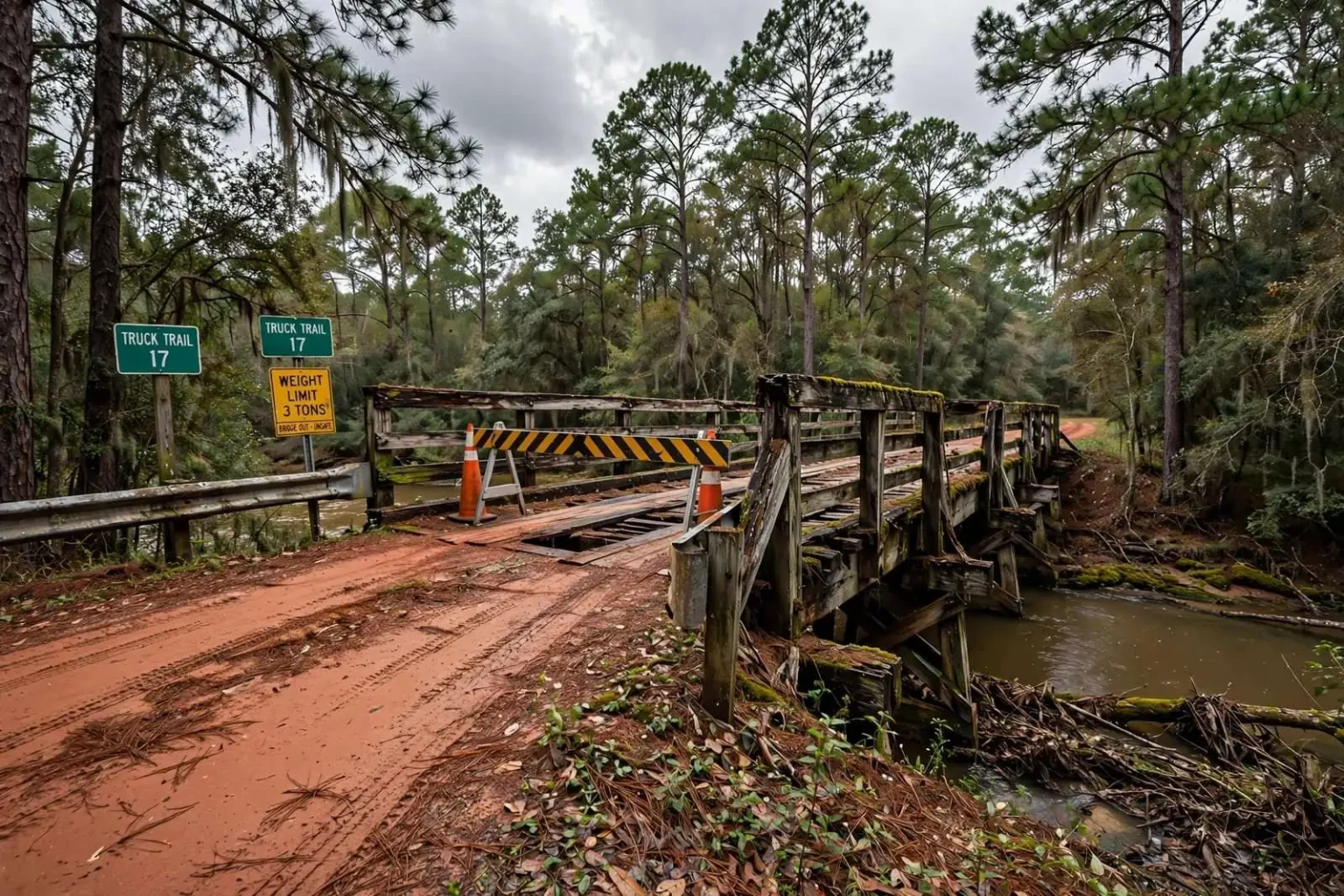
Tucked among tall timber west of a private golf course near Loxley, a five-mile ribbon of red dirt known as Truck Trail 17 has become an unexpectedly thorny problem for local and county leaders in Baldwin County, who cannot agree on who should pay to fix its aging wooden bridges. The quiet route links Wilcox Road to Highway 59, far from the busy development farther south in the county. But its weathered spans are a growing worry.
One of them, the Styxx River bridge, a wooden structure rated for vehicles of three tons or less, was slated to close because of its poor condition, forcing the handful of residents who live along the trail to take longer detours to reach the highway.
The town’s side of the ledger
For the town of Loxley, the core issue is cost. Mayor Billy Middleton said a modern concrete bridge could run $2 million to $3 million, an expense the town simply cannot absorb within its roughly $5 million annual general fund budget. Even a state grant requiring a 20 percent local match, which he estimated at around $600,000, was too steep, and he said the town lacked the ability to borrow the money.
Loxley did spend about $100,000 on a temporary fix to the nearby Reedy Creek bridge to preserve access for a small number of rural households. That repair bought time, but it did not resolve the underlying question of who is ultimately responsible for keeping the trail’s crossings safe, and it left the Styxx River bridge, the worst of the structures, without any funded solution at all.
County officials framed the dispute as part of a larger pattern in which smaller towns annex rural territory without the resources to maintain the roads and bridges that come with it. The Styxx River bridge was folded into Loxley about seven years earlier, while the nearby Roans Creek bridge stayed under county control.
The county is moving ahead with a roughly $1 million replacement of Roans Creek, funded largely through the state’s ATRIP program, with work expected within nine months. “They are depriving them of a road,” Baldwin County Commission President Charles “Skip” Gruber said of the annexation, adding that the county would not abandon the project if it were its own. Commissioners Chris Elliott, Tucker Dorsey and Frank Burt Jr. echoed the strain, noting the county already maintains some 1,600 miles of road and faces its own tight budget.
Two governments, one road
The split of responsibility along a single five-mile stretch of dirt may seem like an accounting quirk, but it is the direct product of Baldwin County’s rapid growth. As towns like Loxley push their corporate limits outward through annexation, they pick up tax base, and they also pick up rural infrastructure that was built decades ago for farm traffic, not for the subdivisions that may one day follow. Bridges that carried tractors across creeks now sit in town limits where residents expect modern standards.
Annexation in Alabama is generally initiated by property owner petition, and towns rarely acquire an annexed bridge along with a dedicated funding stream to replace it. The result, officials on both sides acknowledged, is that the bridge’s fate ended up hostage to the town’s balance sheet rather than the condition of the structure itself.
ATRIP, the Alabama Transportation Rehabilitation and Improvement Program that is paying for most of the Roans Creek work, distributed federal funds to counties and municipalities across the state for road and bridge repairs. Baldwin County used its ATRIP allocations across a long list of projects, but the money flows to the government that owns the asset, which is why Roans Creek moved forward while the Styxx River bridge, sitting inside Loxley’s limits, did not.
Middleton said the town pursued every funding avenue it could identify, including the state grant route, before concluding that the match requirement alone exceeded anything the town could responsibly commit. Loxley’s general fund must cover police, fire and basic street maintenance across a town that has been one of the fastest growing in the county, and a single $2 million bridge would consume roughly half of a year’s budget.
The long-term stakes: the Beach Express
Beyond the immediate repairs, officials see long-term stakes tied to the Baldwin Beach Express. County Engineer Cal Markert said the road, about four miles from Interstate 10, would likely need to be paved and upgraded to serve as a connector and emergency evacuation route if the Beach Express is extended north toward Interstate 65. A proposed interchange would sit between Reedy Creek and the Styxx River.
That geography changes the argument. What looks today like a remote country lane serving a few households could become, under a Beach Express extension scenario, a piece of the county’s hurricane evacuation network. Baldwin County’s population boom along the coast has made evacuation capacity a recurring planning concern, and planners have long identified north-south connectors east of the bay as critical to moving traffic off the beaches during a storm threat.
Markert’s assessment means the county has a planning interest in the corridor even if the bridge itself sits inside Loxley’s town limits. Emergency routes do not respect municipal boundaries, and a bridge closed to all but the lightest vehicles is an obstacle in any evacuation plan that routes traffic along Wilcox Road toward Highway 59.
An ambitious idea with no funding
One ambitious idea floated a $29 million plan to pave the 5.4-mile road and replace its bridges, pitched for possible funding tied to the 2010 Deepwater Horizon oil spill settlements. The spill restoration money that flowed into the Gulf Coast after the BP disaster included road and infrastructure projects intended to bolster the regional economy, and Baldwin County officials identified a list of candidates for those dollars.
But its status remained uncertain, and for the moment, with no money in hand, the little truck trail’s future stayed stuck in limbo. The $29 million figure dwarfed anything either the town or the county had committed to the corridor, and competition for spill-related funds was fierce across the coastal counties, with every community pitching its own priority projects.
In the meantime, the residents who actually live along Truck Trail 17 are left to plan around the closures. The three-ton rating on the Styxx River bridge already excludes fire trucks, garbage trucks and moving vans, and a full closure would push those households onto longer detours to reach Highway 59. School buses, too, must weigh their routes against the aging crossings.
What comes next
Talks between the town and the county are expected to continue, with both sides publicly insisting they are not walking away from the road. The county’s position, articulated by Gruber and the commissioners, is that the town took the bridge when it annexed the territory and should bear the burden of fixing it. Loxley’s position is that a $2 million to $3 million bridge is beyond the reach of any town its size without state or federal help.
Possible paths forward include a joint application for a state or federal bridge program, a shared-cost agreement that splits the expense between the two governments, or waiting on the Beach Express extension to force the corridor’s hand by making the road a regional priority. None of those options, however, has a timeline attached, and the Styxx River bridge’s condition continues to deteriorate as the debate goes on.
For now, Truck Trail 17 remains what it has long been: a quiet red dirt shortcut through the pines, carrying a few cars a day and a disagreement between two governments that both agree something must be done, and neither has yet found a way to pay for it.
A growing county’s infrastructure dilemma
The dispute over Truck Trail 17 is a small-scale version of a challenge Baldwin County confronts across its map. With its population among the fastest growing in Alabama, the county has had to stretch road money between new suburban arterials in the south and legacy rural infrastructure in the north and center of the county. Commissioners have repeatedly warned that maintenance backlogs on existing roads compete directly with the demand for new capacity.
Bridge inventories maintained by the state list dozens of older wooden and low-standard crossings across south Alabama, and replacement costs have climbed faster than the revenue streams that fund them. The gas tax and other traditional road funding sources have not kept pace with construction costs, which is why programs like ATRIP became so important to counties and why their expiration leaves projects like the Styxx River bridge searching for a replacement source.
Local leaders on both sides say the annexation issue is worth a broader conversation as well. If towns expanding into rural Baldwin County inherit bridges and roads they cannot afford to maintain, commissioners argue, the practical result is infrastructure that no government is positioned to fix. Middleton does not dispute the dilemma; he simply notes that a town of Loxley’s size cannot borrow its way out of it, and that the state’s grant formulas presume resources the town does not have.
Until one of those larger questions is answered, the fate of a five-mile dirt road and its two aging wooden bridges will keep turning on budget lines and boundary maps, while the residents along the trail keep driving the long way around.