Mobile Housing Board Picks Developers for $439 Million Overhaul
The Mobile Housing Board chose three developers for a sweeping public housing overhaul estimated at up to $439 million under its Transformation Plan 2020.
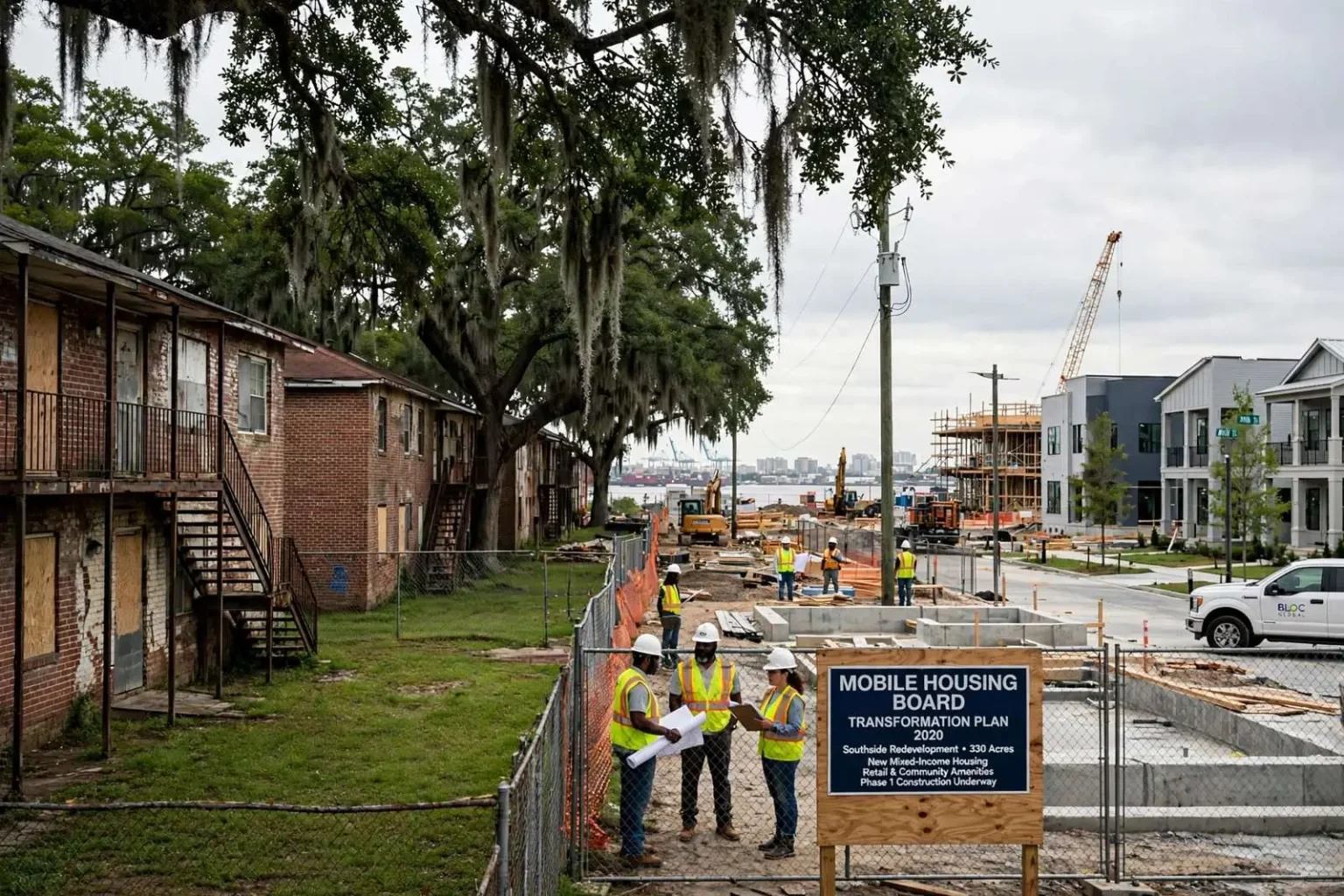
The Mobile Housing Board has picked three development teams to help remake public housing on the city’s south side, an early step in an ambitious plan to overhaul affordable housing across Mobile at an estimated cost of up to $439 million. The selection sets in motion the most consequential rethinking of public housing in the city’s history — a program that would touch every development the board operates and reshape neighborhoods where thousands of Mobilians live.
The effort, known as Transformation Plan 2020, sorts the board’s 13 housing developments into groups that will be revitalized, repositioned or retained. Executive Director Dwayne Vaughn said the board’s initial attention is on Southside communities Thomas James Place, R.V. Taylor Plaza and Boykin Tower, along with the Northside communities Roger Williams and Josephine Allen. Those five developments house some of the city’s longest-served public housing residents and represent the oldest, most worn portions of the board’s inventory.
For the roughly 330 acres of Southside property, the board selected Hollyhand Development of Northport, Columbia Residential of Atlanta, and a partnership of Pennrose Properties and BLOC Global Development Group based in Philadelphia and Birmingham. The three teams bring national and regional experience in mixed-financing redevelopment — the specialty required for a program that layers federal housing dollars with tax credits, private investment and municipal support.
Vaughn said that once fully built out, the Southside transformation could carry a value in excess of $750 million. That figure — larger than the board’s estimate for its entire 13-property plan — reflects the scope of what the Southside sites could become: not refurbished barracks-style apartment blocks, but complete neighborhoods with new construction, retail and shared amenities woven into the surrounding city.
A Different Model of Housing
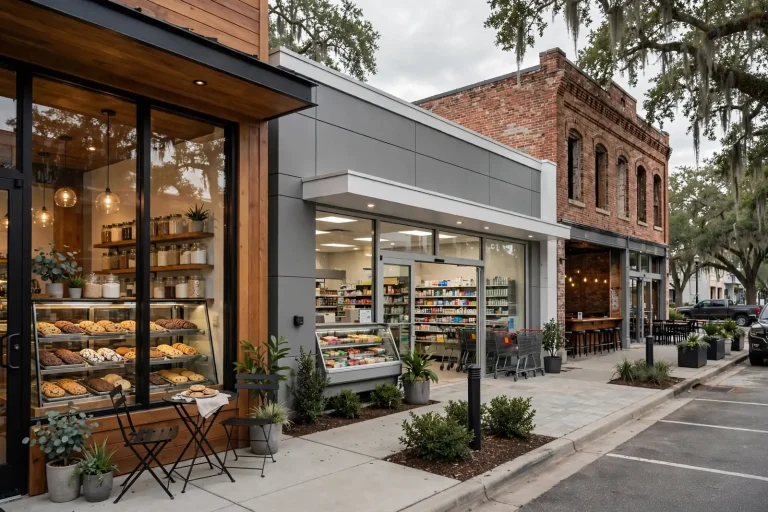
Central to the vision is the idea of mixed-income neighborhoods woven together with commercial and mixed-use amenities such as a gym and a grocery store. The board hopes to design the communities so that lower-income homes are indistinguishable from the rest, encouraging residents of different backgrounds to interact. “We think the interaction of people in a positive way is what makes a community thrive,” Vaughn said. The approach abandons the concentration model that built Mobile’s public housing in the first place — large clusters of subsidized units set apart from the city — in favor of developments where market-rate, workforce and subsidized homes share streets and services.
Not every property will be rebuilt from scratch. On the Southside, Oaklawn is slated to be repositioned along with Central Plaza Towers and Emerson Gardens, with off-site replacement housing offered while work is underway. On the Northside, Gulf Village would be retained, joining Orange Grove and the newer Renaissance community, which were rebuilt in earlier redevelopment rounds and now stand as the local proof of concept for what Transformation Plan 2020 envisions.
Board officials pointed to the age of the existing housing stock as a driving factor. Setting aside the recently built Renaissance communities, the affordable housing developments average about 54 years old, and four properties are more than 70 years old. Buildings of that age — many dating to the 1940s — grow progressively more expensive to maintain, less efficient to heat and cool, and increasingly out of step with modern expectations for how apartments should be configured, regardless of how well they are kept.
Vaughn said momentum from local colleges, a revitalized downtown and major employers such as Airbus and Austal convinced the board that the time to act had arrived. “If we let it go, we will look back and say we missed the time,” he said. The argument is essentially economic: with the regional economy adding jobs and downtown gaining residents, the window for assembling financing and public support for a half-billion-dollar redevelopment effort is open now, and it will not stay open indefinitely.
The Numbers Behind the Plan
Vaughn framed the plan as complementary to Mayor Sandy Stimpson’s “One Mobile” goal of making the city one of the safest and most business- and family-friendly places in the country. Housing that functions — physically, financially and socially — underpins that agenda, and the board has spent years arguing that its aging portfolio is both a moral liability and an economic drag on the neighborhoods around it.
Overall, redeveloping or repositioning all 13 properties is projected to cost between roughly $344 million and $439.5 million, figures that do not include commercial, institutional or recreational components. The final bill will depend on how many units are rebuilt, where, and on what land — variables the master planning process is designed to settle. The Boulevard Group is coordinating the process, serving as the planning consultant that ties the development teams, the board and federal oversight together.
Officials said a master development plan would begin in mid-January and take an estimated four to six months to complete, with residents and local stakeholders invited to weigh in during the 2015 planning phase. That engagement process is where the plan’s most sensitive questions get worked out: how many units of public housing survive the transformation, where replacement housing goes, how relocation is handled for residents whose buildings come down, and what guarantees residents receive about returning to the new communities.
The board’s attention will then turn to the remaining properties as the phases advance, but officials emphasized that the January planning process will look at the whole system at once — how replacement units distribute across the city, which sites keep their residential character and which convert to other uses, and how the Southside and Northside work fits the board’s financial capacity. Decisions made there will shape the housing board’s portfolio, and the neighborhoods around it, for decades to come.
Those questions are the ones that have followed mixed-income redevelopment across the country. Cities that transformed their public housing in earlier waves often saw total unit counts fall, and national experience has taught housing authorities that residents’ trust depends on one-for-one replacement commitments and relocation support made explicit before demolition begins. Mobile’s plan enters that conversation with the advantage of coming later — able to build on lessons learned elsewhere and on the replacement standards federal housing programs now require.
What Transformation Means for Residents
For the families living in Thomas James Place, R.V. Taylor Plaza, Boykin Tower and the other affected communities, the plan promises a future of modern, energy-efficient homes in neighborhoods with grocery stores, gyms and services within walking distance — promises no resident of 70-year-old barracks-style housing has heard kept yet. It also promises disruption: construction phases, temporary moves and the anxiety of watching one’s community rebuilt around a new design.
The board’s challenge is to deliver the first without sacrificing the second. The selection of three experienced teams, the phased approach that begins with the Southside, and the four-to-six-month planning window with resident input all give the effort structure. What remains is the harder work: financing a project of this scale across federal budgets that have grown tighter, maintaining relocation promises over years of construction, and proving that mixed-income design can work on Mobile’s south side the way it did at Renaissance on the north.
If it succeeds, Transformation Plan 2020 will replace every major public housing property in Mobile within a generation’s time — and the decisions made in this first planning phase, on 330 acres of south Mobile, will set the template for everything that follows.
The Teams Chosen to Build It
The three selected developers represent the mix of scale and local knowledge the plan requires. Hollyhand Development, part of a family of Alabama companies with decades of experience in affordable housing finance, brings deep familiarity with the state’s tax credit allocation process — the lifeblood of any multi-phase redevelopment in Alabama. Columbia Residential has built its national reputation on large mixed-income community redevelopments in the Southeast, and the Pennrose-BLOC partnership pairs a major national developer with a Birmingham firm rooted in inclusive, community-driven projects.
Housing boards typically select development teams early precisely because the master plan needs their technical input: what the sites can support, what the financing will bear, and how phasing can proceed without leaving residents in limbo. With the teams in place, Mobile’s January planning effort starts with builders at the table rather than joining later, which shortens the distance between a completed plan and the first construction phase.
The coordination role of The Boulevard Group covers the connective tissue that historically derails efforts of this size — aligning the housing board, the city, federal housing officials, financiers and residents around a single evolving plan. A $400-million-plus program spans multiple funding cycles, and keeping the pieces synchronized is a full-time discipline.
The plan’s sponsors describe it, ultimately, as a bet on Mobile’s trajectory: that a city gaining jobs at Airbus and Austal, filling its downtown and investing in its neighborhoods can afford to solve a 70-year-old housing problem once and comprehensively. The five communities named first will find out what that bet feels like before anyone else — and how Mobile’s answer to public housing’s national crossroads is built.