Gov. Riley Appoints Juan Chastang to the Mobile County Commission
Gov. Bob Riley named Mobile teacher and Republican Juan Chastang to the county commission, filling the three years remaining on Sam Jones' term after Jones became Mobile's first African-American mayor.
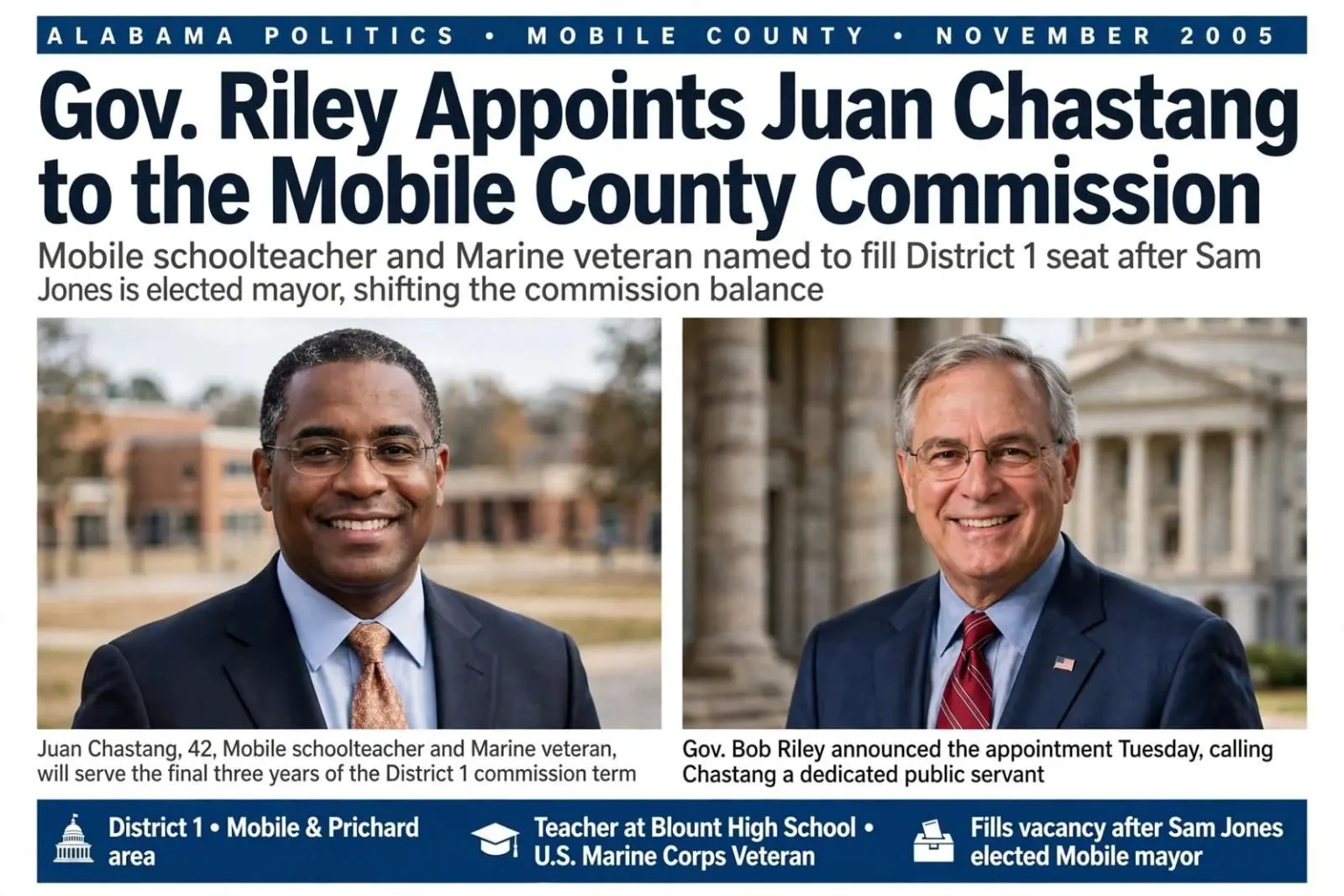
Gov. Bob Riley appointed Mobile schoolteacher Juan Chastang to fill a vacancy on the Mobile County Commission, choosing a Republican to complete a term left open when longtime Democrat Sam Jones was elected mayor of Mobile. The move gave the commission a new member for District 1, the seat that covers a swath of Mobile and neighboring communities and has historically been one of the most closely watched districts in county government. Chastang, an African-American and an official in both the local and state Republican parties, was named to serve the final three years of Jones’ commission term.
Jones, a veteran officeholder, had two months earlier become the first African-American elected to Mobile’s highest municipal office. His departure from the commission created the vacancy that Riley was charged with filling, and the governor’s choice of a member of the opposing party immediately drew attention across the region. In Alabama, where county commissions control road paving, drainage, and a range of services that touch daily life in unincorporated areas and smaller municipalities, a single commission seat can shape priorities for years.
Chastang, who described himself as proud of his conservative principles, also cast himself as “an independent, free thinking person.” “I will look at every issue and in the end will base my decision on what I believe is best for the citizens of Mobile,” Chastang said. “I know I have big shoes to fill. I would like to meet with Mayor Jones later this week. I know we are of different political parties, but we are all in this together — the city of Mobile, District 1, and Mobile County.”
A crowded short list
Others said to have been under consideration included former Prichard Mayor Charles Hardin; Andre Reid, a former state trooper and ally of ex-Lt. Gov. Steve Windom; and veteran Republican activist Jeffrey Jones, according to a source close to the process. The breadth of the list reflected the significance of the appointment, which would determine who represented the district through the remainder of the term. Prichard, the city Hardin once led, sits at the heart of District 1, and its struggles with finances and development have long made its leadership a factor in county politics.
Chastang reportedly enjoyed broad backing within the party’s leadership, many of whom relayed their support to the governor. Party officials cited his energy, his military background, and his years of service in Republican Party organization at both the county and state levels. For a party working to broaden its appeal among African-American voters in Alabama, a candidate with Chastang’s profile carried obvious significance.
“He’s a young J.C. Watts,” said Republican activist Terry Lathan of Theodore. “We’re proud of him. Great things are coming to Mobile County. I think the citizens will be pleased with Juan.” The comparison invoked Watts, the former Oklahoma quarterback and congressman who was among the most prominent African-American Republicans in national politics, and it signaled the enthusiasm Chastang’s candidacy generated among party activists in the Mobile area.
From the Marine Corps to the classroom
Chastang, 42, brought a varied background to the commission. A Mobile native, he was a former city police officer and had served in the U.S. Marine Corps’ 3rd Force Reconnaissance and infantry units. The 3rd Force Reconnaissance Company, based in Mobile, is a reserve unit whose members have been called to duty in conflicts stretching from the Persian Gulf era onward, and service in its ranks is widely regarded as among the most demanding assignments available to a Marine reservist.
His time in uniform and on the police force gave him firsthand familiarity with public safety, an area that falls directly within county government’s reach through the sheriff’s office, the metro jail, and emergency management. Colleagues and supporters pointed to that experience as preparation for a governing body that must balance law enforcement needs against the demands of roads, drainage, and the county budget.
He had also been a restaurateur, once owning BJ’s Hot Wings, a venture that put him on the small-business side of the local economy. Supporters argued that background mattered on a commission that sets policies affecting employers across the county, from permitting to infrastructure. Chastang himself framed his business experience as part of the reason he wanted to make job creation the centerpiece of his service.
He sat on both the Mobile County and state Republican executive committees, and in 2000 he had unsuccessfully challenged Mobile City Councilman Fred Richardson for the District 1 council seat. That earlier campaign gave him name recognition in the district and a ground-level view of city-county relations, even though it ended in defeat. Party leaders who backed his appointment noted that few candidates for the vacancy arrived with a comparable record of electoral and organizational work.
A teaching career in the district
At the time of his appointment Chastang was teaching at Blount High School and coaching the boys’ junior varsity basketball team, while working toward a master’s degree in special education. Blount, located in the Prichard area, is one of the flagship high schools of the Mobile County Public School System, the largest school district in Alabama, and its students and families are among the constituents Chastang would now represent in county government.
His classroom duties meant the new commissioner would be splitting his weeks between county administration buildings and a high school campus, a combination that supporters said would keep him connected to the families his decisions affected. Critics of full-time officeholders, meanwhile, viewed the arrangement as evidence that he understood the pressures working families in the district faced.
He held a bachelor’s degree in communications from the University of Montevallo and a master’s in sports management from the United States Sports Academy, and he was completing a second master’s in special education from Alabama State University. The United States Sports Academy, based in Daphne, is a specialized institution known for sports-related graduate programs, while Alabama State University in Montgomery has long been one of the state’s historically black universities. The pursuit of a special education credential reflected, he said, both professional ambition and a desire to serve students who too often fall behind.
He was a graduate of Davidson High School and a past member of the Mobile County Young Republicans, as well as a past committeeman of the State Young Republicans. His rise through the party’s youth organizations gave him a network of allies across south Alabama and a reputation as a recruiter at a time when the county party was working to bring new faces into its ranks.
Economic development as the top priority
Chastang said he would make economic development a priority, pointing to the commission’s role in recruiting industry, improving infrastructure, and setting the tone for businesses weighing a move to the area. “We must promote our county as the most business friendly place in Alabama,” he said. “Improved job opportunities and increased salaries should be the county’s top priority. I want my students to have the best options of anywhere in Alabama.”
The remarks tied his two careers together: the teacher arguing that better pay and more jobs in Mobile County would keep his students from having to leave the area to build their lives. County officials had spent years courting aerospace, shipbuilding, and manufacturing employers to the Gulf Coast, and commission seats often turn on questions of which roads get widened, which industrial sites get served, and how aggressively the county competes for new projects.
For District 1, which includes neighborhoods that have historically struggled with disinvestment, the promise of a business-focused commissioner carried particular weight. Community leaders in the district had long argued that job growth and transportation improvements were inseparable, and Chastang’s statements suggested he intended to press both themes from his seat on the commission.
A legal fight over the seat
The appointment did not settle every question. Democratic Party interests continued to challenge Riley’s authority to fill the vacancy by appointment, arguing instead for a special election to decide the seat. Their position held that when a vacancy of this kind occurs, voters rather than a governor of the opposing party should choose the successor, and the dispute promised to keep the commission seat in the courts and in the news long after the swearing-in.
The clash highlighted a recurring tension in Alabama local government, where vacancies in county offices have repeatedly spawned litigation over whether appointment powers or special elections control. For the people of District 1, the practical stakes were straightforward: whoever held the seat would vote on county budgets, road projects, and appointments to boards that shape everything from sewer service to industrial development.
Chastang, for his part, indicated he intended to treat the position as more than a caretaker assignment. His opening message — cooperation with Mayor Jones despite party differences, a focus on jobs, and a pledge to judge each issue on its merits — was aimed at a district that had just seen its longtime commissioner rise to City Hall. Whether the legal challenges succeeded or failed, the appointment ensured that the relationship between the city’s new administration and the county commission would be one of the most consequential political dynamics in Mobile for the remainder of the term.