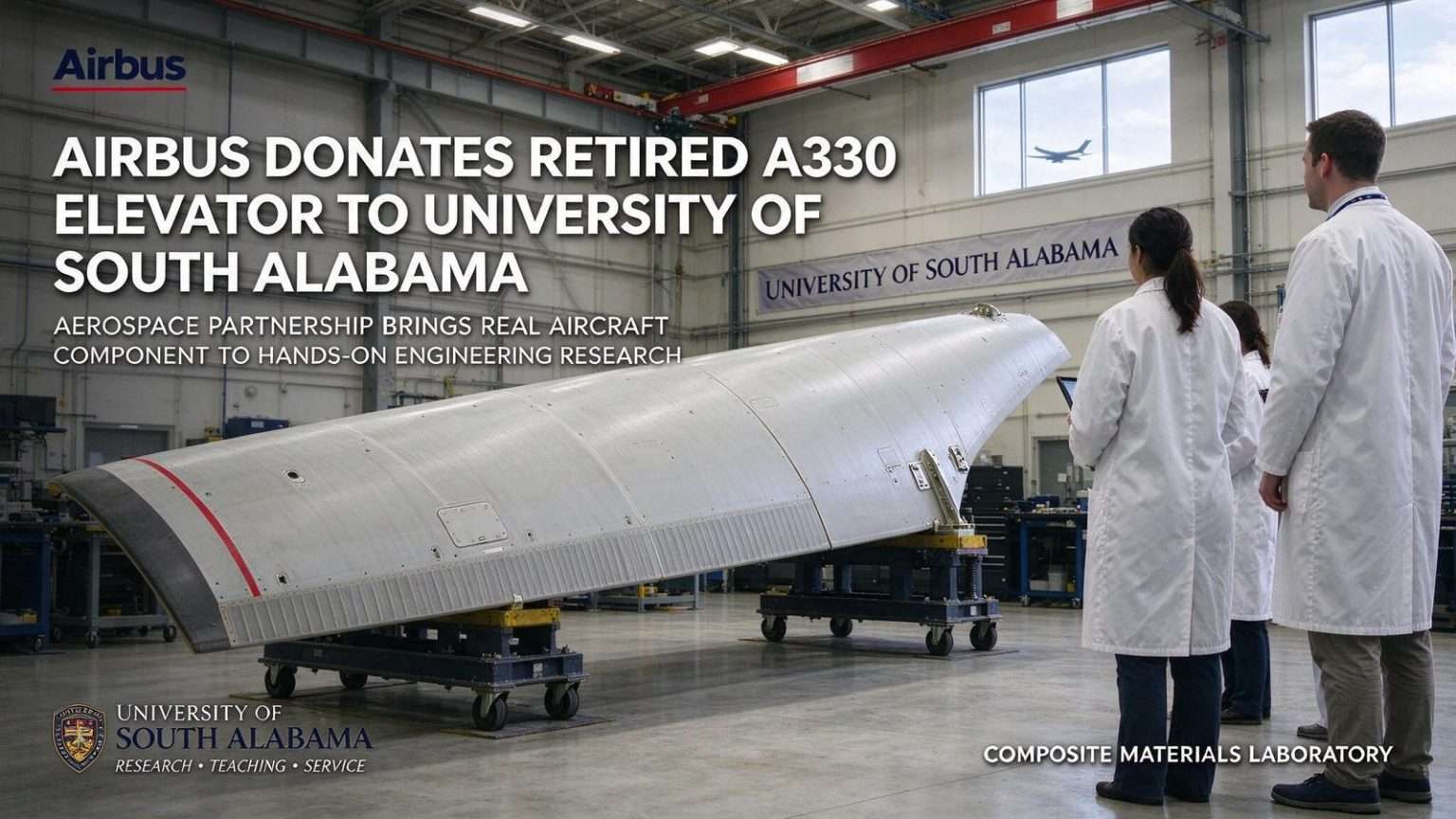
MOBILE, Ala. — The University of South Alabama has a new research tool worth roughly three-quarters of a million dollars, courtesy of Airbus, which donated a retired A330 elevator to the school for education and research purposes.
The part — a flight-control surface from the tail of the aircraft — measures about 28 feet long, weighs just over 200 pounds and is built from composite material. Despite its light weight, the elevator carries a repaired market value of approximately $750,000 and had logged 56,000 flight hours in service with a domestic commercial carrier before being retired and handed over to the university.
The donated elevator arrived on campus last week and was moved into the university’s Engineering Laboratory Building the following day, where researchers will put it to use studying composite materials — the same lightweight, high-strength materials used in modern aircraft hulls and increasingly in automobile manufacturing.
University researchers have spent years developing techniques to strengthen and improve carbon-fiber composites, work that has caught the attention of Airbus as the company builds out its footprint in the Mobile area. The donation reflects a deepening partnership between the university and the aerospace manufacturer, one that has grown steadily as Airbus has expanded its Gulf Coast operations.
That partnership was on display last month when a University of South Alabama delegation — joined by Mobile Mayor Sandy Stimpson and Dave Trent, site director for the Airbus Americas Mobile Engineering office — traveled to Airbus facilities in Toulouse, France, and Munich, Germany, to meet with company executives and tour manufacturing operations firsthand.
Following that trip, University of South Alabama President Tony G. Waldrop said Airbus executives expressed particular interest in two areas of the university’s research: cybersecurity and carbon-fiber composite development. The donated elevator gives researchers hands-on access to real aircraft components as they continue that composite materials work.
Barry Eccleston, president of Airbus Americas, said any partnership with education in Mobile amounts to an investment in the future of the aerospace industry. He pointed to the company’s Engineering Center in Mobile and the construction of its A320 Family Assembly Line as evidence that students who want to work in aerospace now have a local option to do so, and said the donated elevator is meant to give University of South Alabama students hands-on experience with the materials used in modern aircraft as they move closer to launching their careers.
Lynne Chronister, the university’s vice president for research and economic development, said extensive discussions between University of South Alabama faculty and administrators and Airbus Group engineers and leadership led to the donation, which she called a demonstration of the value of strong corporate-education partnerships. She said the university is excited about the overlap between Airbus Group’s vision and the expertise and technologies being developed on campus.
The elevator is expected to be especially useful to Dr. Kuang-Ting Hsiao, a University of South Alabama mechanical engineering professor whose research focuses on composite materials. Hsiao is developing a method of using nano-fibers to strengthen layered carbon-fiber composites, research that was the subject of a cover story just last month. Dr. John Steadman, dean of the university’s College of Engineering, said the large carbon-fiber composite part gives engineering students and faculty a unique resource for studying and testing a full-scale commercial version of the high-strength materials covered in their coursework and laboratory experiments, adding that watching the theory of composite materials become reality in the aircraft industry will give students a new perspective on their future careers.
For the university, the gift represents more than research equipment — it signals growing confidence from one of the world’s largest aerospace manufacturers in South Alabama’s engineering talent, at a time when Airbus continues to expand its manufacturing and engineering presence in the Mobile region.
Mobile is the county seat of Mobile County in southwest Alabama and the state’s only saltwater port. Situated where the Mobile River meets Mobile Bay near the northern Gulf of Mexico, the city has long served as a commercial and cultural gateway between Alabama and the wider Gulf Coast. Founded in 1702 as Fort Louis de la Louisiane and ruled in turn by France, Britain, and Spain before joining the United States in 1813, Mobile carries a layered heritage distinct from the rest of the state.
Today Mobile anchors a metropolitan area spanning Mobile County and neighboring Baldwin County, and it remains a center for shipping, aerospace, healthcare, and higher education in the region. Its downtown and waterfront have seen sustained revitalization, while historic neighborhoods preserve architecture from its colonial and antebellum past. The city’s identity is shaped as much by its working port and industrial base as by its festivals and food culture, making it a frequent focal point for news about growth and change in southern Alabama.
Alabama is a state in the southeastern United States bordered by Tennessee, Georgia, Florida, the Gulf of Mexico, and Mississippi. Often called the Heart of Dixie, it spans Appalachian foothills in the north and flat coastal plains in the south. Its largest cities include Birmingham, Montgomery, Huntsville, and Mobile.
Alabama’s history encompasses Indigenous roots, Spanish and French colonial settlement, a cotton-plantation economy, the Civil War and Reconstruction, and the Civil Rights Movement of the 1950s and 1960s, followed by a shift toward manufacturing, aerospace, and technology. Local news across the state frequently reflects this mix of tradition and change.
The Gulf of Mexico borders Alabama’s southern edge and defines much of the state’s coastal identity. Alabama’s Gulf coastline, centered on Dauphin Island, Gulf Shores, and Orange Beach, supports a tourism industry built around beaches, charter fishing, and marine recreation, while offshore waters host shipping lanes and energy interests.
The Gulf’s warm, shallow shelf and exposure to hurricanes make weather and disaster preparedness recurring concerns for communities from Mobile to Baldwin County. The marine environment also underpins commercial seafood harvests that have sustained Gulf Coast families for generations, tying the region’s economy and culture closely to the water.
Education in South Alabama spans public school systems in Mobile and Baldwin counties, a network of private and parochial schools, and institutions of higher learning including the University of South Alabama, Spring Hill College, and community colleges. Public-school governance rests with locally elected boards.
Boards oversee budgets, curricula, and facilities, often amid debates over funding equity and student achievement. The region’s colleges contribute not only to the workforce pipeline but also to healthcare, research, and cultural life, and education policy set in Montgomery frequently shapes what local districts can do.
Schools are also central to community stability. Enrollment trends, facility conditions, and graduation outcomes are watched closely by families and employers alike, making education a persistent focus of public attention and news coverage across the Gulf Coast.
Collegiate athletics are a major part of life in southern Alabama, where the University of South Alabama in Mobile fields the Jaguars across a range of sports. The university’s football program, which began competition in the 2000s, has become a rallying point for students, alumni, and residents and a source of regional pride.
Beyond the campus, youth, high-school, and recreational leagues across Mobile and Baldwin counties sustain a deep local sports culture, and tailgating and game-day traditions reflect the social fabric of the community. Coverage of local teams regularly intersects with broader themes of economic impact, community engagement, and the role of athletics in mid-sized Southern cities.
Sports also serve as a lens on community investment. Stadium construction, scheduling, and the success of local programs ripple into nearby businesses and neighborhoods, making them a recurring and widely followed subject in regional reporting.
Charitable and nonprofit organizations form a vital safety net across South Alabama, addressing needs from hunger and homelessness to disaster relief and holiday assistance. Groups such as The Salvation Army operate local corps that provide shelter, food, and seasonal programs funded largely by community donations.
The generosity of Gulf Coast residents, often mobilized after hurricanes and economic hardship, underscores how tightly knit many of these communities are. Local philanthropy also relies on volunteers and corporate partners, and the progress of fundraising efforts is a recurring subject of regional news because it reflects the community’s capacity to care for its most vulnerable members.
Holiday campaigns in particular reveal the scale of need and the reach of volunteer networks. The rhythm of annual giving, from food drives to toy distributions, is woven into the regional calendar and into the coverage that keeps residents informed about how to help and where support is most needed.
The economy of the Mobile region is diversified across shipping and logistics, aerospace and shipbuilding, healthcare, tourism, and manufacturing. The Port of Mobile is one of the nation’s busiest seaports and a cornerstone of the local and state economy.
Major employers in aviation and defense contribute to a skilled workforce, while economic-development organizations aim to attract investment and jobs through incentives and infrastructure improvements. Small businesses, from restaurants to professional services, form the backbone of neighborhood commerce.
The health of the regional economy is a frequent subject of public discussion and reporting. Workforce development, recruitment of industry, and the fortunes of local retailers all feed into a broader picture of how the Gulf Coast competes and adapts in a changing national economy.