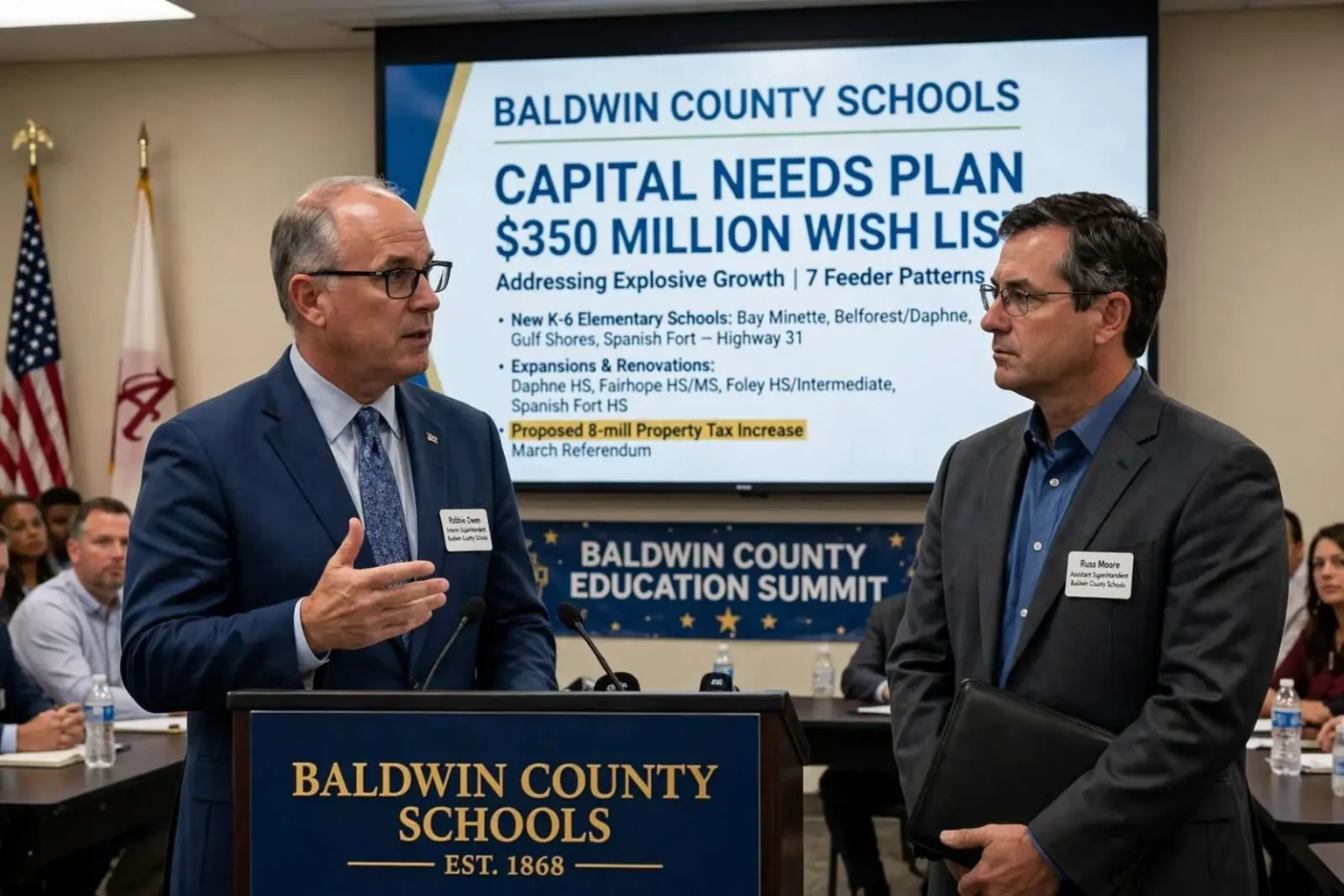
Baldwin County school leaders laid out an ambitious, long-term construction wish list this week, unveiling a $350 million capital needs plan meant to address crowding and rapid enrollment growth across the district’s seven feeder patterns. Interim Superintendent Robbie Owen presented the plan alongside Assistant Superintendent Russ Moore during the Baldwin County Education Summit, walking attendees through proposed projects community by community.
To pay for the sweeping list of upgrades, school officials are eyeing a proposed 8-mill property tax increase. The Baldwin County Board of Education passed a resolution asking the Baldwin County Commission to schedule a public referendum on the tax increase for late March, setting up a decision that would ultimately rest with voters.
The plan touches nearly every corner of the county. In Bay Minette, officials want to build a new K-6 elementary school within three years and add a 10-room classroom wing at Perdido Elementary. In Daphne, where crowding at Daphne East Elementary has become a persistent issue, the plan calls for a new K-6 school in the Belforest area along with an addition and upgrades at Daphne High School, which currently enrolls more than 1,200 students and could grow by as many as 1,700 over the next nine years.
In Fairhope, the plan proposes renovating the long-shuttered K-1 Center downtown, a project Owen said was a direct response to community wishes, drawing applause from the audience at the summit. Additional classroom space is also planned at Fairhope High and Fairhope Middle schools. Foley, home to the county’s largest and fastest-growing high school, could see enrollment climb from roughly 1,800 students to nearly 2,500 within nine years under district projections. The plan calls for property acquisition and an addition at Foley Intermediate, along with an expansion of Elberta Middle School into a full high school, a proposal that drew the loudest applause of the night.
Gulf Shores schools would get a new elementary school and additional classroom space at Orange Beach Elementary to accommodate seventh and eighth graders, addressing overcrowding severe enough that portable classrooms have begun eating into parking space at Gulf Shores Elementary. In Robertsdale, the plan proposes new classroom wings at Elsanor Elementary and Central Baldwin Middle School, plus renovations at Robertsdale High School, including a larger cafeteria, more athletic practice fields and additional parking.
Perhaps no area faces faster growth than Spanish Fort, where officials project a 71 percent enrollment increase, or roughly 1,465 additional students, over the next nine years. The district recently added 20 classrooms at Rockwell Elementary, but Moore said 43 more classrooms are still needed between Rockwell and Spanish Fort Elementary. The plan calls for a new elementary school on Highway 31, along with cafeteria expansion, added classrooms and a remodeled gym at Spanish Fort High School.
School officials said the scale of the plan reflects just how quickly Baldwin County’s population has grown in recent years, and warned that without significant new investment, crowding at several schools would only worsen. The March referendum will give voters the final say on whether to fund the sweeping construction program.
Baldwin County sits directly east of Mobile County across Mobile Bay and is the largest county in Alabama by land area. It encompasses the Eastern Shore communities of Daphne, Fairhope, Spanish Fort, and Foley and stretches south to the beaches of Gulf Shores and Orange Beach along the Gulf of Mexico.
Long among the fastest-growing counties in the state, Baldwin blends suburban development near the bay with tourism-driven coastal economies. Its proximity to Mobile and its position on the Eastern Shore make it a recurring subject of regional news covering growth, infrastructure, schools, and the balance between development and coastal preservation.
The Gulf of Mexico borders Alabama’s southern edge and defines much of the state’s coastal identity. Alabama’s Gulf coastline, centered on Dauphin Island, Gulf Shores, and Orange Beach, supports a tourism industry built around beaches, charter fishing, and marine recreation, while offshore waters host shipping lanes and energy interests.
The Gulf’s warm, shallow shelf and exposure to hurricanes make weather and disaster preparedness recurring concerns for communities from Mobile to Baldwin County. The marine environment also underpins commercial seafood harvests that have sustained Gulf Coast families for generations, tying the region’s economy and culture closely to the water.
Mobile is the county seat of Mobile County in southwest Alabama and the state’s only saltwater port. Situated where the Mobile River meets Mobile Bay near the northern Gulf of Mexico, the city has long served as a commercial and cultural gateway between Alabama and the wider Gulf Coast. Founded in 1702 as Fort Louis de la Louisiane and ruled in turn by France, Britain, and Spain before joining the United States in 1813, Mobile carries a layered heritage distinct from the rest of the state.
Today Mobile anchors a metropolitan area spanning Mobile County and neighboring Baldwin County, and it remains a center for shipping, aerospace, healthcare, and higher education in the region. Its downtown and waterfront have seen sustained revitalization, while historic neighborhoods preserve architecture from its colonial and antebellum past. The city’s identity is shaped as much by its working port and industrial base as by its festivals and food culture, making it a frequent focal point for news about growth and change in southern Alabama.
Education in South Alabama spans public school systems in Mobile and Baldwin counties, a network of private and parochial schools, and institutions of higher learning including the University of South Alabama, Spring Hill College, and community colleges. Public-school governance rests with locally elected boards.
Boards oversee budgets, curricula, and facilities, often amid debates over funding equity and student achievement. The region’s colleges contribute not only to the workforce pipeline but also to healthcare, research, and cultural life, and education policy set in Montgomery frequently shapes what local districts can do.
Schools are also central to community stability. Enrollment trends, facility conditions, and graduation outcomes are watched closely by families and employers alike, making education a persistent focus of public attention and news coverage across the Gulf Coast.
Local government in the Mobile area operates through a combination of mayor-council or commission structures at the municipal level and a county commission in Mobile County, with elected officials handling budgets, public safety, infrastructure, and zoning. Baldwin County has its own commission and a collection of incorporated municipalities.
Decisions made in council chambers and commission meetings affect roads, school funding, economic development, and quality of life, which is why coverage of local government is a staple of regional journalism. The interplay between city, county, and state authorities often determines how effectively the area can address shared challenges.
Because many services residents rely on are delivered at the local level, the choices of elected officials have direct, everyday consequences. Budget priorities, in particular, reveal a community’s values and shape the trajectory of growth and public welfare for years to come.
Collegiate athletics are a major part of life in southern Alabama, where the University of South Alabama in Mobile fields the Jaguars across a range of sports. The university’s football program, which began competition in the 2000s, has become a rallying point for students, alumni, and residents and a source of regional pride.
Beyond the campus, youth, high-school, and recreational leagues across Mobile and Baldwin counties sustain a deep local sports culture, and tailgating and game-day traditions reflect the social fabric of the community. Coverage of local teams regularly intersects with broader themes of economic impact, community engagement, and the role of athletics in mid-sized Southern cities.
Sports also serve as a lens on community investment. Stadium construction, scheduling, and the success of local programs ripple into nearby businesses and neighborhoods, making them a recurring and widely followed subject in regional reporting.
The natural environment is central to life on the Gulf Coast, where barrier islands, bays, rivers, and wetlands support fisheries, recreation, and storm protection. Coastal Alabama faces challenges common to low-lying regions, including hurricane exposure, erosion, and the management of fragile ecosystems.
The Mobile-Tensaw Delta, one of the largest river deltas in the country, is a particularly significant natural asset. Conservation efforts, fisheries regulation, and shoreline restoration are frequent points of collaboration among state agencies, federal bodies like the Army Corps of Engineers, and environmental groups.
How the region plans for growth while protecting its natural assets is a recurring theme in local reporting. The tension between development pressure and ecological stewardship plays out in zoning fights, infrastructure projects, and disaster-recovery decisions that shape the coast for generations.
The economy of the Mobile region is diversified across shipping and logistics, aerospace and shipbuilding, healthcare, tourism, and manufacturing. The Port of Mobile is one of the nation’s busiest seaports and a cornerstone of the local and state economy.
Major employers in aviation and defense contribute to a skilled workforce, while economic-development organizations aim to attract investment and jobs through incentives and infrastructure improvements. Small businesses, from restaurants to professional services, form the backbone of neighborhood commerce.
The health of the regional economy is a frequent subject of public discussion and reporting. Workforce development, recruitment of industry, and the fortunes of local retailers all feed into a broader picture of how the Gulf Coast competes and adapts in a changing national economy.