Baldwin County School Tax Vote Nears as Supporters Rally at Gulf Shores Elementary
Ahead of a critical property tax referendum, Baldwin County school supporters gathered at Gulf Shores Elementary to highlight overcrowded classrooms and portable buildings.
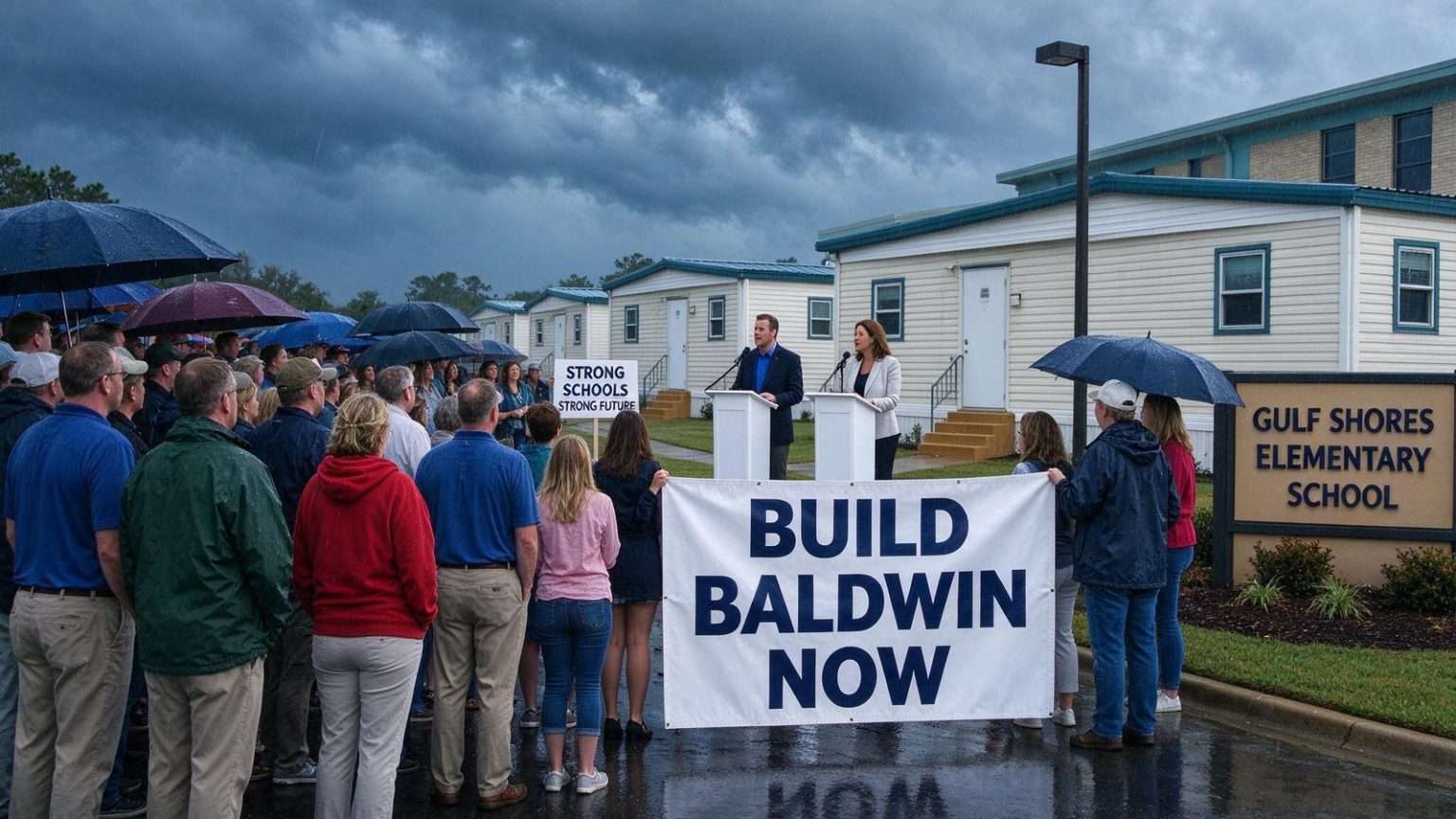
With a decisive school funding referendum just days away, supporters of a proposed property tax increase gathered outside Gulf Shores Elementary School to make their case, pointing to rows of portable classrooms as evidence of a system stretched thin by growth. The rally was the most visible moment of a campaign that had been building for months across Baldwin County, where school enrollment has climbed faster than classrooms could be built and where the referendum’s outcome would shape the county’s finances — and its schools — for a generation.
The “Cottages” and a system at its limits
The rally, organized by the “Build Baldwin Now” coalition alongside school administrators, took place on a stormy Thursday morning against the backdrop of five portable buildings nicknamed the “Cottages” outside the elementary school. The nickname had a friendly ring, but the point the organizers wanted to make was anything but: those buildings are not amenities, they are overflow — evidence that a school built for a coastal town of modest size is now educating far more students than its walls were designed to hold.
Organizers said the county currently relies on 100 portable classrooms scattered across its schools, and warned that number could grow by roughly 400 more if voters reject the referendum. The arithmetic behind those projections is Baldwin County’s growth itself: one of the fastest-growing counties in Alabama, fed by expansion along the Interstate 10 corridor, the eastern shore, and the beach communities, adding students every year to a district that already stretches from Bay Minette to Gulf Shores. Each new subdivision brings new children, and portables have been the system’s default answer when buildings cannot keep pace.
One student who joined the rally, a Foley High School junior aspiring to earn a doctorate in veterinary science, described attending classes inside a cramped trailer her classmates call the “Ag Shack.” She said the space holds 30 desks, makes it hard to see the board, and sometimes leaves latecomers sitting on the floor. Her testimony gave the rally its most concrete image — an honors-track student with professional ambitions learning science in a trailer — and speakers returned to it throughout the morning.
Administrators make the case room by room
Baldwin County School Superintendent Robbie Owen pushed back on the idea that portable classrooms are an adequate long-term solution, pointing to Elsanor, where roughly a third of the school operates out of portables, and Robertsdale, where cafeteria space is too small to seat all students indoors. In schools like those, the portability problem is not just classroom count; it is the strain on libraries, restrooms, lunch periods, and hallways that were sized for a different era. Owen, a veteran of Baldwin County education whose tenure has spanned the district’s transformation, argued that no district can staff its way out of a buildings problem — at some point, walls must be built.
The referendum before voters proposed a property tax increase dedicated to school construction, a mechanism Alabama counties have used for decades to fund capital improvements. Property taxes for schools are a perennially hard sell in a county where homeowners feel growth’s costs directly, which is why supporters chose to show the consequences in physical terms: portables lined up like the Cottages, a cafeteria with a waiting list for lunch tables, a high school science program in a shed.
An economic development argument
County commissioners at the event framed the issue as an economic development concern as well as an educational one. One commissioner argued that failing to invest in schools undermines the county’s ability to attract new industry, noting that auto manufacturing and aerospace companies evaluating the area routinely ask about school conditions. In Alabama’s modern recruitment playbook — the one that landed automotive plants and aerospace suppliers across the state — school quality is a site-selection factor that companies weigh alongside highways, utilities, and labor supply.
Another commissioner said the visible presence of portable classrooms during site visits has left prospective employers unimpressed. Industrial scouts touring a county with 100 portables draw conclusions about a community’s priorities without a word being spoken, the argument ran, and those conclusions cost the county jobs. For the business and political figures at the rally, the referendum was framed not as charity for schools but as infrastructure for the county’s economic future — as fundamental as a sewer line or an interchange.
Two rallies, two futures
A second rally supporting the referendum was held later the same day in Bay Minette, the county seat in the county’s northern end, where a new elementary school would be built if voters approve the tax increase. The twin venues — a beach community in the south, the county seat in the north — were chosen deliberately, underscoring that the portable problem and the promised construction reach every corner of a county that is 1,500 square miles of cities, farmland, pine forest, and shoreline.
Both sides of the debate were expected to make their final appeals in the days remaining before the vote. Opponents had raised the familiar objections to higher property taxes in a county of fixed incomes and growing tax bills; supporters had their answer standing outside Gulf Shores Elementary, rows of buildings meant to be temporary that had become anything but. When the ballots were counted, whichever way the vote fell, the portables would still be there — the question was how many more would follow, and when the county’s students would finally get permanent walls of their own.
Growth is the context for everything
Baldwin County’s enrollment story cannot be understood apart from its growth story. Stretching from the Mobile Bay ferries on the west to the Perdido River on the east, and from the beaches of the Gulf of Mexico to the pine uplands near the Monroe County line, Baldwin is geographically the largest county in Alabama and one of its fastest-growing by population. Cities like Daphne, Fairhope, Spanish Fort, Foley, and Gulf Shores have each absorbed waves of new residents — retirees drawn by the coast, families following industrial and medical jobs, and transplants relocating from colder states — and each new roof over each new house tends, sooner or later, to mean another student in a Baldwin County classroom.
School construction, however, moves at the speed of bonding capacity and public votes, while moving vans arrive daily. The portable classroom is the bridge between those two speeds, and Baldwin’s 100 portables represent the accumulated gap. Portable units cost less than permanent construction, can be installed in months, and can be moved between schools as enrollment shifts — but they cost more over time, deteriorate faster, and impose real educational costs: shared restrooms, staggered lunches, security challenges, and the daily walk through weather between a trailer and the main building.
What the tax increase would fund
If approved, the property tax increase would fund a construction program across the district, with projects identified in the communities where enrollment pressure is worst. The proposed new elementary school in Bay Minette, highlighted at the day’s second rally, answered the north county’s growth, while the portables at Gulf Shores Elementary and the conditions cited at Elsanor and Robertsdale spoke for the south and central county. District administrators have long maintained that the need is not concentrated in any one municipality, and the “Build Baldwin Now” branding was designed to reinforce that countywide framing — the tax asks every corner of the county to contribute, and every corner’s schools stand to gain.
Referendum campaigns of this kind in Alabama typically draw together coalitions that rarely share a podium: school administrators and business lobbyists, teachers’ organizations and county commissioners, parents’ groups and real estate agents who know that school quality is the first question homebuyers ask. The Gulf Shores rally displayed exactly that alignment, with education leaders supplying the details and elected officials supplying the economic argument — a division of labor intended to reach both the parents at the school gate and the taxpayers at the county courthouse.
The wider stakes for Baldwin
The referendum’s stakes reached beyond the schools into the county’s self-image. Baldwin County has spent two decades courting the kind of industrial investment that reshaped neighboring Mobile County’s economy, chasing aerospace suppliers, manufacturing plants, and the service businesses that follow them. Site-selection consultants and corporate evaluators consistently rank school quality among their top criteria, and in a competitive field of Southeastern counties, the difference between a school system showing portables and one showing new construction can be decisive.
There was also a fiscal argument embedded in the campaign: new schools built with voter-approved property tax money do not have to be funded out of the district’s operating budget, which pays teachers and keeps the lights on. Districts that cannot pass capital funding tend to divert operating dollars to portable leases and maintenance, crowding out instruction. Supporters argued the referendum was therefore not an add-on but a correction — a way to pay for buildings the way buildings are supposed to be paid for, instead of out of the classroom budget.
When voters went to the polls, they would be deciding between two futures that the rally’s imagery made vivid: a county where the “Cottages” multiply into hundreds more trailers scattered across 1,500 square miles, or one where new walls rise in Bay Minette, Gulf Shores, and every growing community in between. For the student from Foley High who described her Ag Shack to the crowd, the choice was not abstract at all — it was the difference between learning in a shed and earning the doctorate she had already promised herself.