Same-Sex Marriage Debate Spills Into Baldwin County School Tax Forum
Alabama's same-sex marriage fight unexpectedly surfaced during a Spanish Fort forum on Baldwin County's contested school property tax referendum.
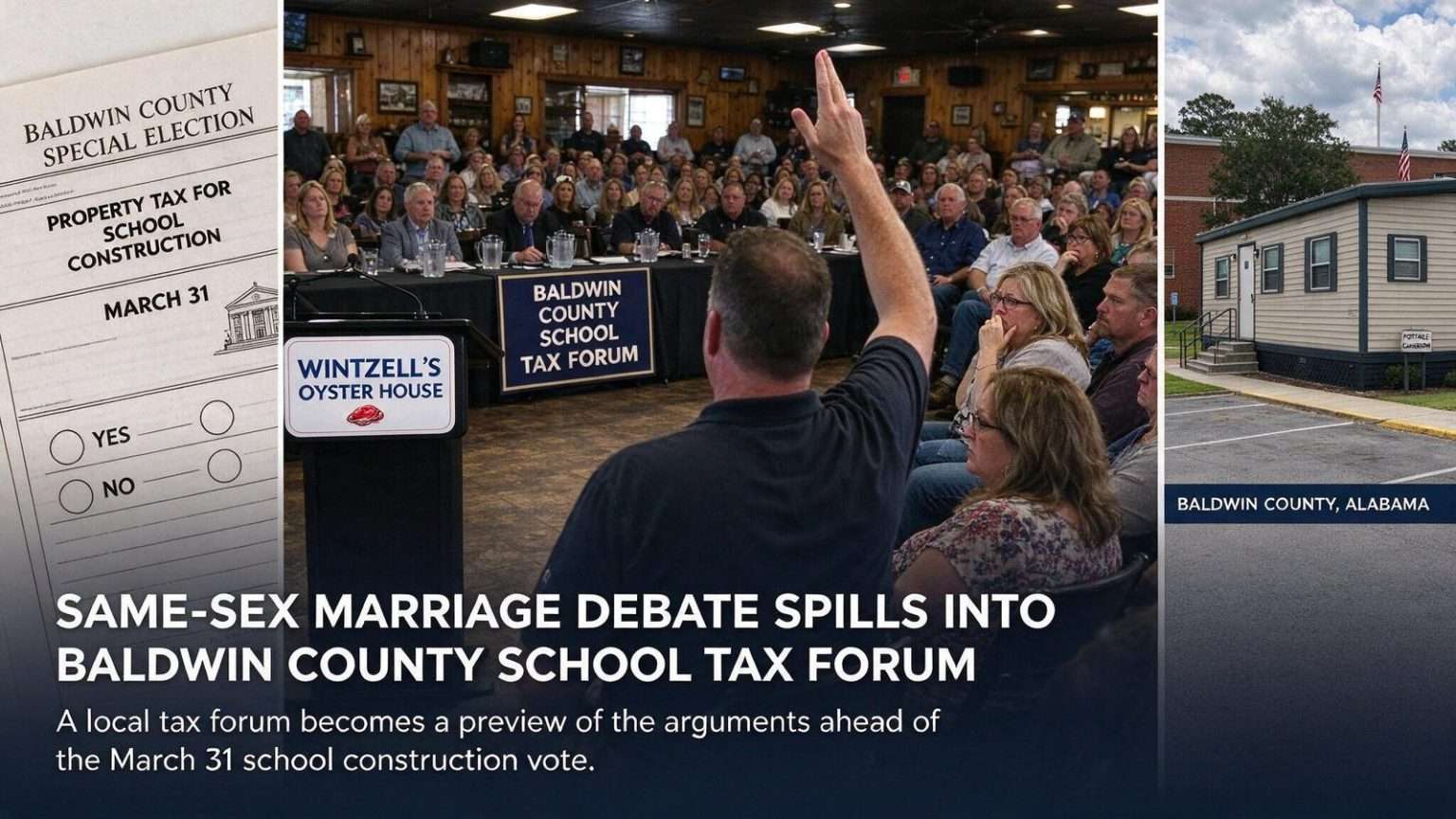
Alabama’s statewide fight over same-sex marriage found its way into an unrelated local debate this month, when a tax opponent linked the issue to a proposed Baldwin County school property tax during a public forum in Spanish Fort. The detour underscored how easily statewide political conflicts can bleed into local ballot questions when voters are already on edge about government and taxes.
The forum, held at Wintzell’s Oyster House and attended by roughly 100 residents, was intended to address arguments for and against an 8-mill property tax increase that would fund school construction across Baldwin County. Instead, the crowd got a preview of the full range of arguments — and objections — that the referendum would generate in the weeks before the vote.
John Howard, a private school teacher and vocal opponent of the tax, used part of his allotted time to warn that federal influence over public education could extend to social issues like same-sex marriage. “Let’s say the Supreme Court says gay marriage is fine,” Howard said, prompting audible groans from tax supporters affiliated with the Build Baldwin Now organization who felt the comment strayed from the topic at hand.
Howard later acknowledged he was unsure whether raising the issue was wise, but said he believed the state’s ongoing marriage litigation was relevant to a discussion about federal influence on local schools. His argument reflected a broader strain of thought among some tax opponents, who frame federal education funding as a vehicle for federal policy priorities reaching into local classrooms.
Jenni Dismukes, vice president of the Spanish Fort Education Enrichment Foundation and a mother of two Baldwin County students, pushed back on the comparison. “What does Alabama’s marriage dispute have to do with education right now?” she asked. “It has nothing to do with what’s going on with our schools.”
The statewide backdrop
The exchange came as Alabama’s probate judges found themselves caught between conflicting state and federal court orders over same-sex marriage licenses, a legal standoff that dominated statewide headlines throughout the winter. County courthouses across Alabama had become the front line of that dispute, with probate judges — the officials who issue marriage licenses — forced to navigate orders from federal courts, the Alabama Supreme Court, and the state’s chief justice that did not always align.
Against that backdrop, the Spanish Fort forum was supposed to be about mills and portables, not marriage. But the crowd’s groans and the back-and-forth between Howard and Dismukes showed how quickly a local tax debate could pick up the emotional charge of the statewide fight, and how determined supporters were to keep the focus on schools.
The marriage litigation had put local officials across Alabama in an uncomfortable position all winter. Probate judges in some counties began issuing licenses to same-sex couples after federal court rulings, while others held off citing conflicting state court instructions, leaving couples’ rights to depend largely on which county they lived in. The confusion made the issue a daily presence in local news, and Howard was not the first Alabamian to connect it to federal power in other arenas.
Beyond the detour into marriage politics, the forum focused on the substance of the March 31 special election, in which Baldwin County voters were asked to renew an existing 7-mill property tax and approve an additional 8 mills. Organizers said the combined measure was expected to generate roughly $350 million over ten years for a county-wide school construction program, addressing chronic overcrowding that has left many schools relying on portable classrooms.
Portables have become the visible symbol of the county’s growth problem. Baldwin County’s population has climbed for years, driven by the expansion of the Eastern Shore communities of Spanish Fort, Daphne, and Fairhope, the growth of the Foley and Gulf Shores corridor to the south, and new development spreading inland. New subdivisions arrive faster than new schools, and classroom units trail enrollment counts at campuses across the county.
The referendum capped weeks of public meetings across Baldwin County as both sides made their case ahead of the vote. Meetings in communities from Bay Minette to the beaches gave parents, teachers, and taxpayers a chance to press school officials on the spending plan, and the Spanish Fort gathering was among the most pointed of the exchanges.
Two organized sides
Opponents, including groups organized under the banner of Educate Baldwin Now, argued the proposed increase was too large and that the school system needed to live within its existing budget before asking voters for more money. Their argument leaned on skepticism of the school system’s planning and spending, and on the size of the combined request — a renewal and an increase presented together, in a single vote.
Supporters, including the Baldwin County School Board, said the funding was essential to keep pace with one of Alabama’s fastest-growing counties. They pointed to enrollment growth, aging buildings, and the cost of construction, arguing that every year of delay means more students in portable classrooms and higher construction prices down the road. Build Baldwin Now, the citizens’ organization backing the measure, organized support among parents and business leaders across the county.
The 8-mill increase would raise property taxes on homes and businesses countywide, and the renewal of the existing 7 mills would continue a tax that had been in place for years. Property taxes in Baldwin County, as in the rest of Alabama, are measured in mills — one-tenth of a cent per dollar of assessed value — and school millages are among the most common local tax questions on Alabama ballots.
Because Alabama relies heavily on local property taxes to fund school construction, counties with fast-growing enrollments but modest millages often face a recurring cycle: crowded classrooms, followed by a tax referendum, followed by another round of growth that starts the cycle again. Baldwin County’s combination of rapid in-migration and historically low property tax rates made that dynamic especially pronounced, and both sides of the March 31 vote built their arguments on it — supporters saying the county must finally build to match its growth, opponents saying the system should manage within what it already collects.
For parents like Dismukes, the case for the tax is concrete: children attending classes in portable buildings, schools over capacity, and a county whose tax base is growing fast enough to fund construction if voters approve it. The Spanish Fort Education Enrichment Foundation, which she helps lead, is one of several local education foundations that have formed across the county to supplement school funding, a sign of how much parents in fast-growing suburbs have invested in their neighborhood campuses.
For opponents like Howard, the case against is equally concrete: a tax increase is permanent money, and a school system asking for it should demonstrate restraint first. The fact that Howard sends his own children — or teaches — outside the public system sharpened the contrast, and his decision to bring federal education policy and the marriage litigation into the discussion drew exactly the reaction it got from the room.
What the vote means for the county
The March 31 election was set as a special election rather than a regular ballot appearance, meaning turnout would depend heavily on each side’s ability to get its voters to the polls. Special elections on tax measures tend to favor whichever side is better organized, which is why the weeks of forums and the dueling citizens’ groups mattered as much as the arguments themselves.
If the measure passed, construction could begin on a slate of projects across the county, with the school board responsible for allocating the revenue among campuses and growth corridors. If it failed, school officials warned that overcrowding would continue to worsen and that the system would have to return to voters eventually with another request — and higher construction costs.
Teachers and school employees watched the debate closely as well. Classroom space affects everything from class sizes to the schedules a school can offer, and administrators have said that portable-heavy campuses strain cafeterias, restrooms, and hallways as much as classrooms. The construction program on the ballot was pitched as a county-wide answer to those problems, with projects identified across the school district rather than concentrated in any single community.
The Spanish Fort forum did not resolve any of that. What it showed was a community divided not so much over whether its schools need help as over how much to pay, on what timeline, and under whose watch. And it showed, in Howard’s detour into the marriage debate, how a county-level tax question can become a proxy for bigger fights — a pattern Baldwin County voters would see more of before the special election arrived.
For the roughly 100 residents who came out on a weeknight to a Spanish Fort oyster house, the evening offered a preview of a campaign that was about to spread across the county — with portable classrooms, millage rates, and, at least once, the Supreme Court all part of the conversation.