GOP Primary Turnout Outdraws Democrats in Alabama for the First Time
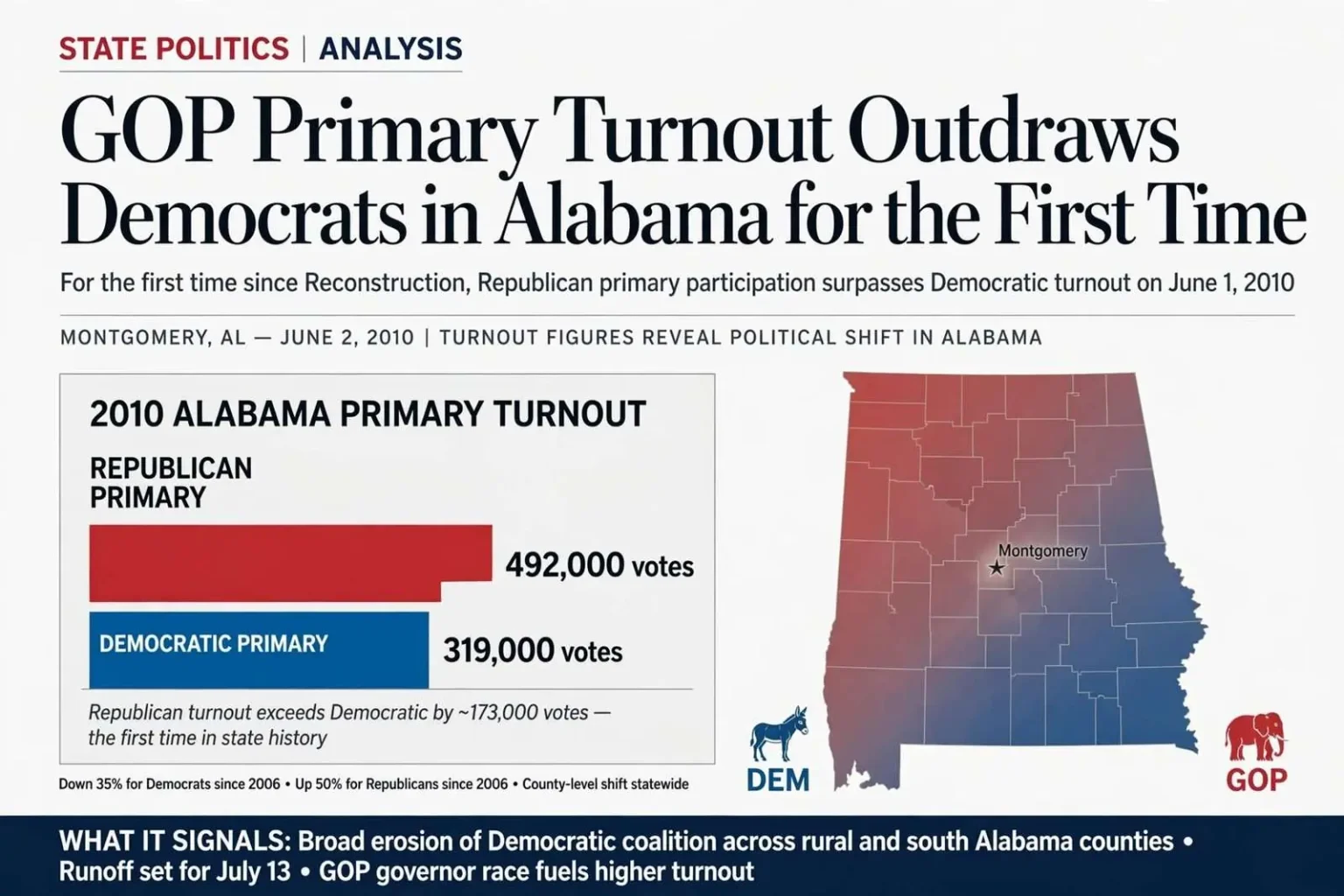
Nearly 492,000 Alabamians voted in the Republican primary against 319,000 in the Democratic primary, a reversal without precedent in a non-presidential year and a warning sign for the state's Democratic Party.
Alabama’s Democratic Party got the short-term result it wanted out of the June 1 primaries. The longer-term numbers underneath those results were another matter entirely.
The 2010 primaries arrived in a year when political gravity itself seemed to be shifting. Anti-incumbent sentiment was running high nationally, the economy was still struggling to shake off the recession, and across the South the old Democratic coalitions that had governed statehouses for a century were fraying. Alabama, with its Legislature still in Democratic hands — a hold unbroken since Reconstruction — was one of the last holdouts of that old order. What happened on primary day, and in the numbers filed away behind the results, offered a measure of how much longer it could hold.
The good news for Democrats
The party’s likely fall ticket — Ron Sparks for governor, Jim Folsom Jr. for lieutenant governor, and James Anderson, in a runoff with Giles Perkins, for attorney general — gave Democrats a credible slate and their best chance of holding their majorities in the state House and Senate.
Sparks’s upset of Artur Davis, whatever else it meant, produced a nominee with genuine appeal in rural and north Alabama, and one who had embraced a state lottery when no other candidate would touch the issue. Sparks, the two-term agriculture commissioner, built his campaign on that single big idea — a lottery whose proceeds he proposed to dedicate to education — and it carried him to a decisive win over Davis, the Birmingham congressman whose district spanned parts of north and central Alabama. For a party that needed to run well outside its urban strongholds, a nominee with rural roots was exactly the profile strategists wanted.
Folsom, a former governor and the son of Governor James E. Folsom Sr., carried one of the most recognizable names in Alabama politics into his re-election bid, and Anderson brought prosecutorial experience to the attorney general’s race. On paper, at least, the party had its slate.
The bad news, in raw numbers
Look past the names to the participation figures, and Democratic leaders had reason for real alarm. On June 1, roughly 319,000 Alabamians voted in the Democratic primary, compared with about 492,000 in the Republican primary.
Never before had the Republican primary in Alabama drawn even one voter more than the Democratic primary. For most of the state’s modern history, the relationship ran the other way — the Democratic primary was where Alabama’s elections were actually decided, and the Republican primary was a formality for a permanent minority party.
The trend line was as striking as the totals. “Statewide, the average Alabama county saw the percentage of voters who chose the Democratic primary decline by almost 35 percent between the 2006 and 2010 primary election,” one analyst who crunched the returns reported. “In that same time period, the average county in Alabama saw the percentage of voters who chose the Republican primary increase by nearly 50 percent.” The calculations were drawn from figures posted on a Democratic website.
Those averages pointed to something deeper than a single strong Republican race: a broad, county-by-county migration of Alabama’s electorate. The shift was not confined to the suburbs of Birmingham and Huntsville, where Republican growth was long expected. It showed up in rural counties, in the Black Belt’s white communities, and across south Alabama — places where Democratic primary ballots had been the default for generations.
What it might foretell
Some Republican consultants read the shift as the leading edge of the prize their party had chased for more than a century: control of both houses of the Alabama Legislature. Democrats had held the Legislature without interruption since Reconstruction.
Whether the primary participation gap was an anomaly or a watershed could not be settled in June. Primary turnout is a crude instrument — it measures which ballot voters chose to pick up, not how they will vote in November, and the Republican ballot that day carried a wide-open governor’s race while the Democratic ballot’s marquee contest was effectively decided early.
That structural difference mattered. A contested primary is the best turnout machine either party owns, and the GOP’s seven-candidate governor’s race — with its debates, its advertising and its score-settling — gave Republican voters a reason to show up that Democrats simply did not have. Some of the gap, in other words, was manufactured by the ballot itself. But the scale of the reversal was too large to be explained by one race alone, and the county-level trend from 2006 to 2010 showed the ground moving even where no hot contest was on the ballot.
Still, the magnitude of the reversal was hard to wave away, and it landed in a year when anti-incumbent sentiment was running high nationally.
The runoff on July 13
Voters had unfinished business. On the Republican ballot, the July 13 runoff was headlined by the governor’s race between Bradley Byrne and Robert Bentley, and included runoffs in Baldwin County for district attorney and for two county commission seats. The Democratic ballot carried a runoff for attorney general. Mobile County voters would also fill the vacant District 2 seat on the county commission in a special election held the same day.
Byrne and Bentley represented two very different faces of the party. Byrne, a former state senator and two-year college chancellor from Fairhope, had run as a reformer with an establishment resume, and he had led the first round of voting. Bentley, a retired physician and state representative from Tuscaloosa, had finished a distant second but carried a straightforward message — “sweet home Alabama” and a promise to bring jobs — that resonated across the state’s small towns. Their runoff would decide which of them faced Sparks in November, and turnout patterns in places like Baldwin County would tell observers a great deal about which way the party’s grassroots were leaning.
The Baldwin County local runoffs added their own draw. County commission and district attorney races rarely attract statewide attention, but in a county growing as fast as Baldwin, they decide who manages everything from zoning along the Highway 59 corridor to the prosecution of cases in the county’s crowded courts. Local races like these reliably bring out voters who might otherwise skip a runoff ballot.
Mobile County’s District 2 special election gave voters on the other side of Mobile Bay their own reason to turn out, filling a commission seat that represented part of the city of Mobile and its surrounding communities.
Register by July 2
Secretary of State Beth Chapman reminded Alabamians that the last day to register in order to vote in the July 13 runoff was July 2. Registration forms were available from her office.
The deadline mattered more than usual in a year with three statewide elections on the calendar — the June 1 primaries, the July 13 runoffs and the November general — because each step in the sequence required voters to be on the rolls in time. Chapman’s office, like county registrars across the state, processed registrations through the mail and through driver license and public assistance offices under the procedures in place at the time.
Under Alabama’s rules at the time, voters who participated in one party’s primary could not vote in the other party’s runoff, though voters who sat out the primary entirely were free to choose either ballot. That last provision was the source of considerable anxiety in Republican circles, given the open question of whether Democratic-leaning organizations would encourage their voters to weigh in on the GOP’s choice for governor.
The worry was easy to understand. Bentley had finished second in a crowded field, and an infusion of crossover voters — people who had skipped June and were free to pick any July ballot — could plausibly tip a close runoff. No one could say in advance how many of Alabama’s roughly 319,000 June Democratic primary voters had stayed home, or how many of them might decide the Republican governor’s race was worth a trip back to the polls.
The attorney general runoff on the Democratic ballot carried its own stakes for the party. James Anderson, a veteran prosecutor, and Giles Perkins were competing for the nomination, and a competitive statewide contest gave Democratic voters a second reason to return on July 13. Whoever won would carry the party’s banner into the fall against the survivor of the Republican side’s contest, in a race that would help decide who led the state’s top law enforcement office.
For Democratic leaders, the arithmetic pointed in an uncomfortable direction. Every voter who crossed over in July was a voter whose November ballot could not be assumed. And if the June participation gap — nearly half again as many Republican ballots as Democratic ones — was a preview of the fall electorate, the party’s Reconstruction-era hold on the Legislature would face its stiffest test in generations. The runoffs would be decided first, but the numbers behind them were already telling the larger story of where Alabama’s politics was headed.