Mobile Special Education Students Turn Recycled Mardi Gras Beads Into $50,000
Students at a west Mobile special-education school raised a record $50,000 this year sorting and reselling donated Mardi Gras beads.
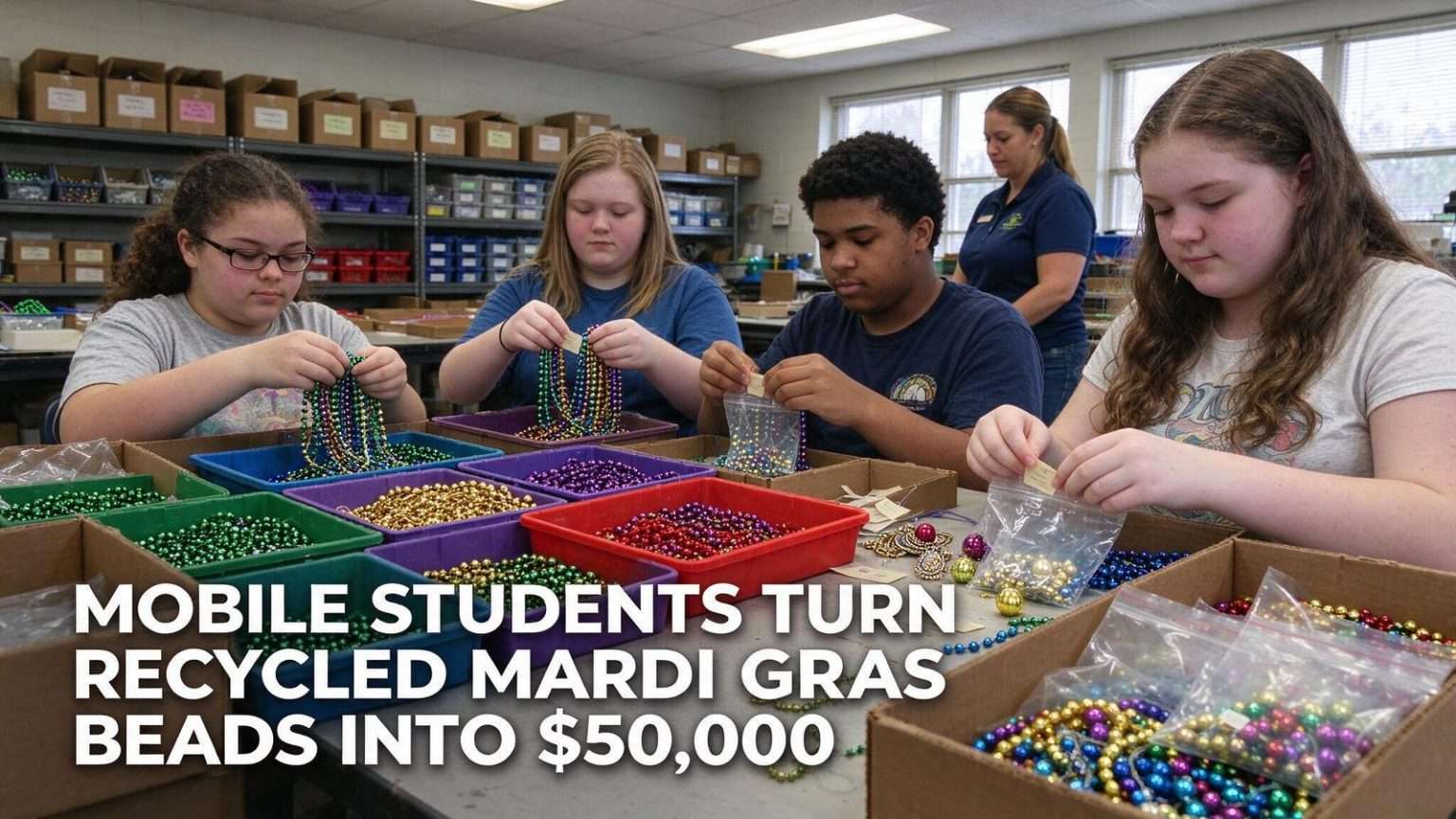
At Augusta Evans Special School in west Mobile, Carnival season never really ends. Each year, thousands of pounds of used Mardi Gras beads arrive at the school, where students spend part of their day transforming the discarded throws into tens of thousands of dollars for their education program.
The beads come through a long-running donation partnership in which area doughnut shops collect strands from Mardi Gras revelers and pass them along to Augusta Evans’ work-education program. For more than a decade, the program has generated hundreds of thousands of dollars as students sort, tag and bag the beads before selling them back to local Mardi Gras mystic societies ahead of the next parade season.
This year’s haul set a new record, according to the school’s employment training teacher, who said the program sold 3,000 cases of beads to roughly 300 customers and raised $50,000, the most in the program’s history.
How the bead economy works
The operation runs on the endless cycle of Mobile’s Carnival calendar. The city’s parades end each winter, the streets are swept, and the strands that gloriously cluttered the route for weeks are gathered up and dropped into collection bins at participating doughnut shops across the area. From there the beads make their way to Augusta Evans, where the real work begins.
Students receive the donations in whatever condition the streets left them: tangled, dusty, mixed by color and quality, sometimes arriving by the truckload. The first task is sorting, separating usable strands from broken ones and grouping the inventory by type. Standard throw beads, the plastic strands tossed by the millions each season, are sold by the case. Designer beads, heavier and more ornate, command a higher price. Large sugar beads, the biggest and most striking pieces, fetch the most per case.
Tagging and bagging follow, turning piles of donated strands into a product that a mystic society can order by the case with confidence about what it is buying. By the time the next parade season approaches, the school’s inventory is ready for its customers, roughly 300 of whom bought 3,000 cases this year alone.
A decade of steady growth
The program has now been running for more than a decade, and its cumulative totals tell the story of a genuinely durable enterprise: hundreds of thousands of dollars raised over the years, all from material that would otherwise be discarded. The $50,000 from this year’s record haul represents the high-water mark of a program that has grown steadily as Mobile’s mystic societies learned they could restock their throws while supporting a school.
The doughnut shop partnership has been central to that growth. By placing collection points at businesses that Carnival crowds already visit, the program made donating a strand or a bag of beads effortless, and the annual tradition has become part of the season’s routine for many families: catch the beads at the parade, drop them off for the students, and know they will be back on the route next year.
The recycling loop is a natural fit for the Gulf Coast’s signature celebration. Mardi Gras generates tons of plastic throws every winter, and Mobile, the home of America’s original Carnival celebration, now has a system that turns a portion of that material into educational funding rather than landfill.
Building real workplace skills
The money raised funds classroom technology and other curriculum needs for the school’s work-skills program, which serves students in their final years of high school, generally between 18 and 21 years old. Many of the students face intellectual and developmental challenges, including cerebral palsy, autism and Down syndrome, and the bead-sorting work is designed to build practical, transferable job skills.
Every stage of the operation maps onto a real workplace task. Sorting develops classification and quality control. Tagging requires fine motor work and attention to detail. Bagging and case counting involve arithmetic, inventory management and meeting a production standard. For students whose transition out of school will depend on demonstrating exactly these capabilities, the bead program functions as a working business embedded in the school day.
Throughout the year, students earn points for their work that can be redeemed for tokens, which in turn can be used for gift cards to area restaurants or activities during the school’s Club Fridays, including dance lessons and video games. The reward structure mirrors a paycheck in miniature: effort produces earnings, earnings buy choices, and the connection between the two is made concrete every week.
Staff say the structure mirrors a real workplace, teaching students how to clock in and out, follow workplace behavior expectations, and complete sorting and clerical tasks accurately. Students learn what an employer will later expect of them: showing up on time, staying on task, taking direction, and producing work that meets a standard set by a customer rather than by a teacher.
Those habits are what transition programs across the country work hardest to instill, and the bead operation gives Augusta Evans a way to teach them that is neither simulated nor abstract. The orders that arrive from mystic societies are real orders, and the students know it. A case that is miscounted or badly packed is a problem for an actual customer, which gives every task a seriousness that classroom exercises rarely achieve.
What the money buys
The $50,000 record translates directly into classroom impact. Technology purchases and curriculum materials that the work-skills program needs are funded from the bead sales, meaning that the value of each case sold returns to the same students who did the sorting, tagging and bagging. It is an unusually direct loop: the students’ labor generates the resources that equip their own education.
For a special education program, that independence matters. Programs like Augusta Evans’ serve students whose needs for specialized equipment and individualized instruction are expensive, and every dollar raised through the bead business is a dollar available for those purposes without waiting on another funding source.
The customers benefit as well. Mystic societies that buy from the school receive dependable inventory at fair prices, and many have come to see the purchase as part of their organizations’ community role. The relationship ties Mobile’s oldest cultural tradition to one of its most meaningful school programs, parade season to classroom season.
Beyond the dollars
Beyond the financial and educational benefits, students also gain something harder to quantify: recognition. When the community sees young people running a genuine enterprise, complete with customers, inventory and a six-figure decade of sales, the perception of what students with significant disabilities can accomplish shifts accordingly. Families in Mobile who might never have visited Augusta Evans learn about the program through the very beads they tossed and donated.
The students, meanwhile, can point to a product in the hands of thousands of parade-goers and know they made it possible. Beads that they sorted and packed circle the streets of Mobile each winter on floats and balconies, and the students who prepared them share in the season’s success in the most tangible way available.
As this year’s record confirms, the program has found a formula that works: a donated material stream, a willing customer base, a school full of workers eager to prove themselves, and a community that keeps dropping its beads in the bin. Carnival season in Mobile never really ends at Augusta Evans, and judging by the sales figures, nobody there wants it to.
Augusta Evans’ place in the city
Augusta Evans Special School has long served Mobile families as the district’s dedicated special education campus, drawing students from across the city rather than from a single neighborhood attendance zone. That citywide role shapes its character: the school’s community is built around shared needs rather than shared geography, and programs like the bead business give students from different parts of Mobile a common enterprise to rally around.
The school’s west Mobile campus houses the classrooms and work areas where the bead operation runs, with spaces set up for the sorting tables, tagging stations and storage that a functioning inventory business requires. During the school day, the work areas hum with the same organized activity that any small warehouse would recognize.
Transition programming for students aged 18 to 21 has become an increasing focus for special education nationally, as educators and families emphasize that graduation should lead somewhere: a job, continued training, or meaningful community participation. Augusta Evans’ work-education program is built squarely around that goal, and the bead business is its centerpiece.
The mystic societies as customers
Mobile’s mystic societies, the membership organizations that stage the city’s parades and balls, buy their throws by the case, and the quantities involved are enormous. Each society needs strands by the thousands for a single parade season, and the cost of stocking floats and balcony satchels adds up quickly. Augusta Evans’ catalog of sorted, case-counted beads offers those societies a reliable supply line, priced by type and ready on schedule before the season opens.
Buying from the school has become for many societies a point of pride as much as a purchase. The orders sustain a program that serves the community’s young people, and society members who toss beads along Government Street or in Bienville Square can reasonably claim that some of those strands passed through the hands of Augusta Evans students on their way to the float.
The roughly 300 customers who bought from the program this year represent a customer base that spans the city’s Carnival community, and the teachers who run the program treat those relationships like any vendor would, with attention to order accuracy, delivery timing and product quality. That professionalism is precisely the point: it is what the students are learning.
A model other communities notice
Programs like Augusta Evans’ bead business have drawn attention from educators elsewhere along the Gulf Coast, where Carnival celebrations from Biloxi to New Orleans generate the same streams of discarded throws. The Mobile model shows the pieces that make such an operation work: collection partnerships embedded in existing businesses, a school with transition-age students and staff expertise, and a customer base with an annual, predictable need.
Within Mobile itself, the program’s decade of operation has made it a fixture of the school year, with families, volunteers and community groups familiar with the bead cycle. The record year will likely encourage more donations and more orders, extending the momentum the employment training teacher described.
For the students, the lesson extends past any single sale. A business that has run for more than a decade, raised hundreds of thousands of dollars and just posted its best year ever is proof that their work has lasting value, and that the skills they are building in the sorting room are the same ones that carry adults through a career. That is the real product of the program, and at $50,000 and climbing, the beads are paying for it.