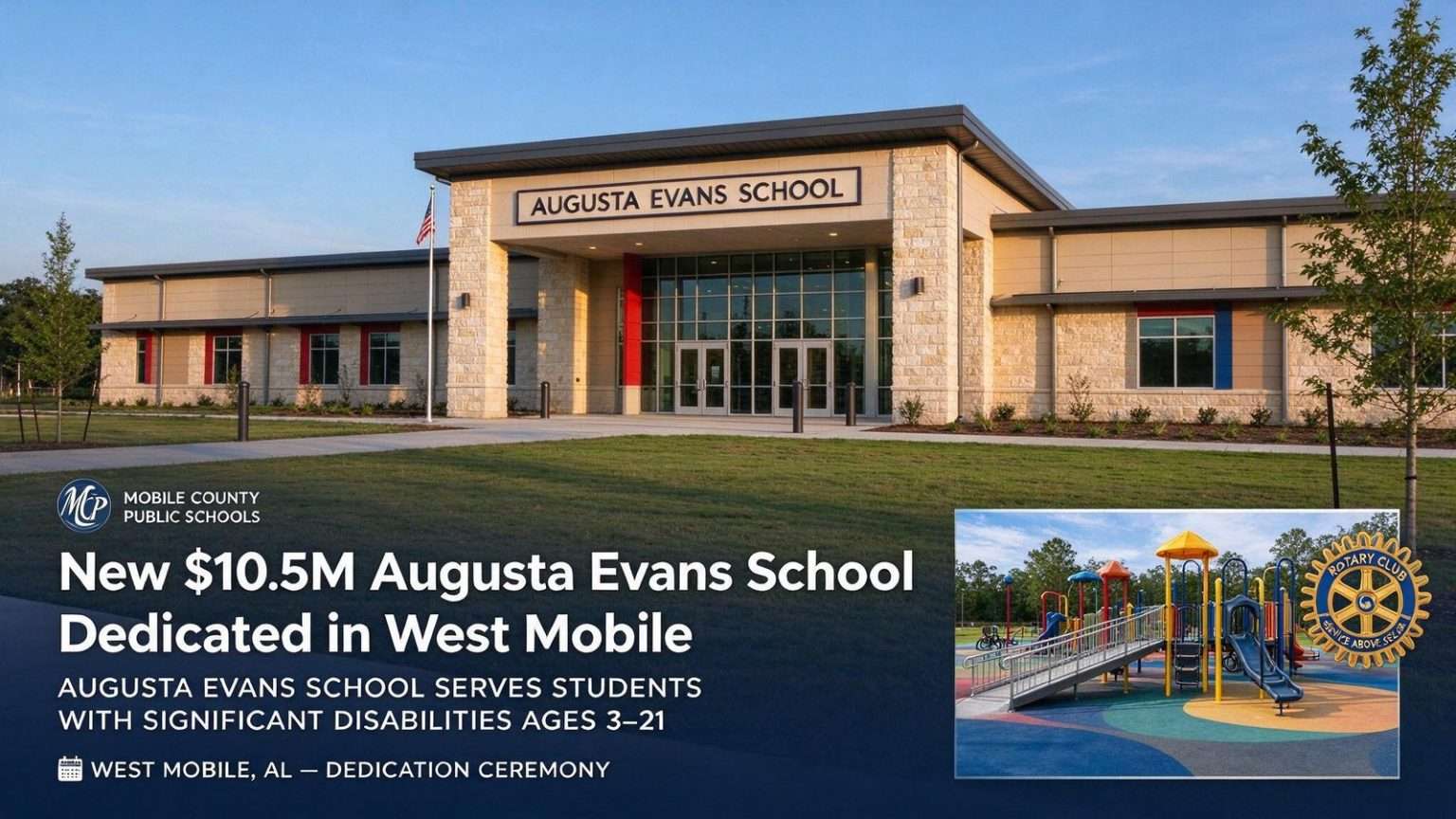
About 100 people gathered on a Sunday afternoon in west Mobile to celebrate the opening of a new school built specifically for students with special needs, marking the end of a years-long effort to replace an aging campus.
The new Augusta Evans School sits on the site of a former middle school that had been demolished several years earlier. The 10.5 million dollar facility replaces the school’s longtime home on Florida Street, which the campus outgrew after decades of use. Augusta Evans serves roughly 270 students between the ages of 3 and 21 who have significant disabilities.
Mobile County Public Schools Superintendent Martha Peek told the crowd that the campus has long been known for its upbeat atmosphere. “In this school, there is a lot of learning, a lot of joy, a lot of happiness, a lot of activities every day,” she said. “I always say Augusta Evans is the happiest school in Mobile County. This is a great day.”
The school board voted unanimously to fund the new building as part of a broader slate of construction projects across the district. Shelia Martin, the district’s director of special programs, said the wait was worth it. “It’s been a long time coming, but we are here,” she said.
The school takes its name from a 19th-century writer who nursed sick and wounded soldiers at Fort Morgan during the Civil War, and whose work later helped lead to the founding of Mobile Infirmary. School officials said the name reflects a legacy of care that fits the campus’s mission.
The new building was designed with the needs of its students in mind. Classrooms are larger than those at the old campus, and hallways were widened so students who use wheelchairs can move around more easily. The school also gained additional space for speech and physical therapy, along with dedicated rooms for activities unique to the program, including greenhouses, a sewing room and space where students sort Mardi Gras beads each year as part of an annual fundraiser.
Sensory rooms equipped with lights, sounds and different textures give students places to explore and decompress throughout the day, a feature staff say has made a noticeable difference since the move.
Community support played a major role in rounding out the new campus. Local backers, including the Rotary Club, raised more than 250,000 dollars to build a playground designed to accommodate children with disabilities, giving students an outdoor space tailored to their needs alongside the new classrooms.
District officials said the move from the old Florida Street building to the new west Mobile campus was completed over the summer, allowing students to start the school year in their new home. For families and staff who had waited years for a modern facility, Sunday’s dedication ceremony offered a formal close to that chapter and a celebration of what many called a long-overdue investment in some of the district’s most vulnerable students.
Mobile is the county seat of Mobile County in southwest Alabama and the state’s only saltwater port. Situated where the Mobile River meets Mobile Bay near the northern Gulf of Mexico, the city has long served as a commercial and cultural gateway between Alabama and the wider Gulf Coast. Founded in 1702 as Fort Louis de la Louisiane and ruled in turn by France, Britain, and Spain before joining the United States in 1813, Mobile carries a layered heritage distinct from the rest of the state.
Today Mobile anchors a metropolitan area spanning Mobile County and neighboring Baldwin County, and it remains a center for shipping, aerospace, healthcare, and higher education in the region. Its downtown and waterfront have seen sustained revitalization, while historic neighborhoods preserve architecture from its colonial and antebellum past. The city’s identity is shaped as much by its working port and industrial base as by its festivals and food culture, making it a frequent focal point for news about growth and change in southern Alabama.
Education in South Alabama spans public school systems in Mobile and Baldwin counties, a network of private and parochial schools, and institutions of higher learning including the University of South Alabama, Spring Hill College, and community colleges. Public-school governance rests with locally elected boards.
Boards oversee budgets, curricula, and facilities, often amid debates over funding equity and student achievement. The region’s colleges contribute not only to the workforce pipeline but also to healthcare, research, and cultural life, and education policy set in Montgomery frequently shapes what local districts can do.
Schools are also central to community stability. Enrollment trends, facility conditions, and graduation outcomes are watched closely by families and employers alike, making education a persistent focus of public attention and news coverage across the Gulf Coast.
Local government in the Mobile area operates through a combination of mayor-council or commission structures at the municipal level and a county commission in Mobile County, with elected officials handling budgets, public safety, infrastructure, and zoning. Baldwin County has its own commission and a collection of incorporated municipalities.
Decisions made in council chambers and commission meetings affect roads, school funding, economic development, and quality of life, which is why coverage of local government is a staple of regional journalism. The interplay between city, county, and state authorities often determines how effectively the area can address shared challenges.
Because many services residents rely on are delivered at the local level, the choices of elected officials have direct, everyday consequences. Budget priorities, in particular, reveal a community’s values and shape the trajectory of growth and public welfare for years to come.
Behavioral-health care on the Gulf Coast is provided by a mix of community mental-health organizations, hospital systems, and private practitioners. Community centers play an especially important role in serving patients who might otherwise lack access to care, often coordinating with courts, jails, and social services.
Demand for these services has grown alongside heightened public awareness of mental illness and the lasting effects of disasters such as hurricanes. Workforce shortages of psychiatrists and other clinicians are a persistent challenge nationwide, and they shape how providers allocate limited staff time between direct patient care and the administrative and legal obligations that accompany treatment.
The intersection of mental health and the justice system is a national concern as well as a local one. Communities across the country have debated how best to divert people in crisis away from jails and toward treatment, a conversation that informs how courts, clinicians, and advocates approach commitment hearings and related proceedings.
Mobile lays claim to a long tradition of outdoor festivals and public celebration, most famously its Carnival or Mardi Gras season, which predates the better-known celebrations of New Orleans. Throughout the year the region hosts music festivals, food and arts events, and waterfront gatherings that draw visitors from across the Gulf Coast.
Such events are economic and cultural anchors for the area, supporting hospitality, tourism, and local artists while fostering a sense of community identity. Organizing them involves coordination among city government, business sponsors, public-safety agencies, and volunteers, and they frequently appear in local news coverage of the region’s cultural life.
For many residents, these gatherings are also a point of civic pride and a way to mark the seasons. The mix of nationally known and local performers common to regional festivals reflects the area’s dual character as both a close-knit community and a stop on broader touring circuits.
Healthcare in the Mobile area is anchored by several hospital systems and provider networks that serve patients across southwest Alabama, the Gulf Coast, and into parts of Mississippi and Florida. Large employers in the sector include regional health systems operating hospitals, clinics, and specialty centers, alongside university-affiliated providers.
Access to care, the financial health of nonprofit hospitals, and the integration of behavioral and physical health are ongoing priorities. As in many parts of the country, local healthcare institutions navigate workforce shortages, changing reimbursement models, and the particular demands of serving both dense urban neighborhoods and far-flung rural communities.
The ties between healthcare and the local economy are strong. Hospitals are among the region’s largest employers, and decisions about service lines, expansion, or closure reverberate through surrounding neighborhoods, making health-system news a staple of regional journalism.
The economy of the Mobile region is diversified across shipping and logistics, aerospace and shipbuilding, healthcare, tourism, and manufacturing. The Port of Mobile is one of the nation’s busiest seaports and a cornerstone of the local and state economy.
Major employers in aviation and defense contribute to a skilled workforce, while economic-development organizations aim to attract investment and jobs through incentives and infrastructure improvements. Small businesses, from restaurants to professional services, form the backbone of neighborhood commerce.
The health of the regional economy is a frequent subject of public discussion and reporting. Workforce development, recruitment of industry, and the fortunes of local retailers all feed into a broader picture of how the Gulf Coast competes and adapts in a changing national economy.
The history of South Alabama is shaped by its position at the crossroads of cultures and waters. Indigenous peoples, including the Muscogee (Creek) and Choctaw, lived in the region for centuries before European colonization by French, British, and Spanish powers.