Mobile County Students Sell Discounted Tickets to Greater Gulf State Fair
Mobile County schools are again selling discounted Greater Gulf State Fair tickets, aiming to top last year's $30,000 in fundraising proceeds.
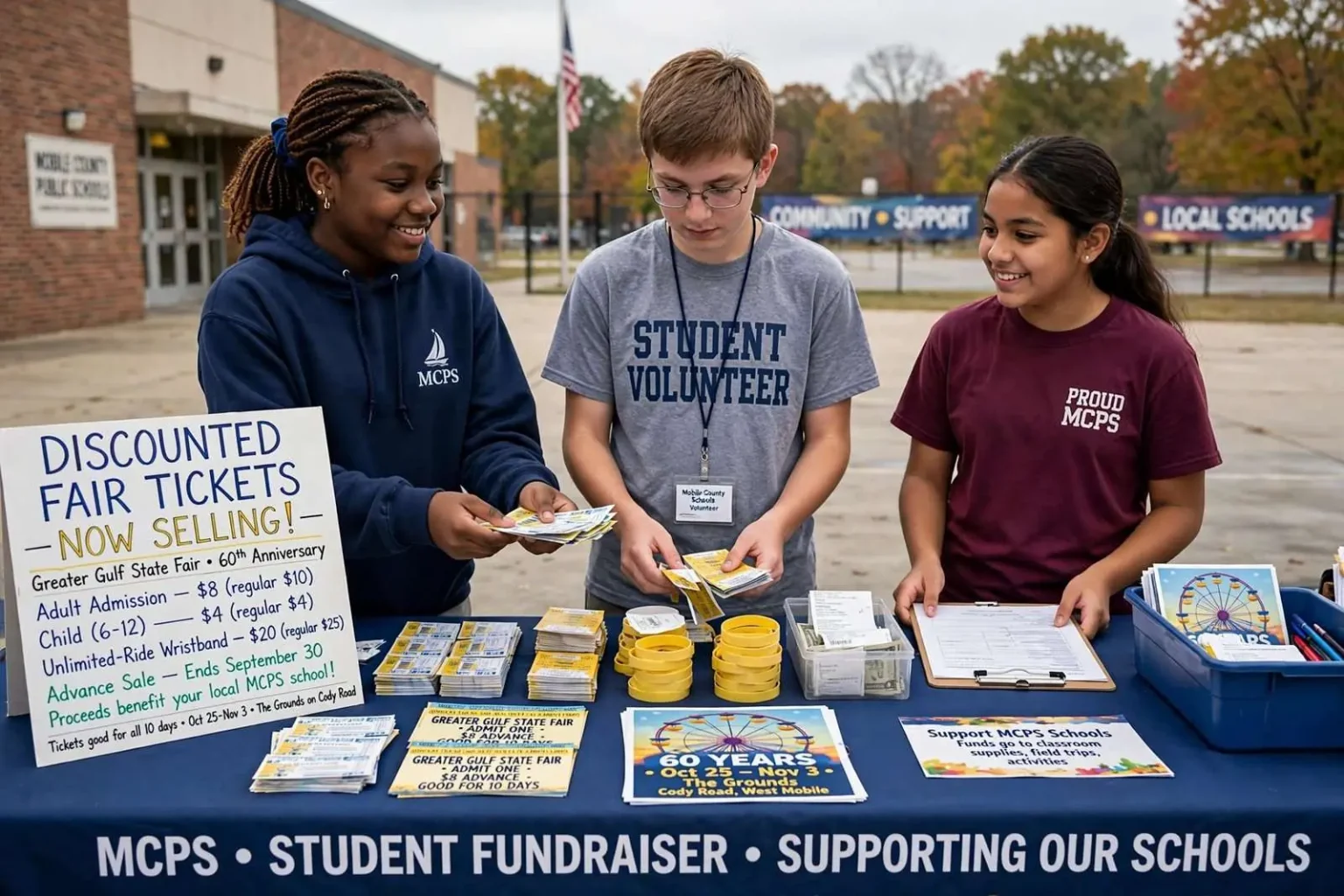
Families across Mobile County have a new reason to check in with the neighborhood school before heading to the fairgrounds this fall. For the second year running, students throughout the Mobile County Public School System are selling discounted admission and ride passes to the Greater Gulf State Fair, with a portion of every sale going directly back to the school where the ticket was purchased.
The pre-sale program, organized through The Grounds, the west Mobile venue formerly known as the Greater Gulf State Fairgrounds, lets any shopper, not just students or their parents, buy in. Advance adult admission runs $8 instead of the usual $10, while children’s tickets drop to $4. Unlimited-ride wristbands, good for any of the fair’s ten days, are priced at $20 rather than $25.
The discounts add up for a family of four. Buying two adult and two children’s admissions in advance saves $8, and pairing them with two wristbands saves another $10, a combined $18 off the gate price. For households watching their budgets, the pre-sale window effectively stretches a fair night further, and the savings flow in both directions: every discounted ticket sold through a school sends a cut back to that school’s own budget.
A Fundraiser That Grew Fast
Organizers with The Grounds say the discounted wristbands were especially popular during last year’s inaugural run of the fundraiser, with roughly nine out of every ten fairgoers opting for the unlimited-ride option instead of buying tickets ride by ride. That preference tells organizers something about how families plan a fair visit: most would rather pay once and ride freely than ration tickets through the evening, particularly with children who want to repeat their favorite rides.
That first year of ticket sales generated about $30,000 for participating schools, and organizers are hoping this year’s campaign, which wraps up at the end of September, can push that total as high as $100,000. The jump is ambitious — more than tripling last year’s total — but the second year of any school fundraiser typically benefits from momentum, as teachers and parents who saw the first-year results work harder to spread the word and neighboring schools join in.
Money raised this way lands in school accounts without strings attached to state funding formulas or federal programs, which is part of its appeal. Principals and parent organizations can direct it toward needs the regular budget covers thinly, from classroom supplies to field trip transportation. In a district as large as Mobile County’s, even modest per-school amounts compound quickly across dozens of campuses.
The Mobile County Public School System is one of the largest districts in Alabama, spanning urban schools in the city, suburban campuses in west Mobile and rural schools stretching toward the county’s northern reaches. A fundraiser that works across that entire footprint reaches families with very different budgets, and the discount structure is designed with that in mind — the reduced prices make a fair night affordable to households that might skip it at gate rates, while the school rebate turns participation into direct support for each campus. Few school fundraisers manage to serve all three goals at once: community value, family savings and school revenue.
Rewards Beyond the Ticket Booth
Beyond the discount sales, The Grounds continues to run an incentive program with the school system that rewards strong classroom performance. Students who post good grades and attendance records at the end of each grading period can earn free admission to the fair, a perk that went to roughly 6,500 Mobile County students last year alone.
The incentive angle matters to educators because attendance and grades dip for predictable reasons, and a tangible reward timed to grading periods gives families one more reason to stay on track. For many students, the fair ticket is a prize that costs the school nothing but coordination, and it reaches thousands of children who might otherwise never walk through the fairgrounds gate. Programs like this one have become a staple of fair operations nationwide, as fair boards look for ways to tie their events to the school calendar and to the communities that support them.
Sixty Years on Cody Road
This year’s fair, marking its 60th anniversary, is scheduled to run from late October through the first days of November at The Grounds on Cody Road in west Mobile. Six decades makes the Greater Gulf State Fair one of the oldest continuous fall traditions in the region, older than many of the subdivisions that now surround the fairgrounds. The venue’s rebranding as The Grounds reflected a broader shift in how the property operates year-round, hosting festivals, concerts and community events well beyond the fair’s ten-day run.
For schools, the timing of the sale gives them several weeks to spread the word to families before the fair’s midway lights up for the season. Selling in September builds anticipation for an event still weeks away, and it lets schools close out the fundraiser cleanly before the holiday-season fundraising push begins in earnest. Late October fair dates also position the event after the worst of the Gulf Coast’s lingering summer heat, making evening visits more comfortable for families with young children.
The fair’s anniversary year adds a hook for marketing and for community memory. Longtime Mobile-area residents often measure the fall by the fair’s arrival, and a 60th-anniversary run gives schools an easy story to tell when pitching tickets: this is not just a fundraiser but a local institution marking a milestone.
Why Schools Lean On Fundraisers
For an event that’s become a fixture of the fall calendar in the Mobile area, the fundraiser offers a rare two-way benefit: families save a few dollars on a night out, and local classrooms pick up extra funding that doesn’t come out of the county’s regular budget. School staff say the tickets are available directly through classroom sales, making it easy for community members to support a specific school simply by asking around before their next trip to the fairgrounds.
That last point widens the program beyond school families. Grandparents, neighbors and coworkers can buy discounted tickets from any participating student, which means the program turns the whole community into a potential customer base for each school. A workplace full of parents from different campuses can spread its ticket purchases across several schools, and every purchase still earns the buyer the discount. Organizers’ hope of reaching $100,000 depends on exactly that word-of-mouth reach, one classroom and one neighborhood at a time.
Planning a Visit
Families aiming to take advantage of the pre-sale prices should buy before the campaign closes at the end of September, since gate prices return once the fair opens in late October. The unlimited-ride wristband remains the strongest value for anyone planning more than a few rides, and because it is honored any of the fair’s ten days, families can choose the evening that best fits their schedule rather than committing to a single date in advance.
Weather rarely poses a problem for the fair’s late-October run, though Gulf Coast residents know that fall fronts can bring a rainy evening or two. The fair’s ten-day span gives families flexibility to pick around any bad night, and weekday visits typically mean shorter ride lines than the popular Friday and Saturday sessions. Parents of young children often favor the earlier evening hours, when crowds are lighter and the midway is easier to navigate with strollers.
Buying through a school also removes the need to stand in the ticket line at the gate, a small but real convenience during the fair’s busiest evenings. Parents coordinating with other families often buy together, and schools typically send order forms home in backpacks as well as promoting sales through email and social media.
The Greater Gulf State Fair’s mix of midway rides, livestock exhibits, food vendors and concerts has long made it a draw across the central Gulf Coast, pulling visitors from Baldwin County and Mississippi as well as Mobile. Its partnership with the county school system has deepened that reach, embedding the fair in classrooms months before the gates open. Sixty years in, the event has managed something rare: staying current with school-age generations while holding onto the fall tradition their parents and grandparents remember.
For now, the ball is with the schools. The sales window runs through the end of September, and whether the campaign reaches its $100,000 goal will depend on how many families take the simple step of buying their fair tickets from a student instead of at the gate. Either way, the partnership has already proven its model once, and the second year gives it a chance to become a fixture in its own right — as much a part of the local fall calendar as the fair itself.