Mobile County Students Showcase Academic Gains at Legislative Meeting
Mobile County students highlighted rising graduation rates and signature academy programs at the school system's annual legislative delegation meeting.
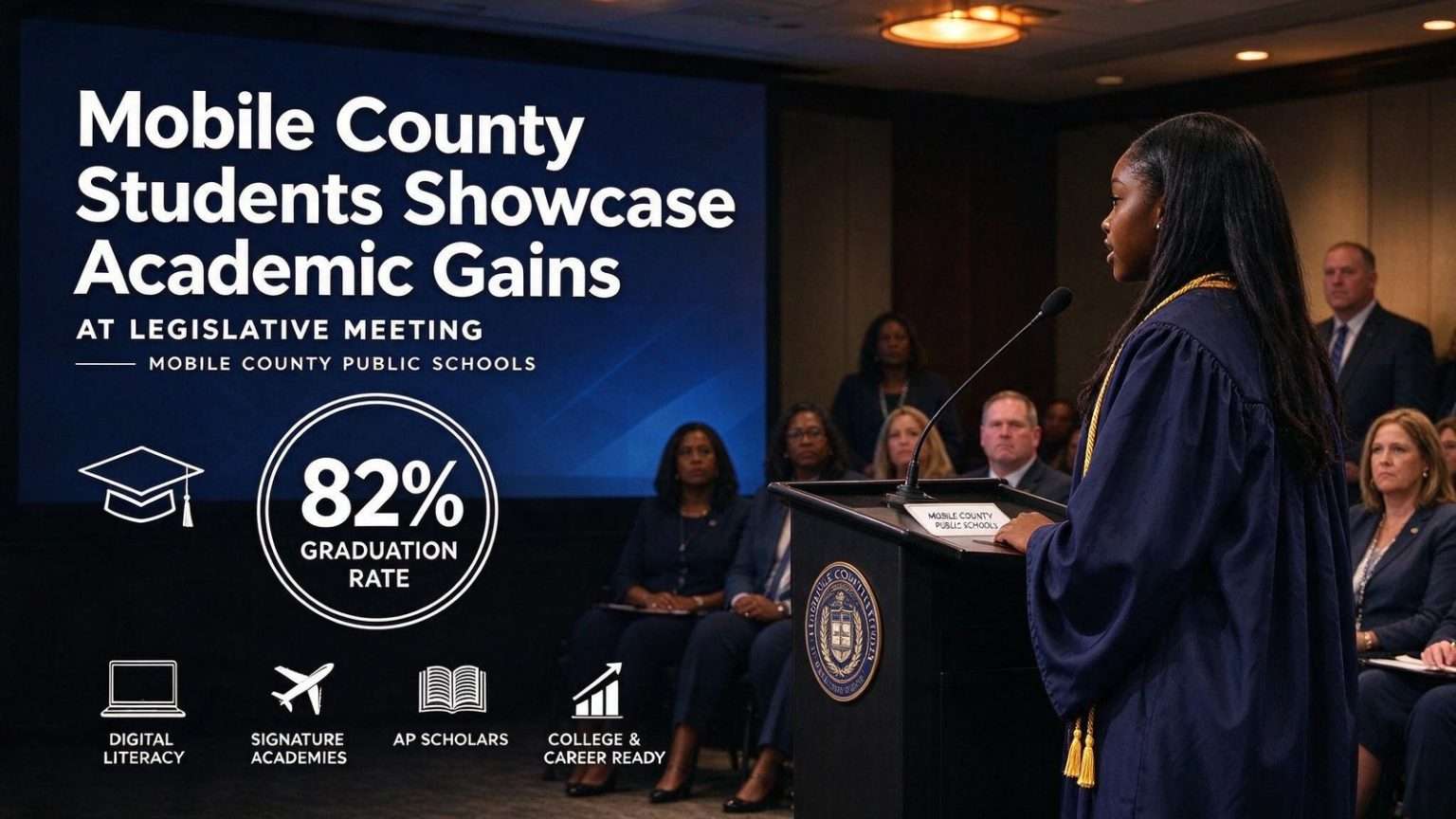
Mobile County Public Schools used its annual legislative delegation meeting this month to spotlight a rising graduation rate and a wave of student success stories, giving lawmakers a firsthand look at programs the district credits with driving academic gains. The headline announcement was the district’s graduation rate climbing to 82 percent, a figure school officials framed as evidence that recent investments in classroom technology and career-focused academies are paying off.
But much of the meeting’s impact came from students themselves, who took turns at the microphone describing how specific programs shaped their education. One elementary student described how her school, one of 16 in the district’s “digital literacy” network, has shifted toward all-electronic class projects displayed on interactive Smartboards, with students reading chapter books on tablets rather than traditional textbooks. She said the approach makes learning more engaging for students and teachers alike.
A high school senior earned applause for sharing that she had already banked 24 college credits through Advanced Placement coursework, having earned AP Scholar of Distinction honors with an exam average of 3.5. She said she plans to study chemical engineering at Auburn University in the fall.
Signature Academies Open to Every High Schooler
Other students spoke about the district’s growing network of career-themed “signature academies,” which allow any Mobile County high schooler to enroll regardless of where they live. One senior described how a school’s aviation and aerospace academy, now in its second year, introduced him to a field he previously knew little about and pointed him toward a planned aerospace engineering degree at Tuskegee University.
Beyond the aviation program, the district’s signature academy offerings span a wide range of career paths, including health careers, coastal studies, manufacturing and industrial technology, teaching, international studies, engineering and maritime entrepreneurship, spread across campuses throughout Mobile County. The open-enrollment model means a student zoned for one high school can attend another for specialized programming, giving families across the county — not just those in specific attendance zones — access to career pathways that would otherwise require private tuition or relocation.
For Mobile County, the largest school system in Alabama, the academies represent a deliberate response to the changing demands of the regional economy. The Gulf Coast job market increasingly rewards technical credentials alongside traditional degrees: shipbuilding and aerospace suppliers, healthcare networks, petrochemical operations, and the growing maritime and coastal science sectors along Mobile Bay all hire from pipelines that begin in high school career-technical programs. District leaders have argued that aligning classroom offerings with those industries keeps graduates in the region with marketable skills rather than leaving them to discover those careers only after an expensive detour.
Digital Literacy and Classroom Technology
The digital literacy network highlighted by the elementary student reflects another strand of the district’s strategy: weaving technology into instruction from the earliest grades rather than treating it as a high school add-on. Schools in the network replaced much of their paper-based work with electronic projects, tablets for reading and interactive Smartboards in classrooms, an approach officials say changes both engagement and the pace at which teachers can adjust to individual student needs.
The district’s pitch to legislators carried a practical purpose beyond celebration. Annual delegation meetings give the Mobile County legislative delegation — the state senators and representatives who represent the county in Montgomery — a direct look at how prior investments in schools translate into results, and they set the stage for budget priorities in upcoming legislative sessions. Lawmakers who vote on Alabama’s education trust fund appropriations heard the district’s case from the students themselves rather than from administrators’ slide decks, which district officials clearly counted as the meeting’s most persuasive element.
What an 82 Percent Graduation Rate Represents
Graduation rates are among the most closely watched indicators in public education, and the climb to 82 percent places Mobile County among the systems demonstrating sustained improvement across Alabama’s large districts. The figure counts students who finish high school within four years of entering ninth grade, and movement of even a few points in a district the size of Mobile County — which educates tens of thousands of students across more than 90 schools — represents hundreds of additional graduates each year.
Administrators attribute the trajectory to a combination of factors: the academies that give students a reason to stay engaged, earlier intervention systems that flag students falling behind in credit accumulation, and technology investments that personalize instruction. Research on dropout prevention consistently shows that students who disconnect from school rarely do so in their senior year; the warning signs appear in ninth grade, and districts that intervene early with credit recovery, mentoring and career-connected learning see the results in their graduation statistics several years later.
The 24 college credits accumulated by the senior bound for Auburn’s chemical engineering program illustrate another dimension of the district’s strategy: Advanced Placement coursework that lets students enter college with a running start. Earning AP Scholar of Distinction honors — awarded to students who score 3 or higher on multiple AP exams with a 3.5 average across them — translates directly into tuition savings and shortens the path to a degree. For a student planning a demanding engineering curriculum, arriving at Auburn with nearly two semesters of credit already banked changes the arithmetic of both cost and course load.
From the Classroom to the Regional Economy
The aviation academy student’s path toward Tuskegee University carries its own significance. Tuskegee, in east Alabama, remains one of the nation’s leading producers of Black engineers and the home of the legacy of the Tuskegee Airmen, and its aerospace engineering program draws students from across the Southeast. That a Mobile County public high school academy put a student on that path within two years of launching speaks to the model the district is pursuing: put specialized programs within reach of every student, and let interest rather than geography determine who benefits.
The health careers, coastal studies and maritime strands of the academy network map closely onto the Gulf Coast’s largest employers. Mobile’s hospital systems and the university’s health sciences programs draw heavily on local talent for nursing and allied health fields, the estuarine ecology of Mobile Bay and the northern Gulf has made coastal sciences a genuine career field rather than an academic niche, and the shipbuilding and port operations that anchor the area’s industrial base require exactly the manufacturing and industrial technology training the academies provide. District officials have described the academies as a way of keeping the county’s own graduates in the county’s own workforce.
The Legislative Ask
While the meeting celebrated results, it also served as a reminder to Montgomery that the programs on display depend on continued funding: technology refresh cycles for tablets and Smartboards, equipment for aviation and manufacturing labs, and the staffing that makes open-enrollment academies function across a county-wide bus system. District leaders have consistently framed their delegation meetings around the same argument that animated this one — that the investments are visible, the results are measurable, and the students standing at the microphone are the evidence.
The graduation rate, the AP scholars and the academy students each made the same case from different angles: Mobile County Public Schools has moved from talking about improvement to showing it, and the district intends for the state’s lawmakers to remember that when education budgets come up for a vote in the session ahead.
How the Academy Model Works Day to Day
Signature academies function as schools-within-schools in most cases, with students taking their core academics alongside cohorts who share a career interest and weaving academy-specific coursework into their schedules. In the aviation and aerospace strand, that means exposure to the fundamentals of flight, aircraft systems and the mathematics behind both; in health careers, certification-track coursework that can lead to credentials employers recognize before graduation; in manufacturing and industrial technology, hands-on lab time with the equipment regional industry actually uses. The district’s partnerships with area colleges and employers allow some academy students to earn dual-enrollment credit or industry certifications, so that a diploma arrives alongside a head start on either a degree or a paycheck.
The open-enrollment design solves a problem that has limited career-technical education elsewhere: the tendency for specialized programs to exist only in schools whose attendance zones happen to have the facilities or the funding. By letting any county high schooler apply regardless of residence, Mobile County turns its specialized programs into countywide assets and gives schools an incentive to build distinctive strengths rather than duplicating the same menu everywhere. Transportation and scheduling remain the practical hurdles, but district officials have pointed to enrollment across the academy network as evidence that families will take advantage of the option when it exists.
The digital literacy schools operate on a parallel principle at the elementary level. Students accustomed from the early grades to electronic projects, tablet-based reading and interactive displays arrive in high school fluent in the tools that AP coursework and academy labs assume. District administrators have described the 16-school network as a proving ground for practices that can scale district-wide, with teachers in the network sharing what works across campuses. The elementary student who addressed the delegation described a classroom where projects live on Smartboards rather than poster board and where chapter books are read on tablets — small changes, but ones that shape how a generation of Mobile County students thinks about school.
Looking Toward the Next Session
The delegation meeting closed with the district’s message on the record: an 82 percent graduation rate and climbing, AP scholars entering Auburn with nearly two years of credit, and academy students heading toward aerospace engineering and health careers. The programs that produced those outcomes — technology in classrooms, specialized academies open to all, early intervention for struggling students — carry recurring costs that depend on state funding decisions. Mobile County’s lawmakers left the meeting with the evidence in hand, delivered by the students whose futures those decisions will shape.