Byrne Says Mobile Could Benefit From Cuba Trade, Faults Obama’s Approach
Rep. Bradley Byrne says Mobile's centuries-old ties to Cuba could bring economic benefits, even as he criticized how the White House pursued closer relations.
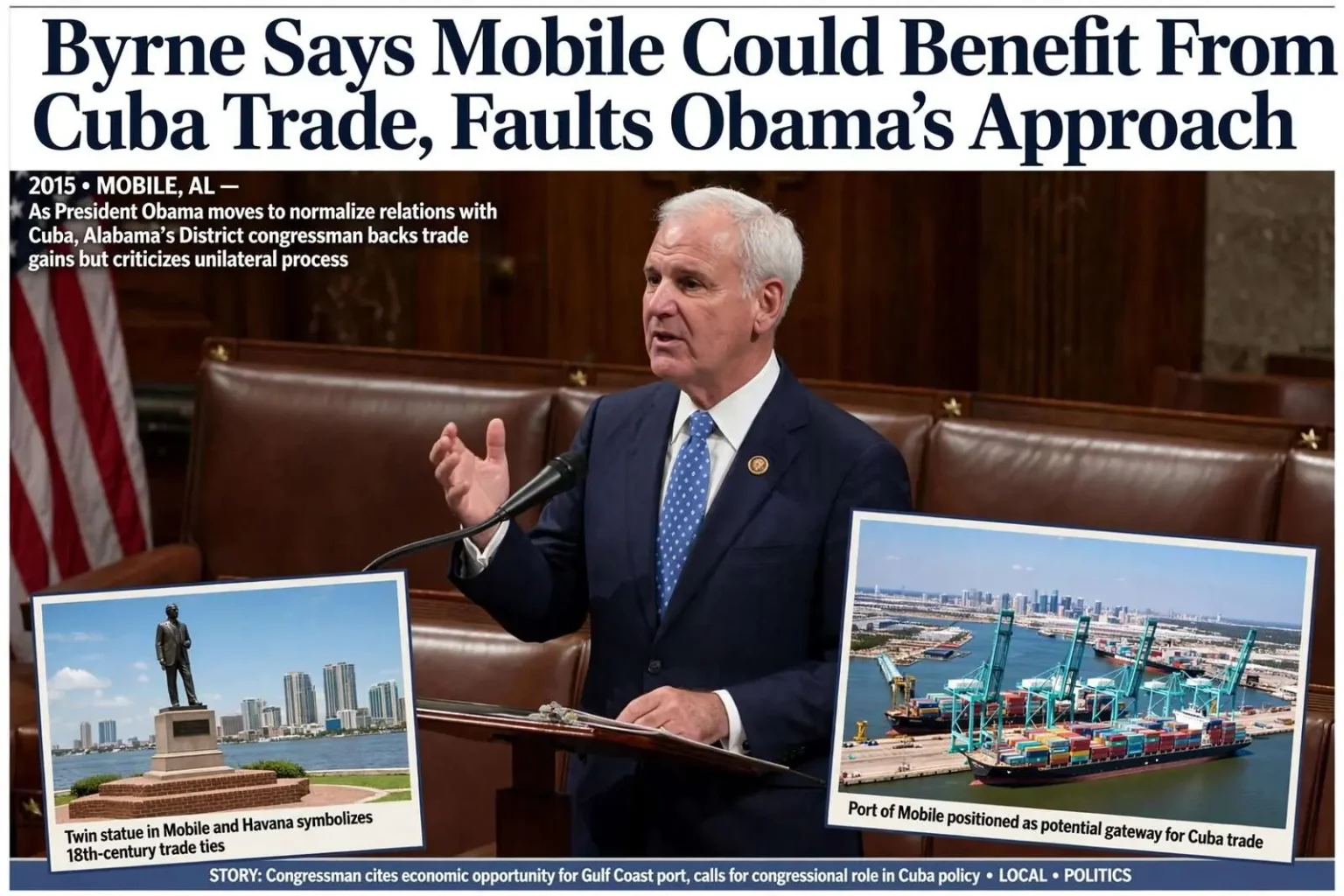
When President Obama announced a move toward normalized relations with Cuba in late 2014, the ripple effects reached all the way to the Port of Mobile. U.S. Rep. Bradley Byrne, R-Fairhope, used his first House floor speech of the new congressional term in early January 2015 to argue that while his district stands to gain economically from closer U.S.-Cuba ties, the president’s approach to getting there was flawed.
Byrne pointed to a striking historical link between the two places: a statue of Mobile founder Pierre Le Moyne d’Iberville that stands in Cooper Riverside Park has a twin in Cuba, a physical reminder of trade and cultural connections between Mobile and the island that stretch back to Spanish colonial times in the 18th century. The French-born explorer who founded Mobile also helped chart and settle Cuba’s coastline, and the paired statues — one on the Mobile River waterfront, one in Havana — have long symbolized the sisterly geography of the Gulf of Mexico’s two port cities.
“It is safe to say that I represent a district that stands to benefit from improved relations with Cuba,” Byrne told his House colleagues. The congressman’s First District encompasses all of southwest Alabama, from Mobile and Baldwin counties down to the Florida line, an economy built on the Port of Mobile, shipbuilding, agriculture, and forestry — industries whose fortunes rise and fall with international trade.
The port’s cautious optimism
Alabama State Port Authority Director Jimmy Lyons has said the port likely would not see tangible benefits from eased Cuba trade restrictions for several years, given the regulatory and logistical steps still required. Decades of embargo have left Cuba’s port infrastructure, cold-chain storage, and financing mechanisms underdeveloped, and American shippers would face a long rebuild before trade flows matched the volume the island’s proximity promises.
Still, Lyons pushed back on Byrne’s cautious stance, saying he wished the congressman would “lead the charge” on improving ties rather than criticizing the administration’s approach, arguing that both Mobile and the broader state of Alabama stood to gain from expanded trade with Havana. The exchange between the port’s chief executive and the district’s congressman set up a debate that has run through Gulf Coast business circles ever since: not whether Cuba trade could help Mobile, but how fast, and through what door.
For Mobile, the stakes are concrete. The port has spent years positioning itself as a deepwater gateway for the southeastern interior, with container terminals, bulk and breakbulk facilities, and rail connections that move goods across the Southeast. Trade with Cuba — poultry and agricultural products from Alabama farms, machinery, fertilizer, and, in time, American tourists and their cargo — could add new volume to a port already investing hundreds of millions of dollars in expansion.
Byrne’s objection: process, not purpose
Byrne’s objection centered less on the goal of normalized relations and more on process. He argued that President Obama bypassed Congress by acting through executive authority rather than seeking legislative buy-in, a contrast he drew with past normalization efforts involving China and Vietnam. Those openings, he noted, came through negotiated agreements and congressional action that committed both nations to a framework — not unilateral executive decrees that a future administration could reverse with a signature.
“The president seems to be more interested in a publicity stunt than in a substantive solution,” Byrne said during his floor remarks. It was pointed language for a first speech of the term, and it placed the freshman-class-turned-sophomore congressman squarely among the majority of his party skeptical of the Cuba opening.
The congressman laid out a list of conditions he said should be met before he would support lifting the long-standing trade embargo altogether: an end to Communism on the island and movement on the fundamental political and property-rights questions that have defined U.S.-Cuba relations since the revolution. Until then, he argued, the United States would be extending economic lifelines to a regime that offers its people neither freedom nor compensation for confiscated American property.
Byrne’s position reflects the view held by many embargo supporters that American concessions reward the Cuban government without securing anything in return. The counterargument, pressed by port officials and agricultural interests across the Gulf South, is that trade itself is the lever: American goods and visitors carrying American money and ideas into Cuba will do more to change the island than five decades of embargo have.
What Cuba trade could mean for Alabama
Alabama’s agricultural and industrial exporters have long viewed Cuba as a natural market. The island imports most of its food, and Gulf ports are the closest American gateways — a geographic advantage that once made Havana and Mobile regular trading partners in sugar, timber, and manufactured goods. Poultry producers, timber interests, and heavy manufacturers across the state have lobbied for years for expanded trade authority, and even the limited humanitarian exceptions of the embargo era have allowed some agricultural sales to flow under cash-in-advance rules.
The port authority’s leadership has consistently argued that Mobile is positioned to capture a significant share of any Cuba trade that opens, thanks to its deepwater channels, its proximity, and its rail and highway connections to the state’s farms and factories. Lyons’ wish that Byrne would champion the cause reflects a long-standing tension in Gulf Coast politics: economic development officials pressing for openness toward Cuba, while the region’s representatives in Washington, responding to embargo-era politics and Florida’s Cuban-American electorate, have remained skeptical.
Byrne’s floor speech also served notice on the administration about how the First District’s representatives intend to engage on trade policy generally. Southwest Alabama’s economy — the port, the shipyards, the paper mills and poultry houses of the rural counties — depends on export markets and on the federal infrastructure investments that keep goods moving. A congressman who questions the president’s process on Cuba is, in the same breath, laying claim to a larger voice over how trade opens anywhere, and the business leaders listening in Mobile took it as exactly that.
The view from the district
Back home, Byrne’s speech drew attention in Mobile’s business community, where the Cuba question touches shipping firms, farm cooperatives, and the port authority’s ambitious capital plans. The Port of Mobile has ridden a decades-long expansion to become one of the fastest-growing container ports on the Gulf, and its backers watch every potential trade corridor — Panama expansions, Mexican manufacturing, and now Cuba — as a piece of the growth puzzle.
The d’Iberville statue tie is more than a rhetorical flourish. Mobile’s founding families and Havana’s colonial history share roots in the same French-Spanish colonial world, and the twin statues — gifts exchanged between the two port cities — have been cited by delegations, historians, and mayors whenever the Cuba question resurfaces. When Byrne invoked the pair in his floor speech, he was reminding colleagues that the Gulf’s ports and Cuba’s are neighbors by geography, whatever their governments’ differences.
Byrne’s critics argue that standing apart from the president’s opening risks leaving Mobile behind while competitors move. Ports in Louisiana, Texas, and Florida are all positioning for Cuban cargo, and a port that hesitates in the early stages of a trade opening may find relationships and contracts locked up by the time restrictions fully ease. Lyons’ public nudge toward “leading the charge” made that concern explicit: in trade, early positioning is often worth as much as eventual volume.
An unfinished debate
The Cuba debate remained unresolved as 2015 began, in Washington and in Mobile. Executive actions had eased travel and remittances, but the embargo itself remained written into federal law, and only Congress could lift it — an outcome that required the kind of comprehensive negotiation Byrne insisted was missing. In the meantime, agricultural sales under existing exceptions continued, delegations continued to visit Havana, and port officials continued to plan for a day when a ferry of container ships might make the short run across the Gulf as a matter of routine.
What the exchange between Byrne and Lyons laid bare is that southwest Alabama’s Cuba debate is not a question of whether the island matters to Mobile’s future, but of how and when. The congressman wants normalization done through Congress, with conditions attached; the port director wants champions, whatever the route. Both agree on the bottom line: a district founded by d’Iberville, with a twin statue in Havana and a deepwater port on the Gulf, stands to benefit when the last cold-war trade barrier in the hemisphere finally comes down.
Until then, Mobile will keep building — terminals, rail lines, and relationships — ready for the day the Havana trade resumes in full, just as it flowed in the colonial era when the founder’s statue first watched over the river.
The Obama administration’s Cuba moves, announced in December 2014, included eased restrictions on travel, remittances, and certain commerce, along with a review of Cuba’s designation on the state sponsors of terrorism list — steps taken without action from Congress. Supporters called it the most significant change in hemispheric policy in half a century; critics, Byrne among them, called it a giveaway that traded real leverage for diplomatic theater. The debate in Mobile echoed the one in Washington, with the added dimension that here, the potential beneficiaries could be named: the port, the farms, the freight forwarders, and the longshoremen who would handle the cargo.