New Calcedeaver Elementary Opens as Mobile, Baldwin Schools Push Ahead on Construction Projects
Students moved into the new $10.5 million Calcedeaver Elementary as Mobile and Baldwin County schools advanced several major construction projects.
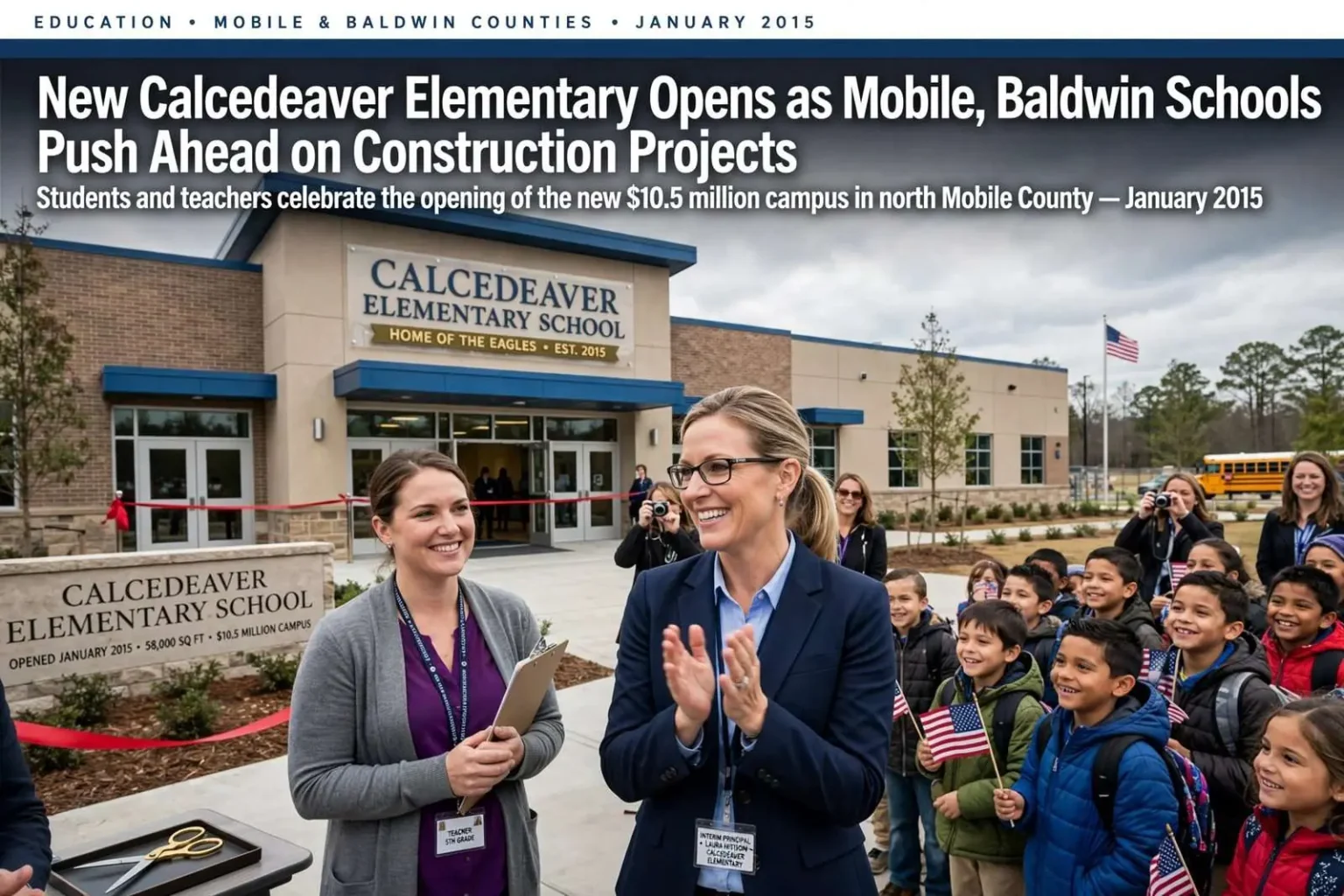
Students and teachers rang in the new year at a brand-new campus as Calcedeaver Elementary School opened its doors in north Mobile County in early January 2015. The $10.5 million, 58,000-square-foot facility replaced an older building and came with new leadership as well: interim principal Laura Hittson stepped in after previous principal Paige Mixon moved to lead North Mobile K-8 School.
For a rural community near the Mississippi state line, the opening marked the end of a long wait. Students who had spent years in an aging building started the semester with modern classrooms, updated technology infrastructure and space designed around how elementary schools are expected to teach in the current era rather than the one that built the old campus.
A Busy Month for School Construction
Calcedeaver’s opening was one of several major building projects moving forward across Mobile and Baldwin county school systems that month.
The Mobile County school board approved a $22 million construction bid from White-Spunner Construction to serve as general contractor for the long-planned new Citronelle High School, with work expected to begin later in January. The project represented one of the larger capital investments in the county school system’s building plan for the area.
White-Spunner, a Mobile-based general contractor, has been a fixture of Gulf Coast construction for generations, and the Citronelle award kept one of the district’s most expensive promises close to home. The new high school has been discussed in the north Mobile County community for years, and the board’s approval moved it from planning documents to a job site.
The two projects — one opening, one breaking ground — bookended the county system’s approach: replace aging rural schools where the buildings have outlived their useful lives, and rebuild flagship high schools where enrollment and community pride justify the investment.
The Magnet Deadline
Families interested in Mobile County’s magnet school program also had a deadline to watch. The system’s seven magnet schools were accepting applications through its website, with the first lottery drawing set for late February, giving parents several weeks to apply for specialized programs across the district.
Mobile County’s magnet program is among the oldest in Alabama, offering themed academics that range from accelerated academics to the arts, and admission is decided by lottery rather than test scores or address. For parents, the annual application window is one of the most consequential dates on the school calendar: missing it means waiting another year for a seat that hundreds of applicants are chasing.
The online application also marked a shift from the paper chases of earlier years, letting families apply from home instead of traveling to a downtown office — a small change that mattered to working parents across the county’s wide footprint.
An Aviation Head Start in Baldwin County
In Baldwin County, school leaders touted a different kind of investment: a $2.7 million aviation training facility at H.L. “Sonny” Callahan Airport that had just opened, enrolling 15 students from five area high schools with room to grow.
The program, developed in partnership with Faulkner State Community College, Enterprise State Community College and the Fairhope Airport Authority, allows high schoolers to earn college credit through dual enrollment coursework tied directly to aviation careers, an unusual offering for a coastal Alabama school system.
The premise is straightforward: aviation and aerospace are among the state’s growing industries, and the pipeline of pilots, mechanics and technicians has to start somewhere. By putting a hangar-side classroom at a working general aviation airport, Baldwin County gave students a path from a high school seat to a cockpit or a maintenance bay while their classmates were still deciding on a major. The first cohort of 15 was deliberately small, built to prove the model before scaling it.
Dual enrollment is the lever that makes it work. Students earn college credit at no cost to their high school transcript timeline, and the community college partnerships mean the coursework counts toward certificates and degrees rather than sitting as electives. For a coastal county betting on workforce development, the facility doubled as a recruiting billboard for the industries it hopes to court.
New Leadership in Baldwin
Baldwin County’s school board also received an update on a broader slate of capital improvement projects during the same period, as newly hired Superintendent Robbie Owen continued settling into his role after his first semester leading the system.
Owen had spoken publicly about his priorities heading into the new year, including plans for the district’s Digital Renaissance technology initiative and the challenge of explaining the system’s capital improvement plan to voters.
The two priorities are linked. The Digital Renaissance — Baldwin County’s push to put digital devices and digital instruction into classrooms — requires networks, devices and training that a capital plan must fund, and convincing voters to support that plan requires explaining what the money buys. Owen’s first semester was spent learning both sides of that equation: the buildings the system needs and the tax base it can ask to pay for them.
Baldwin County’s growth made the task urgent. Classroom counts have climbed for years as families move to the county’s suburban corridor, and new roofs, new schools and new technology all compete for the same dollars.
Pieces of History, and an Empty School
Elsewhere in the region, the City of Bay Minette held a sale of salvaged doors and windows from the former Baldwin County High School building, giving residents a chance to own a physical piece of the county’s educational history.
The sale was more than a clearing-out. Old school buildings hold decades of memory — names carved in lockers, graduations on the front steps — and letting residents carry a door or a window home turned demolition into a kind of farewell. For a city watching a landmark come down, that mattered.
And in Chickasaw, the city school board began weighing whether to reopen the former Hamilton Elementary School building on Grant Street, which had sat vacant since Mobile County’s magnet program moved out.
Chickasaw, which broke away to form its own city school system, has had to be inventive with the buildings it inherited, and an empty, serviceable school on a residential street is either an asset or a burden depending on enrollment projections. The board’s deliberation was, in miniature, the same question every small district in Alabama faces: how much building does a small system really need?
Personnel Moves and Routine Work
Personnel changes also touched the region’s education leadership. Bay Minette native Jeff Langham, who had spent a decade as superintendent of the Elmore County School District, started a new role as Assistant State Superintendent for External Affairs with the Alabama Department of Education on Jan. 1, taking his South Alabama roots to a statewide policy post.
The move put a Baldwin County product in a position to shape how the state department deals with the districts it serves — a reminder that the region’s education talent travels, and that decisions made in Montgomery are often informed by careers built in places like Bay Minette.
Local school boards in Baldwin County, Chickasaw and Saraland all held meetings that month to continue routine business, underscoring how construction, staffing and program decisions across several small and mid-sized districts were shaping the school year for thousands of students throughout Mobile and Baldwin counties.
That is the quieter story behind the headlines: a new elementary school opening its doors, a $22 million high school moving toward groundbreaking, fifteen teenagers starting an aviation curriculum, and boards from Bay Minette to Chickasaw working through the ordinary votes that turn plans into classrooms. Together they amount to a region betting, in concrete and coursework, on its own schools.
For Calcedeaver’s students, the details of the new campus will matter more than any ribbon-cutting speech. Elementary children spend their days in the same rooms year after year, and the difference between a dim, drafty building and a bright, climate-controlled one shows up in attendance, in focus and in the simple willingness of families to choose their neighborhood school. Teachers, meanwhile, traded decades of improvisation for classrooms built for group work, reading stations and the technology that instruction now assumes.
The transition in leadership will shape how the fresh start is used. Hittson inherits a staff getting to know a new building at the same time it is getting to know a new principal, an unusual alignment that also offers an opportunity: routines and culture can be set once, for the building and the team together, rather than layered onto old habits. Mixon’s move to North Mobile K-8 keeps experienced leadership within the same corner of the county, where the two campuses serve many of the same families as their children grow.
North Mobile County has seen its share of school realignment in recent years, with boundary changes and campus swaps that followed population shifts around the Mobile River and the northern suburbs. Against that backdrop, a $10.5 million building erected in the community — rather than a consolidation shipping its children elsewhere — is a statement of commitment that residents do not take for granted.
The same January that brought the new campus also brought the ordinary machinery of school governance across the two counties: bid approvals, lottery calendars, board agendas and personnel appointments. None of it makes headlines the way a football championship does, but it is the ledger on which a region’s schools are actually judged. By that measure, the first month of 2015 was a busy one, and the students of north Mobile County and eastern Baldwin County started the new year with more than resolutions — they started it with new rooms, new programs and, in a few cases, a first look at a cockpit.