Whooping Cough Cases Surge in Mobile County Schools as Baldwin County Sets Tax Vote
Mobile County schools saw a sharp rise in pertussis cases this fall, while Baldwin County set a March referendum on a school construction tax.
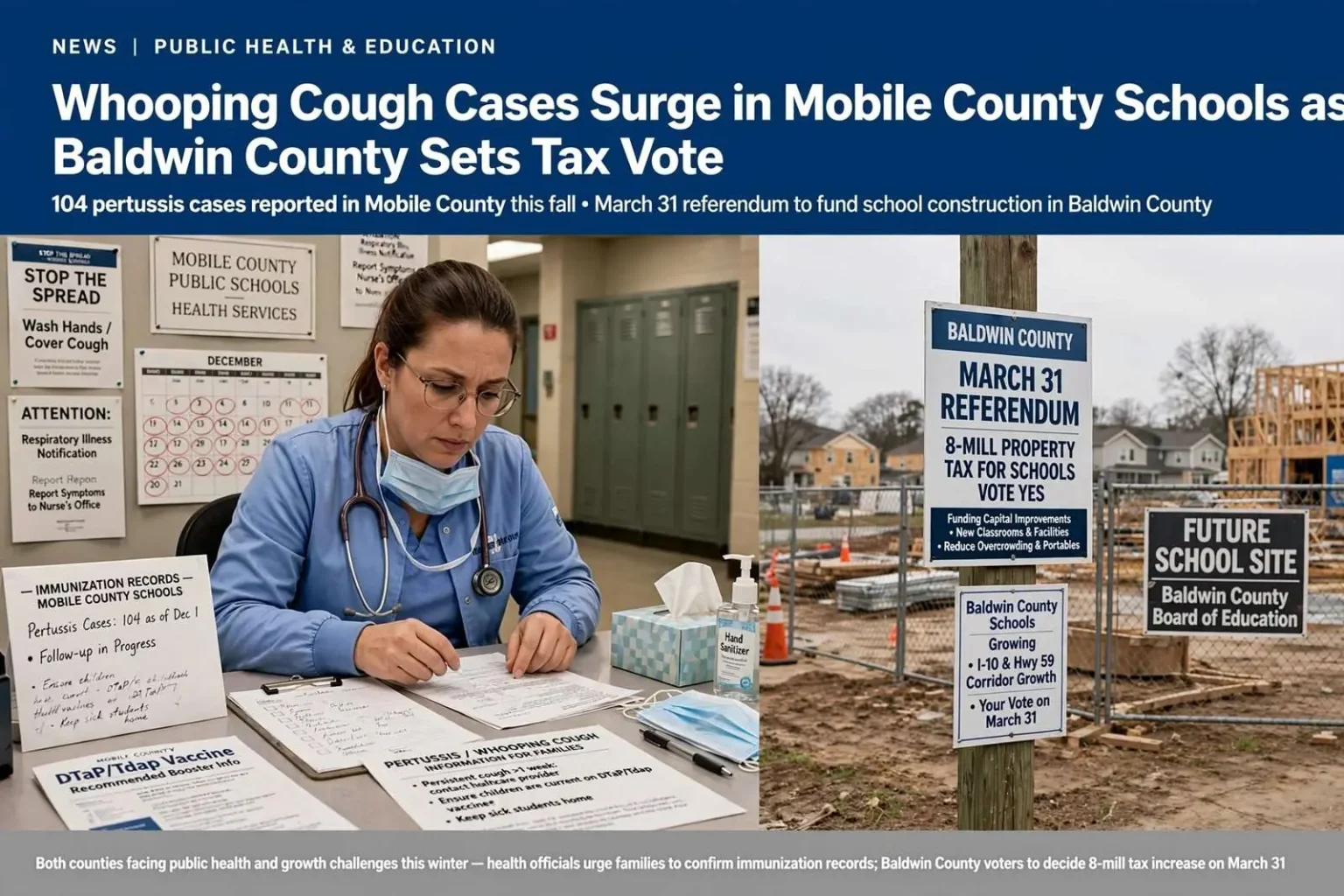
Health officials in Mobile County reported a sharp increase in whooping cough cases this fall, with at least 104 confirmed and probable pertussis cases logged by Dec. 1 — more than 12 times the eight cases reported in all of 2013. The spike has raised concern among school administrators, particularly given how many students in Mobile and Baldwin county schools are not up to date on required immunizations.
School nurses and district health coordinators have been working to identify students with lapsed vaccination records, though officials have not said how many children across the two counties fall into that category. The record-review work is tedious but essential: Alabama law requires proof of immunization for school enrollment, with exemptions available, and over the years the paperwork drifts — families move, records stall and booster windows pass unnoticed until an outbreak makes the gaps visible.
What Pertussis Is and Why It Spreads
Pertussis, a highly contagious respiratory illness also known as whooping cough, spreads easily in classroom settings and can be particularly dangerous for infants and young children who have not completed their full vaccination series. The illness begins like a common cold — runny nose, low fever, mild cough — before progressing into severe coughing fits that can last for weeks and, in the classic presentation, end with the high-pitched “whoop” of a desperate breath.
The bacteria travel on respiratory droplets, which makes schools, daycares and households the efficient engines of an outbreak. Antibiotics can shorten the infectious period, but by the time a case is confirmed, exposed classmates and family members typically need preventive treatment as well — a cascade of phone calls, clinic visits and letters home that school nurses across Mobile County have been managing since the case counts began climbing in the fall.
Protection against pertussis comes from the DTaP vaccine series in early childhood, with Tdap boosters required at the middle-school years in Alabama and recommended for adults who spend time around infants. Immunity from the vaccine fades over time, which is why booster timing matters and why adolescents and adults can carry and spread the illness even when their own symptoms are mild.
For infants too young to be fully vaccinated, the risk is the gravest. Health departments typically respond to a pertussis surge by urging adults who care for babies — parents, grandparents, caregivers — to check their own booster status, a strategy known as cocooning that wraps the most vulnerable in a circle of immunized adults.
The Numbers Behind the Alarm
The contrast between 104 cases by Dec. 1 and eight in all of 2013 illustrates how quickly pertussis can rebound in a community. Outbreaks of this scale tend to build in clusters — a classroom here, a sports team there — before case-finding catches up, and the fall timing put the surge squarely inside the semester, with students assembling daily in the close quarters where the bacteria thrive.
Local health officials’ advice to families has followed the standard playbook: keep sick children home, seek medical evaluation for persistent coughs, and confirm that everyone in the household is current on vaccines. School districts, for their part, continue the unglamorous work of chasing immunization records — the administrative mirror of the outbreak itself.
Baldwin County Sets a March Tax Vote
Meanwhile, the Baldwin County Board of Education is moving ahead with a major funding push for school construction. The Baldwin County Commission has approved a March 31 referendum asking voters to approve an 8-mill property tax increase dedicated to capital improvements across the fast-growing district, which has struggled in recent years to keep pace with enrollment growth along the Interstate 10 and Highway 59 corridors.
An 8-mill increase is substantial — the kind of dedicated levy that funds new schools rather than patching old ones. The growth pressure it addresses is visible from the air: subdivisions spreading along the Interstate 10 corridor from Daphne and Spanish Fort toward Malbis, and up Highway 59 through Gulf Shores, Foley, Robertsdale and Summerdale, where Baldwin County’s population growth has run among the fastest in Alabama for years. New rooftops mean new students, and new students mean classrooms, cafeterias and gymnasiums the district does not yet have.
The money would be earmarked for capital improvements — construction, land and major renovation — rather than day-to-day operations, meaning the referendum’s success would show up in school buildings first. District leaders have pointed to portable classrooms and overcrowded campuses along the growth corridors as the visible cost of falling behind.
The funding request comes as the district also transitions to new leadership. The Baldwin County school board voted unanimously in late November to hire Robbie Owen as its next superintendent.
“I love Baldwin County … I want to do whatever I can to make this a better place,” Owen said after the vote.
Owen inherits a district facing both rapid growth and aging facilities, making the outcome of the spring tax referendum a significant early test for his tenure. A superintendent’s first year is typically spent learning the system’s rhythms; Owen’s will open with a countywide campaign to persuade voters to tax themselves for school buildings — a conversation that will take him to civic clubs, church basements and commission chambers across a geographically enormous county that stretches from Mobile Bay to the Florida line.
A New School for North Mobile County
Farther north in Mobile County, students and teachers are preparing to move into the new Calcedeaver Elementary School when classes resume after the holiday break. The $10.5 million campus is one of Mobile County’s Blue Ribbon school communities, a recognition of the academic record that has made the school a point of pride in the Mount Vernon area at the northern edge of the county.
Calcedeaver serves a community with deep Native American heritage, and the school’s programs have long drawn attention for honoring that history while posting some of the strongest elementary results in the district. Replacing an aging campus with a new $10.5 million facility represents a significant investment in a rural corner of the county that school officials hope will carry the school’s momentum into the next generation.
What a Mill Means for Taxpayers
For Baldwin County property owners weighing the March 31 vote, the arithmetic is concrete. One mill equals one dollar of tax per $1,000 of assessed value, and Alabama assesses owner-occupied homes at 10 percent of appraised value — so an 8-mill increase on a $200,000 homestead translates to a modest annual sum compared with what the same property would carry in commercial hands. Agricultural and timber land, which covers much of inland Baldwin, is assessed at lower rates still, which shapes how the campaign will be argued across the county’s farming communities.
Referendum politics in Baldwin County have a history: school tax measures have come before county voters before, and the district’s growth story is its strongest selling point. The children now in portables along Highway 59 are the argument, and opponents’ counterpoints — that existing revenue should be stretched further — will meet it in every civic forum between January and the last day of March.
For Mobile County readers, the contrast is instructive. Mobile County’s school system is far larger and serves a slower-growing population, so its capital priorities look different: consolidation and replacement of aging buildings, like the new Calcedeaver campus, rather than frantic construction to catch up with growth. Baldwin’s 8-mill ask is what a district does when it cannot build fast enough; Mobile’s new elementary is what a district does when it must replace what time has worn out.
The Season Ahead for Both Counties
The months after the holidays will test both systems at once. Mobile County school nurses will return to classrooms still managing a pertussis outbreak that showed no sign of exhausting itself by December, with the usual January return-from-break spike to plan for. Letters home, vaccination clinics and record chases will continue until the case curve bends.
In Baldwin County, the referendum campaign will ramp up through the winter, with the vote set for March 31 — a spring date that puts the decision in front of the county’s seasonal residents and year-round voters alike. The new superintendent’s voice will carry the campaign, and the size of the turnout will say a great deal about how Baldwin’s fast-growing communities value their classrooms.
And in Mount Vernon, the first bell of the new semester will ring in a building that took years of planning and $10.5 million to deliver — a smaller story than an epidemic or a tax vote, but the kind that communities remember longest.
What Parents Can Do Now
Health officials’ guidance for families in both counties remains straightforward. Parents should confirm their children’s immunization records are current with the school nurse now, not after a notice goes home; check that adolescents have received the Tdap booster required for middle school entry; and consider their own booster status, particularly for adults around infants who cannot yet be fully vaccinated.
Anyone with a cough that lingers beyond a week, or that comes in severe fits, should contact a health care provider and mention possible pertussis exposure — early treatment shortens the contagious window and protects the people around the patient. Households with new babies should be especially prompt.
Between the outbreak, the referendum and the new campuses, the season ahead will remind both counties that public health and public education run on the same fuel: records kept current, buildings kept ready and voters and parents willing to invest in both. The 104 cases logged by Dec. 1 will either mark a peak or a midpoint; the March 31 vote will either fund the next decade of classrooms or send planners back to the drawing board. Either way, the two counties’ winter will be busy.