University of South Alabama Mobile
Woman Dies After Being Shot in Mobile Parking Lot
A 55-year-old woman died after being found shot in a Mobile parking lot near Megginson Park; police are investigating.
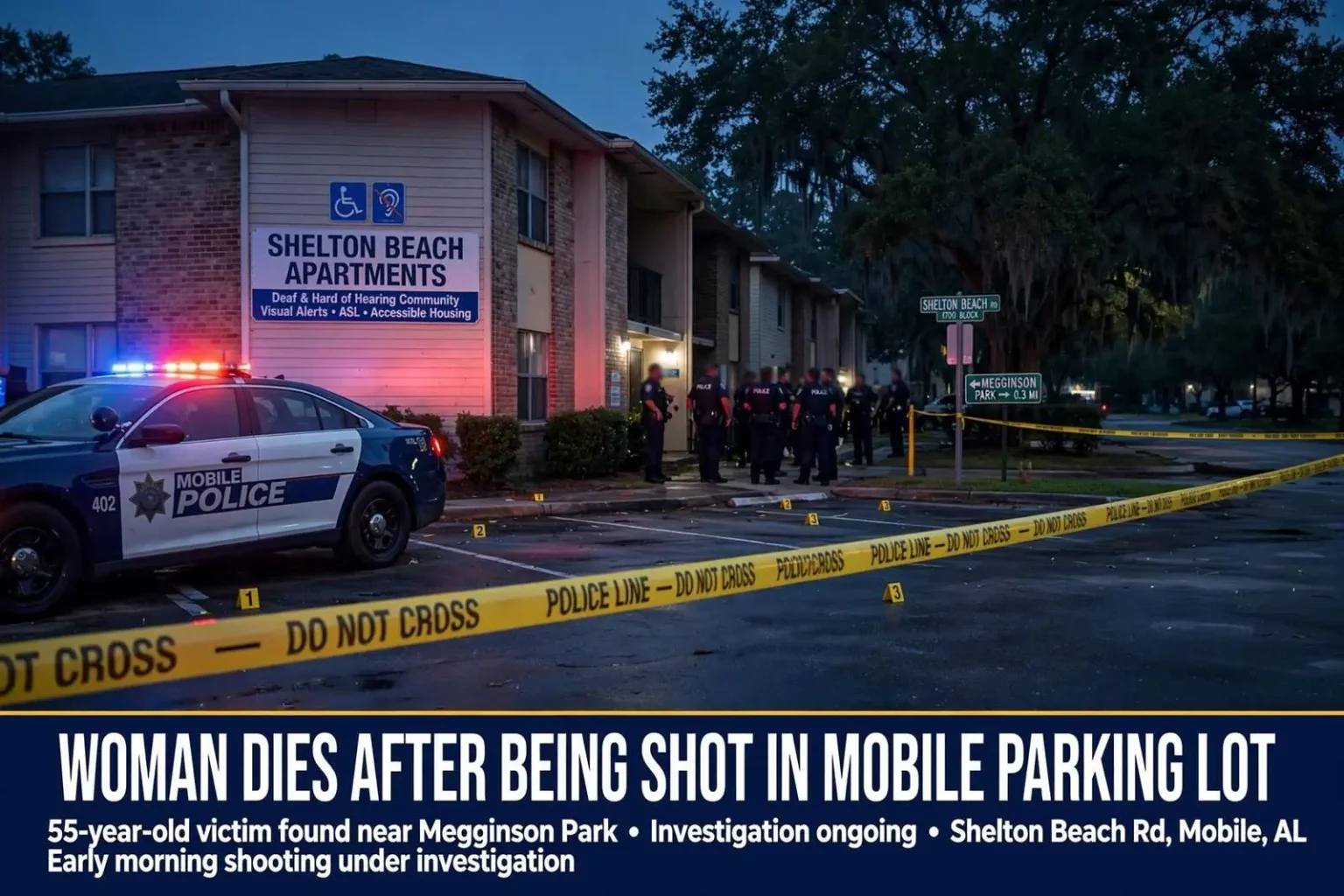
A woman is dead following an early-morning shooting near Megginson Park in Mobile, according to Mobile Police. The 55-year-old victim was discovered in a parking lot in the 1700 block of Shelton Beach Road, the site of an apartment complex serving deaf residents, in a case that investigators continued working through the days after the gunfire.
Officers responded to the scene at approximately 3:20 a.m. after receiving a report of a possible shooting in the area. When they arrived, they found the woman lying in the parking lot suffering from a gunshot wound. She was rushed to University of South Alabama Medical Center, where she later died from her injuries, despite the efforts of emergency crews who moved her from the scene within minutes of the first call.
As of the time of the report, Mobile Police had not released the victim’s identity, a step that typically follows confirmation that next of kin have been notified. Homicide detectives with the department have taken over the investigation and are working to determine what led to the shooting and who may have been involved.
Investigators have not indicated whether they have identified a suspect or motive in the case. Mobile Police have not said whether they believe the shooting was a targeted incident or a random act of violence, and detectives generally avoid characterizing a case in its early stages while witnesses are still being located and physical evidence is still being processed.
The neighborhood
The Shelton Beach Road corridor sits in a residential part of Mobile near Megginson Park, an area that includes a mix of apartment complexes and single-family homes. The route carries neighborhood traffic through one of the city’s older residential sections, where tree-lined streets and mid-century apartment complexes house a cross-section of Mobile families, retirees and working residents.
The apartment community where the shooting occurred is specifically designed to serve deaf and hard-of-hearing residents, adding an additional layer of concern for neighbors following the incident. Housing designed around the needs of deaf residents builds in features most complexes never consider — visual doorbell and alarm systems, layouts that support sign-language conversation, and a community where neighbors communicate in American Sign Language as naturally as speech.
An early-morning shooting at such a location raises particular questions about how emergency information moves through the community. Deaf residents rely on visual alerts, text-based 911 access and relay services to reach help and to receive warnings, and police outreach after an incident nearby has to account for those channels if every neighbor is to be reached with the same information at the same time.
The park itself, Megginson Park, serves as the neighborhood’s green space, the kind of compact city park that anchors daily life in Mobile’s older residential districts — playground equipment, open lawn and a gathering place within walking distance of the surrounding streets. Its proximity to the shooting scene is part of why the case has drawn such close attention from residents who use the park and the roads around it every day.
Shootings in residential areas of Mobile, particularly those involving unresolved motives, tend to raise significant concern among neighbors and prompt heightened patrols in the surrounding area. Officers stepped up their presence around the corridor as detectives worked, a standard practice intended both to discourage follow-up violence and to reassure residents that the investigation remains active.
How the investigation proceeds
Homicide work in the first hours after a death concentrates on a handful of tasks: canvassing for witnesses who may have heard or seen something around the time of the gunfire, collecting physical evidence from the parking lot and surrounding grounds, and reviewing anything the scene itself can tell investigators about where the shooter stood and how many shots were fired. Detectives also work backward from the victim’s last known hours, mapping who she was with and where she had been in the days before her death.
In a case with no identified suspect or motive, that canvass carries special weight. Residents of the apartment complex, neighbors along Shelton Beach Road and anyone who drove through the area around 3:20 a.m. all hold potential pieces of the picture — a sound, a vehicle, a figure crossing the lot. Investigators depend on those fragments, which is why police appeal so directly to the public in cases like this one.
The University of South Alabama Medical Center, where the victim was taken, serves as one of Mobile’s primary trauma facilities, receiving the most serious cases from across the city and region. Its emergency crews and trauma teams handle shootings, crashes and other critical injuries around the clock, and in this case the hospital’s staff were unable to undo the damage done in the parking lot.
How to help
Mobile Police are asking anyone with information about the shooting to come forward. Tips can be submitted directly to the department’s non-emergency line, through Crime Stoppers, or by text message using the department’s anonymous tip system — three channels designed to make reporting as easy and as safe as possible for people who may be reluctant to get involved.
Crime Stoppers programs across the Gulf Coast allow tipsters to remain anonymous, offering reward money for information that leads to an arrest while shielding the identity of the person who provides it. Tips can be about anything, however small: a car seen leaving the area, an argument heard earlier in the evening, a description of someone spotted near the complex. Detectives routinely stress that details which seem insignificant to a witness can be the piece that completes an investigative picture.
For deaf and hard-of-hearing residents, all three channels are accessible without calling: text tips, online forms and relay services allow a report to be filed without a voice call, and advocates have long pushed police departments to publicize those options prominently rather than burying them. In a community built around sign language, the difference between a voice-only tip line and a text line is the difference between participation and exclusion.
Deaf communities nationwide have worked for decades to ensure emergency services are accessible, from text-to-911 availability to video relay interpreting in hospital settings. When a serious incident occurs at a residential community built for deaf residents, those systems are tested in real conditions — and the case gives police an occasion to reinforce the channels through which deaf residents can report what they know.
Community members with any information, however minor it might seem, are encouraged to contact investigators as the case remains an active and ongoing investigation. Detectives have not announced a timeline for the next steps, but the early hours of a homicide investigation — when memories are freshest and physical evidence is least disturbed — are usually the ones that determine whether a case moves toward an arrest or stalls.
The broader pattern
Mobile, like cities across Alabama and the South, continues to confront gun violence that clusters in residential neighborhoods and, disproportionately, in the hours after midnight. Police leadership in recent years has emphasized a combination of focused patrols in high-violence areas, community engagement and rapid response to shootings as the department’s core strategy, with homicide detectives carrying caseloads that stretch across the entire city.
For the neighborhoods around Shelton Beach Road and Megginson Park, an unsolved early-morning shooting leaves a residue that outlasts the news cycle. Residents weigh their own routines differently — evening walks, early departures for work, time spent in shared parking lots — and community leaders typically respond by pressing for lighting, patrols and communication with police until the case is resolved.
The victim’s age, 55, places her among the adults whose deaths in gun violence often receive less attention than younger victims, though the loss for her family is no smaller. Pending the release of her name, friends and relatives have been left to grieve privately while detectives work to establish who was responsible.
What investigators establish in the coming days will shape everything that follows: whether the shooting was connected to a dispute that began elsewhere, whether the victim knew the person who fired, or whether a stranger’s violence touched a community chosen at random. Each of those answers leads to a different investigative path, and Mobile detectives have not yet signaled which of them this case follows.
Police also use cases like this one to remind residents of basic precautions in the late-night hours: reporting suspicious activity immediately, keeping porches and parking areas lit, and sharing anything unusual with neighbors rather than assuming someone else will call it in. None of it undoes a tragedy, but departments credit alert residents with shortening countless investigations.
Anyone with information is urged to come forward while the investigation is fresh. For a neighborhood whose residents communicate in sign language, and for the wider community along Shelton Beach Road, the department’s appeal is the same as it is in every unsolved homicide: the people who live with the consequences of a case like this are also the people most likely to hold its solution.