Two Found Fatally Shot in Prichard Vehicle, Third and Fourth Homicides of Year
Prichard police discovered a man and woman shot to death inside a car near Warren Street, marking the city's third and fourth homicides of the year.
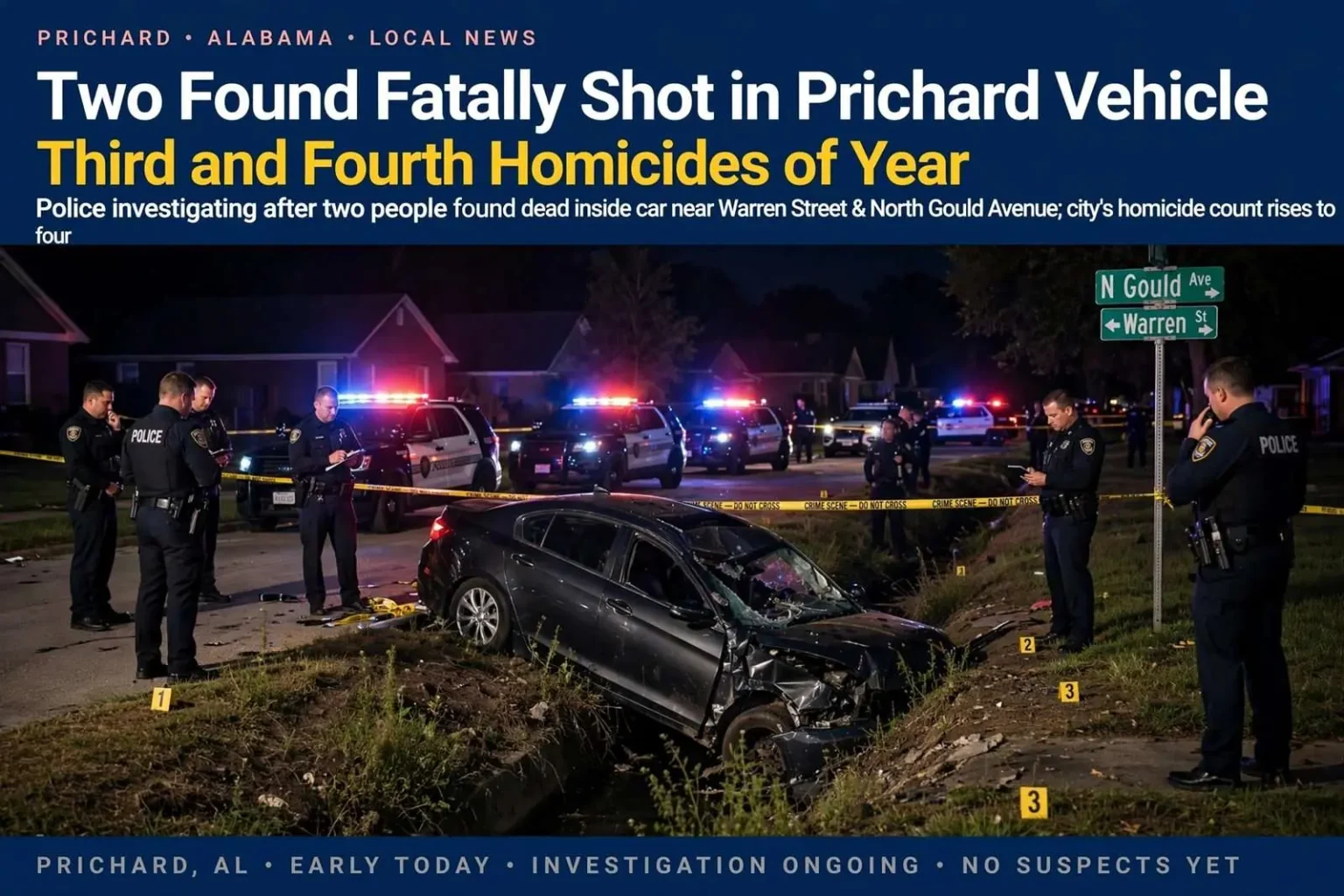
Prichard police are investigating after officers responding to reports of gunfire discovered two people shot to death inside a vehicle near the intersection of Warren Street and North Gould Avenue. The deaths, which brought the city’s homicide count to four for the year, arrived amid mounting concern in the community about violent crime, and they left detectives working one of the most serious cases of the year with few public answers in its earliest hours.
According to city officials, dispatchers received calls reporting gunshots in the area late in the evening. When officers arrived, they found a car that had gone into a ditch nearby. Inside were a man and a woman who had each suffered multiple gunshot wounds. Both were pronounced dead at the scene, and the area around the vehicle was closed off as investigators began the work of documenting what had happened in the dark along a residential stretch of the city.
The Scene and the First Hours
As of the investigation’s early stages, authorities had not publicly released the identities of the victims and said no suspects had been named. Investigators were working to confirm who the two were, notify their families and reconstruct the final movements that brought them to the spot near Warren Street and North Gould Avenue — the routine but painstaking sequence on which every homicide case is built. Patrol officers secured the scene through the night, and detectives returned at daylight to examine the vehicle and the surrounding area in better light.
A spokesperson for the mayor’s office said detectives were treating the case as an active homicide investigation and were appealing to the public for information. Anyone with knowledge of the shooting was urged to contact the Prichard Police Department directly rather than share information solely through social media, so that investigators could follow up promptly on any leads. The appeal reflected a recurring frustration for investigators in the social media era, when tips posted publicly can spread faster than they reach detectives and can be seen by the very people police are seeking.
The vehicle itself became the case’s central piece of evidence. Cars found shot up and ditched near crime scenes are examined for bullet trajectories, shell casings, fingerprints, DNA and the digital traces modern vehicles carry, and each element can take weeks of laboratory work to yield results. Investigators also canvassed the neighborhood for surveillance cameras and witnesses — a step that has become decisive in cases where no one steps forward, since doorbell and business cameras now capture stretches of street that once went unrecorded.
The Toll So Far This Year
The deaths represent the third and fourth homicide victims Prichard investigators have handled since the start of the year, a toll that came only days after another fatal shooting in the city claimed the life of a 31-year-old man in an unrelated incident. That earlier case also remained open as detectives continued gathering evidence, and the back-to-back losses within a single week gave the department’s investigative workload a weight it rarely carries in a city of Prichard’s size.
The string of shootings has renewed concern among some residents and community leaders about violent crime in Prichard, a city that has weathered significant financial and public-safety challenges in recent years, including a period of municipal bankruptcy that strained the resources available to its police department. The city, which sits just north of Mobile in the heart of Mobile County, has spent decades working through the economic decline of the industrial jobs that once anchored its neighborhoods, and the strain shows in both its budget and its crime statistics. Community meetings on public safety have drawn standing-room crowds in the past, and residents have repeatedly pressed city hall for more visible patrols and faster follow-up on shootings.
A City Under Strain
Prichard’s fiscal history is inseparable from its public safety challenges. The city filed for bankruptcy protection during a dispute over its employee pension obligations, and the years that followed forced painful choices across every department, including police. Rebuilding a full complement of officers, investigators and equipment after such a period takes years, and city officials have acknowledged that the department’s capacity to work major cases depends heavily on partners — the Mobile County District Attorney’s office, state and federal agencies, and regional task forces — to supplement its own resources.
The city’s location compounds the challenge. Prichard borders Mobile and sits along corridors that carry traffic between the city and the rest of the county, and like many small cities ringed by larger ones, it absorbs crime that does not respect municipal lines. Investigators routinely coordinate with neighboring departments when vehicles, suspects or shell casings cross city boundaries, and a case like the one on Warren Street may draw on resources from across the metro area before it is resolved.
City officials have not announced any immediate policy changes in response to the recent violence, but Prichard’s police leadership has said detectives are prioritizing the case given its severity. That prioritization means the department’s most experienced investigators are assigned to the case, with patrol resources shifted to cover the affected neighborhoods while detectives work the leads. Leadership has also pointed to the department’s cooperation with regional agencies as a force multiplier that lets a small department pursue major cases it could not staff alone.
How the Community Can Help
Homicide investigations in cities Prichard’s size often turn on community cooperation, and police appealed directly to the residents who live nearest the scene. Witnesses may hold fragments they do not recognize as important — a vehicle seen twice, voices raised, a unfamiliar car parked where none usually sits — and detectives assemble those fragments into timelines. The department’s request that tips go directly to investigators rather than through social media was aimed at protecting both the speed and the integrity of that process, since public speculation can contaminate witness recollection and tip off suspects.
The plea also carries a harder truth about gun violence in small cities: someone in the neighborhood usually knows something. Cases move when that knowledge reaches investigators, and they stall when fear of retaliation keeps it quiet. Community leaders in Prichard have long balanced both realities, urging residents to cooperate with police while calling on the city to invest in the streetlights, youth programs and economic development that address violence at its roots.
Investigators continue to process evidence recovered from the scene, including from the vehicle itself, as they work to identify those responsible. Autopsies will establish the exact circumstances of the victims’ deaths, laboratory results will take weeks, and detectives will keep canvassing in the meantime. For the families of the man and woman found on Warren Street, and for a city that has now buried four homicide victims this year, the investigation’s progress cannot come soon enough — and the department has promised that the case will remain open until it is solved.
Prichard’s Long Road Back
The city’s struggle with violent crime is measured against a longer story of economic loss. Once a thriving industrial hub whose shipbuilding and manufacturing plants drew workers from across the Gulf Coast, Prichard saw its employment base erode over decades as plants closed and jobs moved away. The population has fallen from its mid-century peak, and the tax base that remains supports a city government that must provide full municipal services — police, fire, sanitation, administration — to a community with far less revenue than it once had. Every budget cycle forces choices between services residents need, and public safety advocates argue that policing alone cannot compensate for the disinvestment that feeds crime in the first place.
Regional cooperation has become a practical lifeline. Prichard’s officers work alongside the Mobile County Sheriff’s Office, the Mobile Police Department and state and federal partners on investigations that cross jurisdictional lines, and multi-agency anti-crime initiatives in the Mobile area have included the city in their coverage. Federal partnerships have produced prosecutions in past Prichard homicide cases when federal charges carried longer sentences and investigative resources the city could not muster alone. For a department of modest size, those relationships determine whether major cases end in arrests or grow cold.
Residents who want to help the current investigation can reach the Prichard Police Department directly through its dispatch and investigative lines, and tips can be left without giving a name. What detectives need most, officials said, are the small details — times, descriptions, vehicle movements — that turn scattered observations into a case. Each passing week makes recollections harder to retrieve and evidence harder to recover, which is why investigators renew their public appeal at every stage of a case like this one.
The two deaths on Warren Street will be counted in statistics, but for the streets around them they are neighbors — people whose absence will be felt at kitchen tables and church pews across the city. Prichard has buried too many of its residents this year already. Whether the next call to police comes from a witness willing to talk may decide whether the city’s fifth, sixth and seventh homicide cases ever have to be opened at all.