Port of Mobile’s Pinto Terminal Wins National Engineering Honor
The Alabama State Port Authority collected the top engineering honor from the American Association of Port Authorities for the technology deployed at the Port of Mobile's Pinto Terminal.
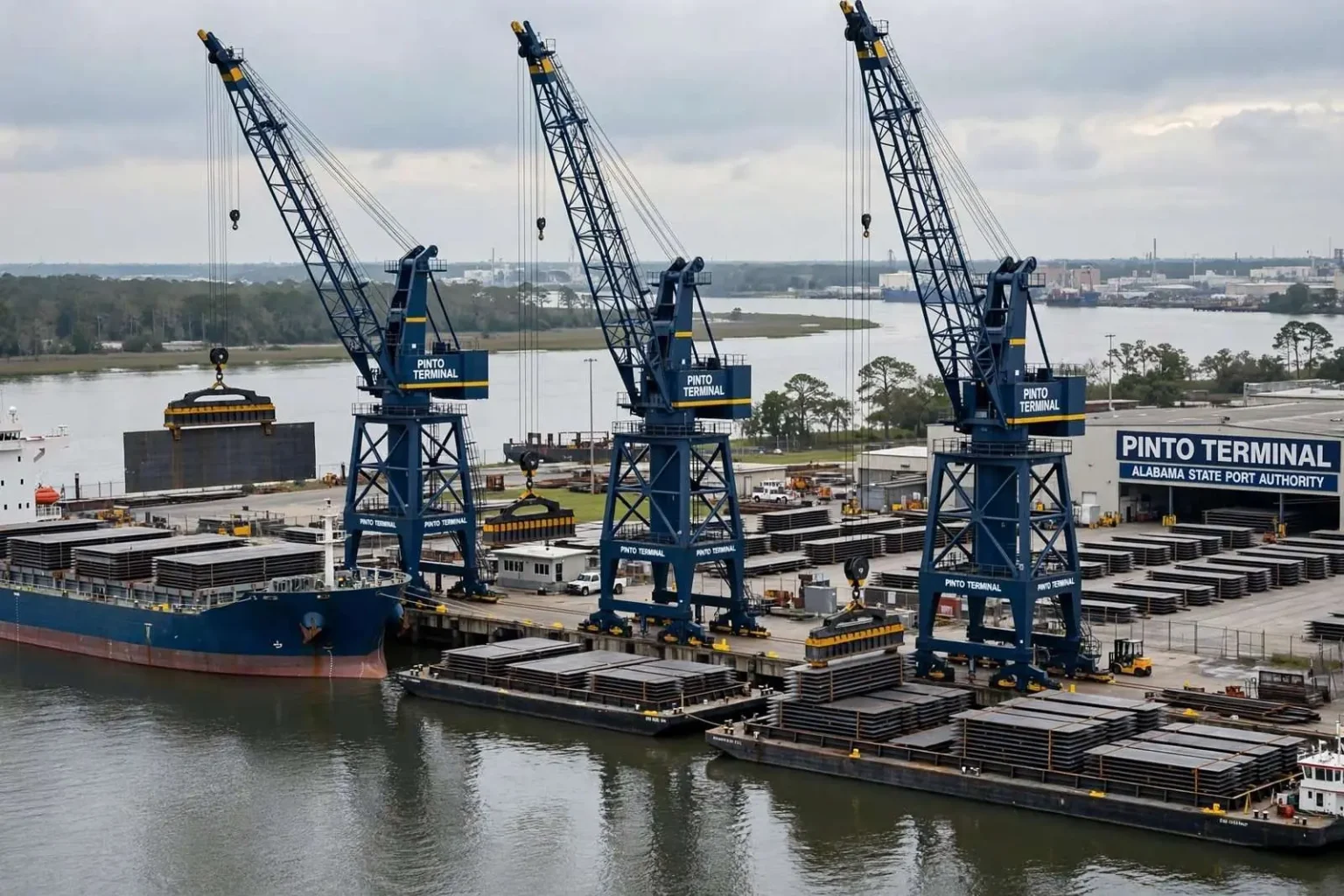
The Alabama State Port Authority earned the top engineering honor from the American Association of Port Authorities for the innovations and cargo-handling technology it deployed at the Port of Mobile’s Pinto Terminal, a recognition from peers across the Western Hemisphere. The association, which represents seaports throughout the Americas, planned to present its recognition awards in September at its annual convention in Seattle.
Port Authority director and chief executive Jimmy Lyons said the agency was honored, crediting a team of engineers and operations managers who developed a terminal concept designed to reduce the handling and costs of moving steel slab from ocean-going vessels to barges.
A Honor Earned Among Peers
The American Association of Port Authorities has served since its founding as the trade association for public seaports across the United States, Canada, the Caribbean and Latin America, and its annual engineering and communications awards are judged by port professionals who understand exactly what a terminal project demands — dredging schedules, berth design, cargo flow and the unforgiving arithmetic of moving tonnage cheaply. An award from that audience carries a weight that a marketing plaque does not: it is a judgment from the operators who run competing facilities every day.
For Mobile, the recognition also served as a statement of standing. The Port of Mobile had long ranked among the nation’s busiest by tonnage, anchored by coal exports, forest products, and container traffic on the Mobile River, but its national profile had historically trailed larger coastal ports. Winning the association’s top engineering honor placed a South Alabama facility ahead of projects from ports many times its size, at a moment when the authority was bidding for industrial prospects whose decisions hinged on whether Mobile could deliver world-class infrastructure.
Lyons, who led the authority through the era of its modern expansion, framed the honor in exactly those terms — evidence that a mid-sized Gulf port could out-engineer its competition when the stakes were high enough.
Built for a Major Industry
Pinto Terminal was engineered to serve ThyssenKrupp Steel USA, whose mill lay 43 miles north of the terminal on the Tombigbee River near Calvert. The plant was among the largest single industrial investments in Alabama history, and it anchored a north-running logistics chain that began at Mobile’s docks and ended at the mill’s furnaces in north Mobile County.
The steelmaking process begins with raw slab — semi-finished steel cast in enormous rectangular blocks — which the Calvert mill would receive from overseas mills in Brazil and Germany, reheate it, and roll it into finished carbon and stainless steel products for the American market. Ocean vessels carried the slab across the Atlantic to Mobile; barges then moved it upriver. The terminal sat at the hinge between those two legs of the journey, and every inefficiency at that hinge multiplied across the mill’s production schedule.
Optimizing technology and reducing operating expenses, Lyons said, had been the primary objectives, and a driving factor in recruiting a major industry to the region. State and local leaders had competed hard to land the mill, and the port’s ability to promise a purpose-built steel terminal was among the arguments that carried the project to Alabama. Pinto Terminal was the physical fulfillment of that promise, built to a specification set not by the port’s convenience but by the customer’s production line.
The terminal layout consisted of a 45-foot-draft, 1,050-foot-long ship berth, a slab storage yard and a barge-handling slip positioned between the ship berth and the shore-side yard. The deep draft berth was sized for the largest vessels then calling at Gulf ports — the post-Panamax class too wide for the old Panama Canal locks — ensuring that no ship bound for the mill would be turned away by the terminal’s own dimensions.
Three post-Panamax ship-to-shore cranes, each standing 200 feet high in operating position, carried a maximum capacity of 78 metric tons and were fitted with magnet lift devices capable of hoisting steel slabs weighing up to 36 metric tons. Those magnets, the authority said, were the first used in any ship-to-shore cargo operation in North America.
The magnets replaced the spreader bars and slings that conventional cargo operations use for steel, cutting the time and labor required for each lift. A crane operator working slabs with a magnet clears a vessel without the constant repositioning and rigging work that conventional lifts demand, and every minute saved at the berth shortens a ship’s port call — the single largest cost driver in ocean shipping. The innovation mattered because steel slab is awkward cargo: massive, heavy, and unforgiving of damage, it rewards handling systems that touch each unit as few times as possible.
Innovations From Crane to Barge
Another distinguishing feature was a barge-haul system described as a first for the marine terminal industry, with three units that could independently or simultaneously control three barges during loading. Conventional systems required barges to be lashed or tethered and moved together, but Pinto’s independent action allowed the cranes to load barges separately, creating a more efficient operation.
The distinction is easier to see than to explain. At a conventional terminal, a bank of barges moored together loads as a unit — a crane waiting on one barge’s spot waits on all of them, and a completed barge cannot leave until the group finishes. Independent control meant the terminal could keep three barges moving on three separate clocks, feeding whichever one the cranes reached next and releasing finished barges to the upriver run without disturbing the rest. On a schedule measured in millions of tons a year, that flexibility translated directly into cost.
The terminal also employed radio frequency identification technology capable of recording each slab, which could vary in size, weight and metallurgy. The RFID system allowed the crane operator’s computer to communicate directly with the customer to identify the specific slabs needed for production. That streamlined operations, Lyons said, by enabling inventory tracking and efficient delivery to the plant.
The tracking mattered because the mill did not consume slab in warehouse order. Its production schedule called for specific slabs — a particular grade, thickness and metallurgy — on a particular day, and a terminal that could tell the mill exactly which unit sat in which yard position could stage deliveries to match the rolling schedule. In effect, the storage yard functioned as an extension of the mill’s own inventory system, with the port’s computers and the customer’s speaking the same language across 43 miles of river.
Together, the three systems — magnetic cranes, independent barge handling and RFID tracking — formed a single design philosophy: touch each slab fewer times, move it faster, and never lose track of it between the ocean vessel and the mill gate.
Scale and Stakes
The numbers behind the terminal were substantial. Pinto’s annual throughput capacity ran to about 5 million tons, with a slab storage yard capacity of 150,000 tons. At full production, ThyssenKrupp was expected to process some 5.1 million tons of carbon and stainless steel annually and to employ 2,700 people.
For a region still recovering from the loss of textile and papermaking jobs across Alabama, a mill promising thousands of positions represented the kind of industrial recruitment that defines a generation, and the port’s terminal was the supply chain’s front door. The employment figure at the mill itself understated the regional effect, which extended to construction trades, trucking, river transport and the service economy that grows up around a major industrial payroll in a rural county.
The timeline had been demanding as well. Following ThyssenKrupp’s decision in 2007 to build in Calvert, the Port Authority had faced a deadline of December 2010 to complete a steel-handling terminal able to accommodate post-Panamax vessels carrying roughly 4.1 million tons of inbound carbon steel slab annually from Brazil and Germany, then transload it to inland river barges bound for the mill.
A three-year construction window for a marine terminal of that scale left little room for the delays that routinely attend waterfront projects — permitting, dredging, crane fabrication and delivery, all sequenced against the mill’s own construction schedule. The terminal had to be ready when the first ocean vessels arrived, because the mill’s commissioning depended on a supply of slab that could only come through Mobile. Meeting the deadline was itself part of the engineering achievement the association recognized.
The transloading concept also drew on Mobile’s natural advantages as a river port. The Tombigbee River, running north from Mobile Bay toward Calvert and beyond into the Tennessee-Tombigbee Waterway system, gives the port a direct barge corridor into the interior Southeast, a route that moves heavy cargo at a fraction of the cost of overland trucking. A terminal designed around that corridor — ocean vessel to river barge in a single operation — turned geography into a competitive weapon in the recruitment of heavy industry.
The barges themselves carry an economic logic worth noting: a single standard river barge moves as much cargo as dozens of trucks, and the Tombigbee run from Mobile to Calvert replaced what would otherwise have been a constant stream of heavy trucks over the region’s highways. The terminal’s barge-first design therefore served the state’s roads as much as its river economy.
An Affirmation From the Industry
For a port that had staked much on landing the steel project, the national engineering recognition amounted to an affirmation. Lyons said it was good to receive recognition from peers on these achievements, casting the award as validation of a bet on technology and efficiency that had helped bring a major manufacturer to South Alabama.
The bet had been a public one. Port authorities operate on revenue from the cargo they handle and the bonds they issue against future traffic, and committing to a purpose-built terminal for a single anchor customer required confidence that the steel project would reach production. The award from the port industry’s own professional association confirmed that the execution had matched the ambition — that the cranes, the barge system and the tracking technology were not merely adequate but, in the judgment of peers, the best engineering of their year anywhere in the hemisphere.
Recognition of that kind also travels. Industrial prospects evaluating Gulf Coast locations commission detailed reviews of a port’s capabilities, and an international engineering award enters that file as third-party evidence that Mobile delivers what it promises. For an authority competing against larger ports for the next generation of industrial projects, the association’s verdict on Pinto Terminal was worth more than the trophy itself: it was a credential the port could carry into every subsequent negotiation.
The terminal’s story, in the end, was the story the port had told state leaders when it recruited the mill — that Alabama’s only deepwater seaport could match any harbor in the hemisphere when the assignment demanded it. The American Association of Port Authorities, examining the result, agreed.