University of South Alabama Mobile
Three Finalists Named for Mobile Judgeship as Port Authority Taps New Trade Chief
A Mobile judicial committee narrowed its field to three finalists as the Alabama State Port Authority named Frank Fogarty its new vice president for trade and development.
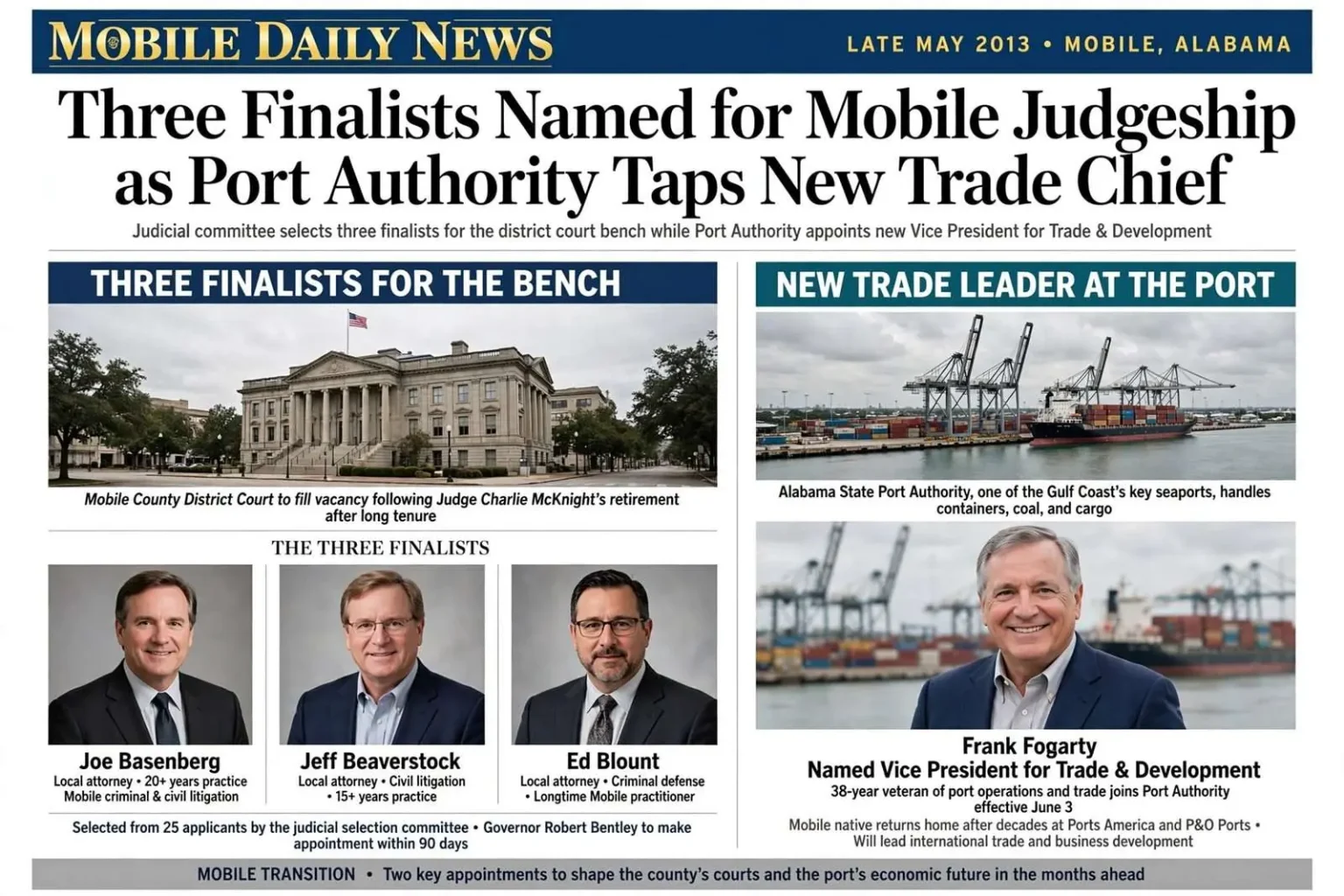
Late May 2013 brought resolution to one closely watched Mobile appointment and the beginning of another. A judicial committee settled on three finalists for a district court seat, while the Alabama State Port Authority announced new leadership for its trade division, developments that touched both the courthouse and the working waterfront.
The two announcements landed within the same news cycle, and together they captured a moment of transition for Mobile’s public institutions. One decision would determine who presided over one of the busiest district courtrooms in the county. The other would shape how the port, the economic engine of the region, pursued cargo business across the globe. Both appointments also highlighted the distinct paths Mobile’s civic institutions follow when filling top positions — one routed through the governor’s office, the other through a port authority’s executive leadership.
Three Finalists for the Bench
The Mobile County judicial selection committee named local attorneys Joe Basenberg, Jeff Beaverstock and Ed Blount as the three finalists to fill the impending vacancy on the Mobile County District Court. The committee had winnowed the choices from a field of 25 applicants who sought the judgeship, which would be created at month’s end with the retirement of District Judge Charlie McKnight.
The selection committee’s task was to move a long list of applicants down to a short list the governor could act on. Committees of this kind typically include local bar representatives and community members who review applications, interview candidates and weigh each lawyer’s courtroom experience, reputation and ties to the community before forwarding their recommendations.
With the committee’s work complete, Gov. Robert Bentley would have 90 days to select the appointee from among the three. Under Alabama’s system for filling judicial vacancies, the governor’s choice would serve the remainder of the term, and the position would later come before voters in the ordinary course of elections.
District courts occupy a demanding middle ground in Alabama’s judicial system. Mobile County District Court judges handle misdemeanor criminal cases, small claims and civil disputes up to a statutory threshold, traffic cases and the preliminary hearings that determine whether felony charges advance to a grand jury. The docket is one of the heaviest in the county, which is why vacancies on the bench draw sustained attention from the local legal community.
The retirement of Judge Charlie McKnight marked the end of a long tenure on the Mobile County bench and opened one of the county’s most visible judicial seats. The three finalists each brought their own record of legal practice in Mobile, and all three were familiar names in the local bar, having built their careers in the same courts they now hoped to preside over.
For the 25 lawyers who applied, the process underscored how competitive judicial appointments can be in a county of Mobile’s size. A seat on the district court bench offers a different kind of legal career — one that trades private practice for public service and places an attorney at the center of the community’s daily legal life.
Cochran Passes on Congress
In the region’s political news, informed sources indicated that Mobile County Sheriff Sam Cochran would not enter the race to succeed U.S. Rep. Jo Bonner in Alabama’s First Congressional District. The decision removed one prominent name from the growing list of prospects eyeing the seat, which Bonner planned to vacate later in the summer.
Bonner’s announcement that he would step down from the House seat set off one of the more active political seasons southwest Alabama had seen in years. The First Congressional District takes in Mobile and stretches across the southern part of the state, a region that includes the port city, Baldwin County’s growing communities and the military installations that anchor the local economy.
Cochran, as the longtime sheriff of Mobile County, carried the kind of name recognition that most candidates spend years trying to build. His law enforcement background and decades in county government would have made him a formidable contender, and political watchers had counted him among the potential heavyweights from the moment the seat opened up.
His decision to stay out of the race left the field to other contenders and narrowed the early speculation about who would seek the Republican nomination for the vacancy. Sheriff is itself an elected position in Alabama, and remaining in the post meant Cochran would continue leading one of the largest sheriff’s offices in the state rather than launching a campaign for Washington.
The episode also illustrated how quickly vacancy politics move in Alabama. Once an incumbent congressman signals an early departure, the calculations of nearly every ambitious officeholder in the district change at once — some weighing a run, others deciding, as Cochran did, that the timing was not right. Each decision reshapes the field that ultimately appears on the ballot.
A New Trade Leader at the Port
At the Alabama State Port Authority, director and chief executive Jimmy Lyons announced that Frank Fogarty had been named vice president for trade and development. Fogarty would lead the authority’s international trade division and serve as a key figure in its sales and marketing initiatives, assuming his duties June 3.
“Mr. Fogarty’s extensive management experience in the port industry will enhance and expand the foundations laid in business development at the port,” Lyons said.
Fogarty brought 38 years of professional experience in domestic and international trade, terminal operations and stevedoring at U.S. ports. That background spanned both sides of the port business — the commercial work of attracting cargo and carriers, and the operational work of moving it across the docks — giving him a perspective that covered the full chain from sales pitch to ship’s hold.
Before joining the authority, he served as senior vice president for sales and marketing at Ports America in Iselin, New Jersey, and earlier as a vice president of P&O Ports North America in Houston. Both are significant names in American port operations, and Fogarty’s path through them placed him among the experienced hands that seaports compete to attract when filling their top commercial posts.
A native of Mobile, Fogarty held a bachelor of science degree from the University of South Alabama and was a graduate of the University of Tennessee’s executive development program. His return to the Port City represented a homecoming of sorts, bringing a Mobile native’s familiarity with the waterfront together with a national career in port management.
His appointment came at a moment of transition for the port’s trade division, underscoring the authority’s continued focus on expanding cargo and carrier business through its coastal terminals. The Port of Alabama in Mobile ranks among the major seaports on the Gulf of Mexico, handling containers, breakbulk cargo, coal and other commodities that move through its terminals along the Mobile River and into the bay.
The vice president for trade and development sits at the center of that effort. The role involves courting shipping lines, freight forwarders and cargo owners, defending existing business against competing ports and building the case for new services. Success in the position is measured in tonnage, container counts and carrier calls — numbers that translate directly into jobs and economic activity across the region.
Lyons, who led the authority through a period of ambitious expansion, framed the hire as a continuation of momentum already established by the port’s business development team. For a Gulf port competing with larger operations in New Orleans, Houston and the Atlantic coast, recruiting a trade executive with decades of national experience was a statement about the scale of business Mobile intended to pursue.
What the Appointments Meant for Mobile
Taken together, the May announcements offered a snapshot of how Mobile’s institutions renew themselves. A governor’s appointment would soon decide who held a county judgeship; a port authority’s internal promotion from the national talent pool would shape its commercial future. In both cases, the decisions would ripple through the community long after the initial headlines faded.
The judicial vacancy carried immediate practical consequences for the county’s courts. Every felony case that passed through district court for preliminary hearing, every misdemeanor trial and every small claims dispute would eventually land on the new judge’s docket, and the 90-day appointment window meant the courthouse would know the answer before summer’s end.
The port appointment, meanwhile, spoke to longer horizons. Trade development work bears fruit over years, as shipping services are won, cargo contracts are signed and terminal investments are justified by growing volumes. A veteran of 38 years in the industry arriving in June would spend his first months learning the authority’s operations and its book of business before the effects of his leadership could be measured.
For Mobile residents, the connection between the two stories was closer than it might appear. The district court handles the legal traffic of everyday life — traffic cases, disputes, preliminary hearings — while the port supplies a substantial share of the economic activity that fills the region’s payrolls. Both institutions, in their different ways, shape the daily experience of living and working in the Port City.
The spring of 2013 was a busy season for such transitions across Mobile’s public institutions, with retirements, appointments and political maneuvering touching the courthouse, the courthouse annex and the docks all at once. The finalist list for the judgeship, Cochran’s withdrawal from congressional consideration and Fogarty’s arrival at the port each marked one chapter closing and another beginning.
As June approached, attention in the legal community turned to the governor’s office, where the choice among Basenberg, Beaverstock and Blount would be made. On the waterfront, attention turned to the new trade executive tasked with growing cargo business at one of the Gulf’s most historically significant ports. In both arenas, Mobile’s institutions were preparing for the people who would lead them into the years ahead.