Bradley Byrne Set to Enter First District Race as Congressional Field Forms
Bradley Byrne scheduled a big announcement widely expected to launch his bid for the First District congressional seat, as the port earned a credit upgrade and a Baldwin sheriff's race took shape.
The race to succeed U.S. Rep. Jo Bonner in Alabama’s First Congressional District gained fresh momentum in early June 2013, as a familiar figure prepared to make his intentions known and other contests up and down the coast came into sharper focus. With Bonner’s planned departure looming in August, the Southwest Alabama political calendar was suddenly crowded: a congressional field taking shape, a port reporting financial good news, a sheriff’s race forming in Baldwin County, and Mobile’s mayoral contest moving into public view.
Byrne prepares an announcement
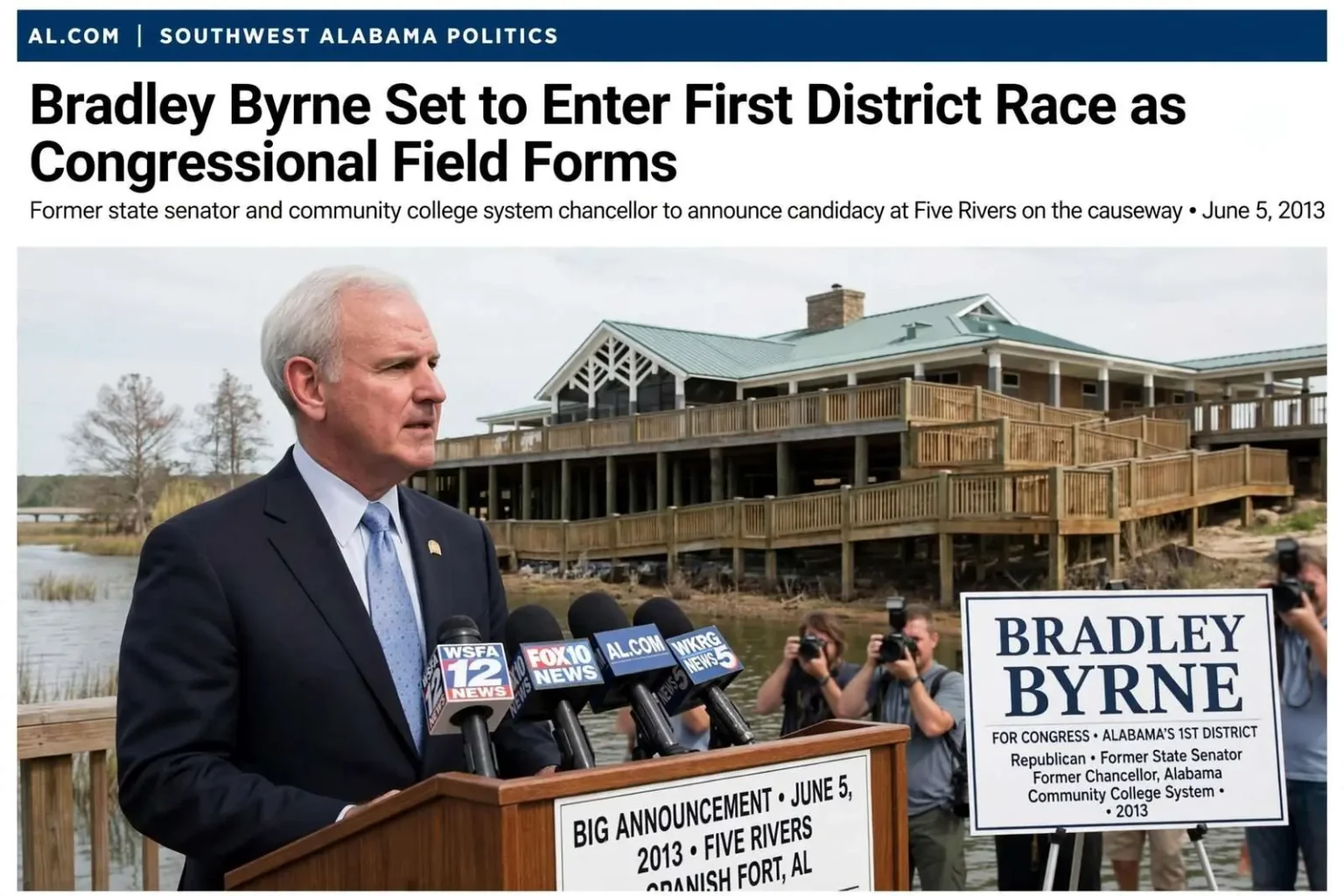
Bradley Byrne scheduled what his camp billed as a “big announcement” regarding his political future at Five Rivers on the causeway in Spanish Fort. The venue choice was no accident — the Delta Resource Center on the Spanish Fort causeway overlooks the Mobile-Tensaw Delta, one of Baldwin County’s most recognizable landmarks, and sits at the symbolic seam between the two counties that anchor the First District. Byrne was widely expected to declare his candidacy for the First District seat, which Bonner planned to vacate in August.
Byrne brought one of the more varied résumés in Alabama Republican politics to the prospect. A former chancellor of the state’s two-year college system and a former member of the state Board of Education, Byrne had taken over the community college system in 2007 at one of its most difficult moments, when the system was working to restore public confidence amid a sweeping corruption investigation. He had represented Baldwin County in the state Senate and had lost a 2010 Republican gubernatorial runoff to Robert Bentley — a defeat that, in the algebra of Alabama politics, left him with statewide name recognition and a network of donors and operatives waiting for a second act.
Prospective successors to Bonner were also invited to address a Republican breakfast club on the causeway, giving the gathering the feel of an unofficial cattle call. Bonner’s planned resignation meant the seat would be filled by a special election rather than waiting for the next regular cycle — a compressed timeline that rewards candidates who can organize quickly and raises the stakes of every early announcement. For the First District, a seat that has stretched across Mobile, Baldwin, and the counties of Southwest Alabama, the succession contest would decide who carried the region’s interests in Washington, from port funding to coastal restoration dollars.
A stronger credit rating at the port
The Alabama State Port Authority received welcome financial news as Standard & Poor’s upgraded its outstanding dock facilities revenue bonds to an A-minus rating from BBB-plus, with a stable outlook. For a public agency that finances terminals, cranes and channels in the bond market, a two-notch-adjacent upgrade is real money: stronger ratings translate into lower borrowing costs on every future bond issue, and they signal to shippers and investors that the port’s finances are on solid footing.
Director and chief executive James K. Lyons said the agency was very pleased that the rating service had recognized substantial improvements in the port’s financial position. Lyons, who led the Port Authority for decades, had spent years steering the agency through the kind of capital investments — new terminals, deeper berths and expanded coal capacity at McDuffie Island — that strain finances before they pay off. The upgrade was, in effect, a credit-market verdict that the strategy was working.
S&P cited the potential for revenue diversification with the opening of the Pinto Terminal, a strong niche position, rising cargo trends and improved financial margins. Each element pointed to the same underlying story. The Pinto Terminal, built on the Choctaw Point peninsula at the mouth of the Mobile River, added modern container capacity at a port long dominated by bulk and breakbulk cargo, giving the Authority a foothold in the container trade that had largely bypassed Mobile. The niche position reflected the port’s specialized strengths — coal, forest products, and heavy cargo — that competitors elsewhere on the Gulf cannot easily replicate. Rising cargo trends and improved margins rounded out the case that Mobile’s port was positioned to grow rather than merely hold steady.
The timing mattered beyond the bond desk. In 2013, the Port of Mobile ranked among the busiest ports on the Gulf of Mexico by tonnage, and the state had recently begun investing heavily in its future through the Alabama Port Authority’s partnerships and, later, the state’s commitment to deepening the federal channel. An A-minus rating in mid-2013 was an early marker in the run of financial and infrastructure milestones that would follow for the port in the years ahead.
A challenge brewing in Baldwin
In Baldwin County, Larry Milstid, a former chief deputy in the sheriff’s department during the Jimmy Johnson era, announced he would seek the office himself in the next Republican primary. In Baldwin County, where the Republican primary is effectively the general election, that announcement put the county’s top law enforcement job in play before a single vote had been cast.
Incumbent Sheriff Hoss Mack was seeking re-election. Mack had held the office since succeeding Johnson, presiding over a department responsible for policing a county that was among the fastest-growing in Alabama — a stretch that spans from the causeway communities and the Eastern Shore to the farm towns and coastal enclaves south of U.S. 98. Both men were residents of Silverhill, setting up a contest between two figures well known in the same small south Baldwin community, a detail that promised a personal, neighbor-to-neighbor campaign in a county where law enforcement runs on familiarity.
Milstid’s bid also carried the weight of institutional memory. As a former chief deputy under Johnson, whose tenure stretched across decades of Baldwin County’s transformation from a rural farming county into one of the state’s population powerhouses, Milstid had seen the department at nearly every scale — from a small rural force to the modern agency required to police cities like Gulf Shores, Fairhope and Daphne and the corridors between them. Challenges from inside the department’s own alumni are among the hardest kind for an incumbent to dismiss, because they typically come with the endorsement of retired deputies and their families, a constituency that votes heavily in county Republican primaries.
The mayoral race reaches the voters
In Mobile, the summer mayoral contest continued to unfold in public forums. The Interdenominational Ministerial Alliance of Mobile and Greater Vicinity planned a mayoral forum at John L. LeFlore High School, where incumbent Mayor Sam Jones and challenger Sandy Stimpson would address issues facing the city, with seating limited to 250. The alliance — a decades-old organization of Black clergy that has long served as a gatekeeper in Mobile politics — lent the forum particular weight, since its endorsement and the turnout its congregations can produce have shaped city elections for generations.
The venue itself carried history. John L. LeFlore High School is named for the civil rights leader whose decades of organizing in Mobile — through the NAACP and the Non-Partisan Voters League — reshaped the city’s political structure and opened municipal office to Black candidates. A mayoral forum held under his name, in a summer when the city’s first Black mayor was seeking a third term, tied the present campaign to the long arc of the city’s political history.
Jones, a former city councilman and county commissioner first elected mayor in 2005, faced a challenge in the race’s arithmetic: Mobile’s municipal elections are nonpartisan on paper, but this contest would be decided by coalition — long-standing support in the city’s Black communities against a formidable drive for change votes in west Mobile. Stimpson, a Mobile businessman and civic leader, had made city finances and infrastructure his campaign’s central themes and had spent months building the argument that the city needed new management. Stimpson was also scheduled to appear on a local call-in radio program, extending his reach to voters who would never squeeze into a school auditorium with 250 seats.
The forum season mattered in a campaign where the two contenders would rarely share a stage. With limited media markets and a city divided between downtown, Midtown and west Mobile’s annexed suburbs, public appearances were where undecided voters would actually see the candidates side by side — and where questions about streets, drainage, crime and the city budget would be asked without the filtering of campaign advertising.
A judicial vacancy waiting on the governor
And the judicial picture remained in view, as the three finalists for the impending Mobile County District Court vacancy, attorneys Joe Basenberg, Jeff Beaverstock and Ed Blount, awaited Gov. Bentley’s decision following Judge Charlie McKnight’s retirement. Judicial vacancies in Alabama are filled by gubernatorial appointment rather than election in the moment, a process that concentrates considerable power in the governor’s office and gives the state bar’s local judicial selection committee a decisive role in narrowing the field.
Each of the three finalists brought a distinct profile to the decision. Basenberg was a veteran of Mobile’s legal community with deep roots in local Democratic-leaning civic circles, Beaverstock carried a long commercial litigation practice and a reputation from the city’s business bar, and Blount brought his own record of practice and public service. District Court judges in Mobile County handle the cases most residents are likely to encounter — small claims, misdemeanors, preliminary hearings in felonies, and the county’s growing domestic relations docket — which makes the appointment one with daily, practical consequences for the people of the county.
McKnight’s retirement marked one more transition on a bench that had seen several in recent years, and the eventual appointment would set up the appointed judge to run in the next election cycle as the incumbent — an advantage that in Mobile County politics is difficult to overstate. For the three attorneys in the waiting room, the summer would be spent, in the quiet way of judicial appointments, simply waiting on a call from the governor’s office.
A season of decisions for Southwest Alabama
Taken together, the first weeks of June 2013 captured how much of Southwest Alabama’s public life turns in a single season. A congressional seat opened a contest that would define the region’s voice in Washington; the port’s upgrade hinted at the economic future the region was building toward; Baldwin County’s sheriff’s race would test a generation of change in the state’s fastest-growing county; and Mobile’s mayoral forum season would decide who steered the city’s government for the next four years. For voters across the First District, the work of paying attention had officially begun.