Mobile’s Alabama School of Math and Science Brings Rocketry to Rural Students
Mobile's Alabama School of Math and Science sent staff and students on a rocketry outreach trip to Sumter County schools as part of its statewide mission.
The Alabama School of Math and Science, the Mobile-based public magnet school, is expanding its reach into rural parts of the state through a new outreach program built around a subject almost guaranteed to grab a student’s attention: rockets.
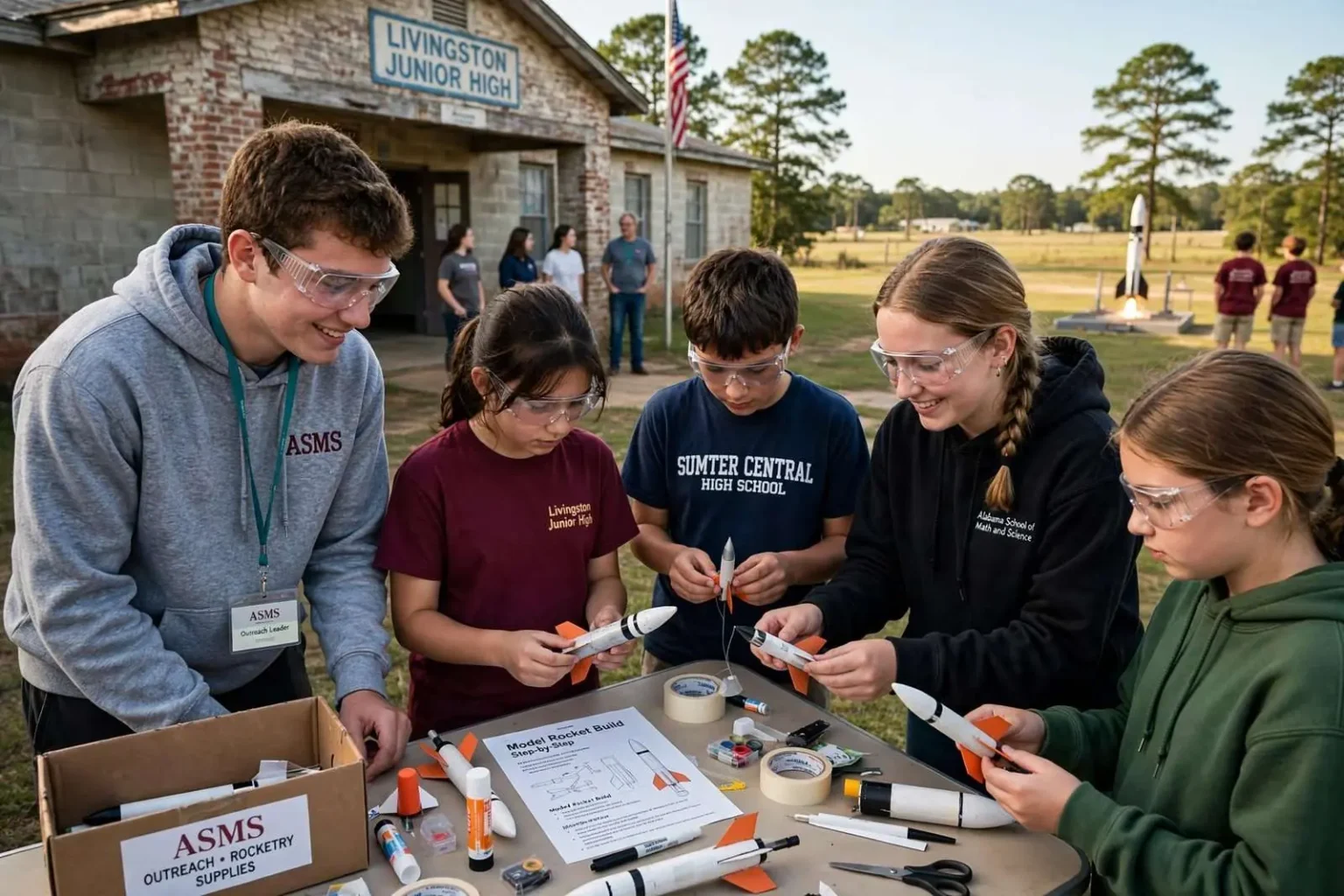
Staff and current students from the Mobile school recently traveled to Sumter Central High School and Livingston Junior High in Sumter County for the outreach program’s first rocketry demonstration. Students there built their own model rockets in small groups before heading outside to watch them launch, giving them a hands-on introduction to the kind of science programming ASMS is known for.
The visits brought a slice of the Mobile campus’s specialized curriculum directly to west Alabama, hundreds of miles from the residential school that most rural students have only heard about, if they have heard of it at all. For the ASMS team, the day was equal parts science lesson and recruiting mission — a chance to show students in one of the state’s most rural counties what hands-on STEM education looks like and to encourage them to imagine themselves in a program built for high achievers.
A Mission That Reaches Beyond Mobile
The school’s president said the outreach effort reflects a core part of ASMS’s mission, which centers on developing the potential of high-achieving students statewide, with particular attention to those who may not otherwise have access to challenging academic opportunities close to home, including students from economically disadvantaged communities.
That statewide mandate has been part of the school’s identity since its creation by the Alabama Legislature as a public, residential magnet school. Students attend tuition-free, living on the Mobile campus for an intensive academic experience that concentrates on mathematics, science and technology. Because admission is open to students from every corner of Alabama, the school has long faced the challenge of making sure families in small towns — far from Mobile and often without strong pipelines of information about selective programs — know the opportunity exists and understand how to pursue it.
Rocketry, school officials say, is a natural vehicle for that message. Building and launching a model rocket compresses physics, engineering, mathematics and teamwork into a single afternoon, and the spectacle of a launch tends to stick with students in a way that a brochure or a recruiting fair cannot. The demonstration format also travels well: the materials are portable, the activity works in a schoolyard, and the excitement is immediate.
Inside the Sumter County Visit
The trip was led by the school’s director of student services and public relations coordinator, along with several ASMS students who volunteered as outreach leaders, helping guide the rocket-building activities and answering questions from the younger students about life at the residential math and science school in Mobile.
The presence of current ASMS students was a deliberate choice. Outreach organizers have found that younger students often respond more openly to peers than to adults, asking questions about dorm life, coursework and friendships that they might hesitate to raise with school staff. The ASMS volunteers walked the Sumter County groups through the build process, helped troubleshoot rocket designs, and shared their own paths from small Alabama hometowns to the Mobile campus.
Organizers said the younger students responded enthusiastically to the demonstrations, with the rocket launches drawing particular excitement from the crowd. Each launch gave the groups a chance to see whether the rockets they had assembled in the classroom would fly — and the outdoor flights delivered the kind of payoff that educators hope will linger long after the visiting team heads back down the highway.
For many students in rural counties, the visit offered a rare glimpse of the kind of specialized STEM programming available at ASMS, a school that draws students from across Alabama to its Mobile campus for an intensive residential academic experience. Sumter County, tucked against the Mississippi state line in Alabama’s Black Belt, has a small population spread over a wide rural area, and students there typically have fewer opportunities to encounter specialized science programming than their counterparts in the state’s metro areas. School systems in the region have worked in recent years to broaden what they can offer, but resources remain stretched across rural districts statewide.
That gap is precisely what the outreach program is designed to narrow. Rather than waiting for rural students to discover the school on their own, ASMS is taking a taste of its programming into their home communities, meeting students where they are and letting them experience challenging science work before they ever have to make a decision about applying to a residential school.
More Counties on the Schedule
The Sumter County stop is just the beginning of a broader outreach push. ASMS said its team plans to take the rocketry program to Perry County and Wilcox County next, continuing an effort to introduce students in rural, often underserved parts of the state to opportunities they might not otherwise know exist.
Perry and Wilcox counties, like Sumter, are Black Belt communities where school leaders have long sought ways to expand advanced coursework and enrichment activities for motivated students. Bringing the rocketry demonstrations to those counties will extend the program’s footprint across a band of west-central and south-central Alabama where the distance to Mobile makes casual recruiting visits impractical and where word-of-mouth about selective programs travels slowly.
School officials say they hope the visits plant a seed with students who might not have considered themselves candidates for a selective math and science academy, encouraging them to look into ASMS and similar programs as they plan for their education.
The school’s leaders have framed that message as central to the institution’s purpose. A residential magnet school can only fulfill its statewide mission, they argue, if talented students in places like Livingston, Marion and Camden see the school as something built for them rather than as a distant institution reserved for families in Alabama’s larger cities. Every rural visit, on that view, is an investment in a pipeline that keeps the school’s enrollment representative of the whole state.
Why Rockets Work as a Teaching Tool
Educators who work in STEM outreach often point to rocketry as one of the most effective entry points for students who have not yet shown interest in science. The activity rewards careful measurement, patience and teamwork, but it also delivers a dramatic, visible result — a rocket climbing into the sky — that immediately connects the abstract concepts of thrust, drag and stability to something students can see and feel. Programs built around model rockets have been used for decades by schools, 4-H clubs and national organizations to pull students into engineering pathways, and Alabama has an especially rich backdrop for that kind of work.
The state’s ties to aerospace run deep, from the Marshall Space Flight Center in Huntsville, where rockets that carried Americans to the Moon were developed, to the United Launch Alliance operations in Decatur and the aerospace employers spread along the Gulf Coast. For Alabama students, a model rocket on a schoolyard is not just a toy; it is a small piece of an industry that has shaped the state’s economy and identity for two generations. Outreach teams like the one ASMS sent to Sumter County often lean on that context, encouraging students to see aerospace and engineering as careers that are genuinely within reach from an Alabama hometown.
Whether the Sumter County students who watched their rockets fly will eventually apply to the Mobile school is impossible to predict, but school officials say the goal of the program is broader than any single recruitment cycle. Some students will remember the visit as the first time science felt like something they could do rather than something done to them in a classroom. Others may follow up with their counselors, ask about applications, or simply carry a new confidence about math and science into the rest of their schooling.
The model used in Sumter County also carries a practical advantage for a small outreach team: it scales. The same group of ASMS students who guided the rocket-building sessions can lead them again in a different county the following week, and the materials can be reused across visits. That efficiency matters for a school working to cover a large geographic area with a limited staff, and it helps explain why rocketry emerged as the centerpiece of the new program rather than laboratory experiments that require specialized equipment.
The ASMS team plans to keep building on that momentum as the outreach schedule expands. With Perry and Wilcox counties next in line, the rocketry program is set to reach a stretch of rural Alabama that has rarely seen this kind of direct engagement from the Mobile campus — and, if the enthusiasm in Sumter County was any indication, the launches to come should draw plenty of excited crowds of their own.