BASF Gift Keeps Kids’ Lab Chemistry Workshops Going at Mobile Exploreum
A $20,000 donation from BASF will keep the popular Kids' Lab hands-on chemistry workshops running at Mobile's Gulf Coast Exploreum Science Center.
Young science enthusiasts in Mobile will keep getting the chance to mix, measure and experiment thanks to a $20,000 gift from chemical manufacturer BASF, which will allow popular hands-on chemistry workshops to continue at the Gulf Coast Exploreum Science Center. The renewal of the company’s support secures the future of one of the downtown science center’s most popular educational offerings, and it continues a partnership that has put thousands of Gulf Coast children in lab aprons over the past several years.
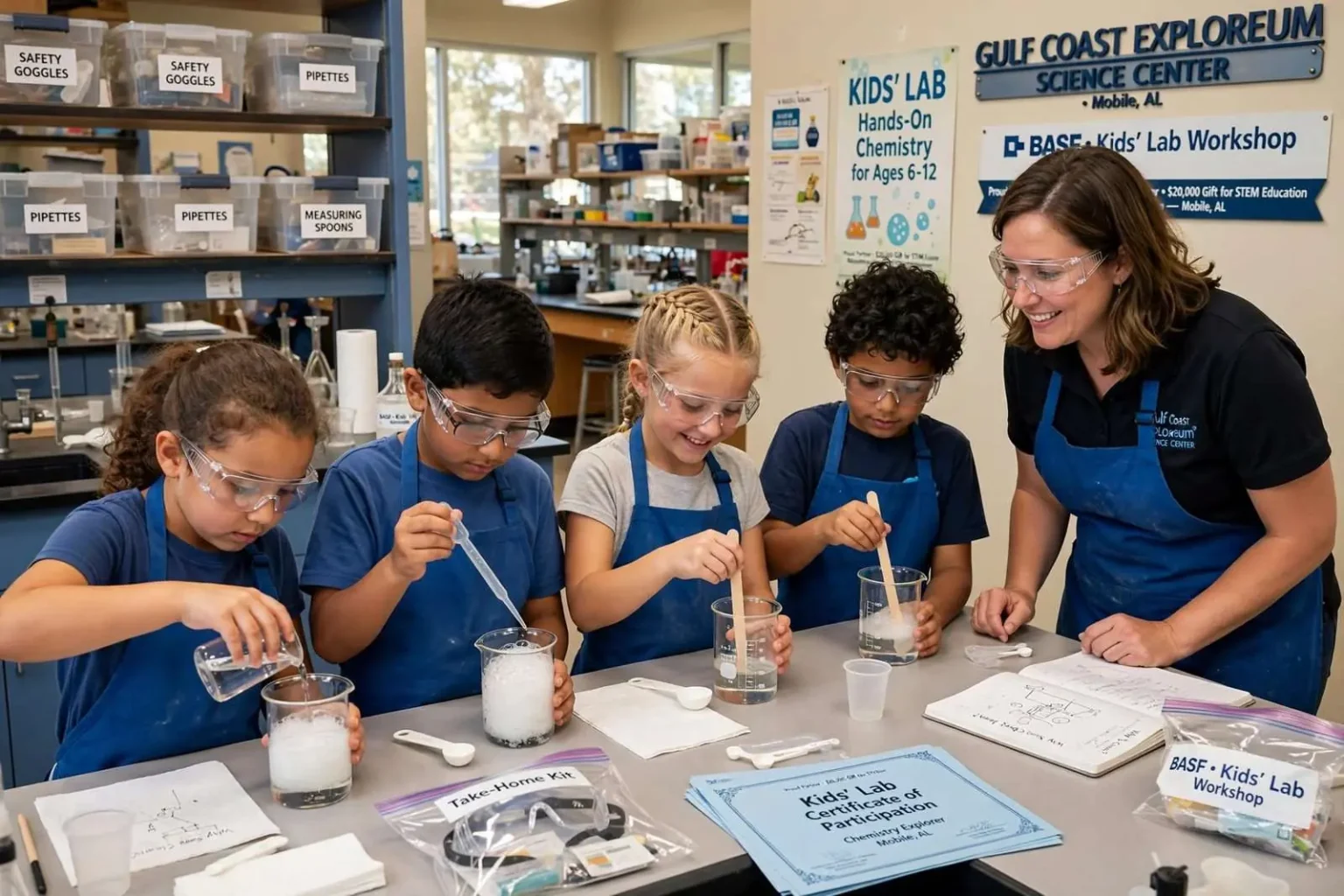
The donation supports the Exploreum’s Kids’ Lab program, a series of instructor-led sessions aimed at children between the ages of 6 and 12. The program occupies a specific niche in the museum’s education lineup: unlike drop-in exhibits or large-stage demonstrations, Kids’ Lab sessions put each child at a workstation with real materials, guided by an instructor through experiments designed for their age group. The format gives elementary-age students a laboratory experience most will not encounter in a school classroom until years later, if at all.
During each workshop, young participants dig into chemistry through safe, engaging experiments and interactive demonstrations designed to show how the science shapes everyday life. The sessions are built around the idea that chemistry is not an abstraction confined to an industrial plant or a textbook — it is the reason soap cleans, bread rises, and plastics hold their shape. Kids’ Lab instructors walk students through the connections, letting them see and touch the reactions for themselves.
“Our Kids’ Lab program is a fun, interactive experience which allows students to learn how chemistry improves everyday life,” said George Vann, vice president of BASF’s McIntosh site, in a statement announcing the renewed support for the award-winning workshops.
The McIntosh connection matters locally. BASF operates a major chemical manufacturing complex in the small Mobile County community of McIntosh, north of the city along the Tombigbee River, making the company not just a corporate donor but a hometown employer whose products and workforce are part of the regional economy. The company’s support for chemistry education in Mobile carries a natural logic: the students measuring and mixing at the Exploreum today are the potential chemists, engineers, and operators of the region’s chemical industry tomorrow.
Reaching beyond the museum walls
The company’s involvement reaches well beyond the downtown science center. BASF employee volunteers also carry the program into area schools, and Vann noted that nearly 7,000 students had taken part in the experiments over the previous two years. The school outreach model sends the same hands-on chemistry into classrooms that might never make a field trip to the Exploreum, extending the program’s reach across southwest Alabama and into communities where museum visits are logistically difficult.
Employee volunteers are a distinctive feature of the program. The scientists, engineers, and operators who staff the sessions bring working knowledge of industrial chemistry to the table, and their presence gives students a face for careers many had never considered. For BASF, the volunteers are also an investment in the community where many of them live — the kind of engagement companies increasingly identify as central to their workforce pipeline and civic standing.
Each child who participates walks away with tangible reminders of the experience, including a lab apron, safety goggles, a certificate of participation and a pouch of take-home items. The take-homes are more than souvenirs: the apron and goggles make each child a participant in the ritual of laboratory science, and the certificate formalizes what they accomplished. Teachers and parents have noted that the physical items give children a way to keep the experience alive after the workshop ends.
Exploreum officials welcomed the continued partnership. Jan McKay, the center’s executive director, thanked BASF for its “ongoing support of science education” and said the collaboration lets the museum bring close-up demonstrations and direct instruction to children.
“Most importantly, it raises science literacy amongst young people throughout the state and region,” McKay said.
The emphasis on science literacy reflects the Exploreum’s broader mission as the Gulf Coast’s principal hands-on science museum. The center, located in downtown Mobile near the city’s museums and historic district, serves school groups from across south Alabama and the panhandle with traveling exhibits, a domed theater, and permanent galleries alongside its educational programming. Corporate partnerships like the BASF gift fund programming that admission revenue alone could not sustain.
A global program with local roots
The Kids’ Lab initiative is part of a broader global effort by the German-based company. Since 2010, BASF has delivered the program in more than 16 countries and reached an estimated 21,000 participants in North America alone. The scale makes the Mobile sessions one node in an international education network, but the program’s design — small groups, real experiments, local volunteers — keeps each site rooted in its own community.
BASF’s commitment to science education extends across its North American operations, and the company has framed programs like Kids’ Lab as both a civic contribution and a long-term investment in the technical workforce that manufacturers depend on. Chemical manufacturing in particular faces a well-documented challenge in attracting younger workers, and early positive exposure to chemistry is where that pipeline begins.
In Mobile County, that equation has local weight. The McIntosh complex and the cluster of chemical and industrial facilities along the river north of Mobile employ thousands of workers in skilled positions — operators, lab technicians, maintenance trades, and engineers — and the region’s schools and museums are where future interest in those careers is kindled. Programs that make chemistry tangible for a ten-year-old serve that economic reality as directly as any recruiting effort.
For the Exploreum, the gift arrives as part of a continuing expansion of its educational role. Science centers across the country have taken on a growing share of informal STEM education as schools face constraints on field trips and laboratory resources, and the Exploreum’s instructor-led workshops are its answer — programming that delivers what classrooms cannot, at the age when students are deciding whether science is for them.
What the workshops look like
A typical Kids’ Lab session runs children through an experiment arc: an introduction to the day’s theme, hands-on work with safe household or laboratory materials, observation of the results, and a wrap-up conversation connecting what they saw to chemistry in the world around them. Instructors are trained to keep the sessions moving — the audience is elementary-age, and the design leans on short tasks, visible reactions, and plenty of interaction.
Safety instruction is built into the experience. Children don their goggles and aprons before touching any materials, and the sessions model the discipline of real laboratory work in miniature. The take-home pouch reinforces the lessons with materials families can use to revisit the experiments together.
The award-winning status of the workshops reflects recognition the program has earned within the museum and corporate-giving worlds, and the Exploreum has pointed to it as a model for its other educational offerings. The sessions typically fill quickly when they are scheduled, and the museum’s education staff have made the program a recurring fixture on the center’s calendar rather than an occasional special event.
For families in the Mobile area, the latest contribution means one of the region’s signature science education programs will continue uninterrupted — another cycle of aprons, goggles, and first reactions measured by small hands. For BASF, it is a renewal of a partnership that has already reached thousands of students. And for the children who fill the workshop stations in the coming year, it is a chance to learn, in the most literal way possible, what chemistry is and does.
Chemistry, for most elementary students, is a word they have heard but never handled. The Kids’ Lab sessions are designed to close that gap early, at an age when research on education consistently shows children forming lasting attitudes about science. A child who has watched a reaction foam in a beaker she is holding approaches the subject differently in middle school than one who has only read about it — and that difference, multiplied across thousands of students, is what programs of this kind are built to produce.
The Exploreum’s role as the region’s principal informal science venue gives it reach that individual schools cannot match. School groups from Mobile, Baldwin, and Washington counties, and from across the state line in Mississippi and the Florida panhandle, pass through the center’s doors throughout the year, and the education staff tailor programming to grade levels in ways classroom teachers can request when they book. The Kids’ Lab slots into that schedule as a guaranteed hands-on component for visiting groups.
The museum’s downtown location reinforces its accessibility. Situated among Mobile’s museums and within walking distance of the city’s convention facilities and historic core, the Exploreum draws both scheduled school visits and walk-in families, tourists, and weekend visitors. Its mix of traveling exhibitions and permanent galleries keeps local families returning, and its educational programs anchor the center’s relationship with regional schools.
The industry-education partnership model
The BASF-Exploreum partnership is an example of a model that has become central to science education funding: manufacturers underwrite informal education programming, museums deliver it, and employee volunteers provide the human connection between the two. For museums, corporate gifts like the $20,000 renewal fund programming that neither admission fees nor school budgets could cover. For companies, the visibility and community standing are paired with a concrete workforce development rationale.
Corporate science education programs have grown in sophistication as companies recognize that their future employees’ interest in technical careers is often decided in elementary school. The most effective programs, like Kids’ Lab, avoid recruiting language entirely — they simply make the science engaging and let the exposure do the work. The aprons and goggles a child takes home carry no message beyond participation, but the memory of a successful experiment has a way of persisting.
The volunteer component also builds relationships that outlast any single session. Teachers whose classrooms receive the school outreach visits gain a contact in the region’s industrial community, and the volunteers themselves — many of them parents of school-age children — become advocates for the program within their own networks. That web of relationships is difficult to replicate and is a large part of why the partnership has renewed year after year.
For the coming year, the renewed gift means the workshop schedule continues as planned: sessions at the Exploreum, outreach visits to area schools, and thousands more children who will pull on an apron, put on goggles, and find out what chemistry feels like. In a region whose economy runs in significant part on the chemical industry, that early familiarity is an asset that compounds — one student, one experiment, one workshop at a time.