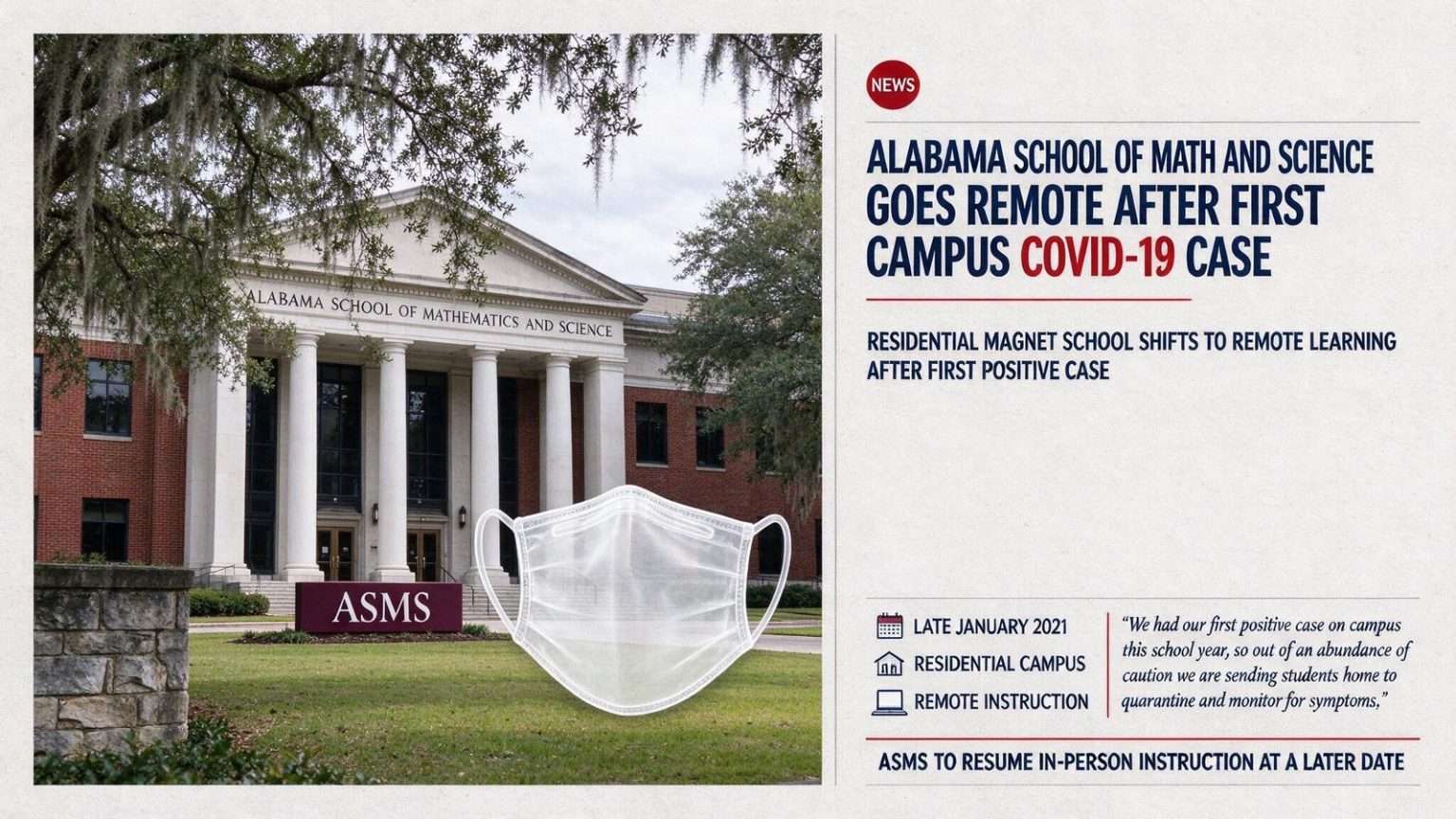
The Alabama School of Mathematics and Science has shifted to remote instruction after recording its first positive COVID-19 case on campus this school year, school officials said in late January 2021. The residential magnet school, located in Mobile’s Spring Hill neighborhood, sent students home to quarantine and monitor for symptoms out of an abundance of caution, according to Allyson McMaken, the school’s assistant director of communications.
“We had our first positive case on campus this school year, so out of an abundance of caution we are sending students home to quarantine and monitor for symptoms,” McMaken said. Because the school had already rotated between in-person and distance learning at several points during the 2020-21 academic year, administrators said students and faculty were well prepared for the pivot back to remote classes.
“Students have been learning remotely at different points this school year already, so this is something they and our faculty members are very prepared to do,” McMaken said. “We do plan to resume in-person instruction at a later date.”
A Complicated Quarantine for a Residential Campus
As Alabama’s only public residential high school, ASMS draws academically advanced juniors and seniors from across the state, most of whom live in campus dormitories during the school year. That residential model — central to the school’s mission of bringing together the state’s brightest students regardless of where they live — made quarantine logistics more complex than at a traditional day school.
Rather than isolating students in dormitories, officials chose to send students home while the campus situation was assessed and contact tracing was carried out. For families spread across Alabama’s 67 counties, the announcement meant abrupt travel plans and a return to at-home learning arrangements many had hoped had been left behind in the fall.
A School Built for the State’s Top Students
Founded in the late 1980s and located on a campus in Spring Hill, one of Mobile’s oldest and most storied neighborhoods, the Alabama School of Mathematics and Science serves juniors and seniors from every corner of the state. Admission is competitive and tuition-free for Alabama residents, with the state funding the specialized instruction that public school districts generally cannot offer at that depth.
Students at ASMS take an intensive STEM-focused curriculum — advanced mathematics, computer science, laboratory sciences, and engineering courses — alongside traditional humanities coursework, and many arrive having exhausted the advanced offerings at their home high schools. Dormitory life is a defining feature, with students from Baldwin County to the Tennessee Valley living side by side and participating in research projects, academic competitions, and residential programs that a conventional high school schedule cannot accommodate.
That density of shared living space is precisely what made COVID-19 management on campus a delicate task. Residential schools concentrate students in dormitories, dining halls, and laboratories around the clock, so a single positive case carries implications far beyond one classroom. School officials nationwide with residential programs faced the same calculus during the 2020-21 year: how to preserve the in-person experience that defines the institution while protecting students living in close quarters.
A Year of Pivots
The late January case and remote pivot came during an academic year defined by disruption. ASMS had already moved between in-person and distance learning multiple times in 2020-21 as conditions shifted across Mobile and the state, and administrators leaned on that accumulated experience when the first on-campus case arrived.
Faculty had refined their remote instruction practices across each cycle, and students had established routines for studying from home. That preparation, officials said, is what made the latest transition manageable rather than chaotic — a matter of switching modes, not building a system from scratch.
The school’s experience mirrored what residential and magnet programs across Alabama contended with throughout the pandemic. Schools that draw students from wide geographic areas faced added complications: students traveling long distances home and back, exposure risks during transit, and the challenge of coordinating quarantine timelines with dozens of different home school districts and county health departments.
COVID-19 in Alabama Schools in January 2021
The case arrived during the most dangerous stretch of the pandemic in Alabama to that point. Winter 2020-21 brought record hospitalizations across the state as holiday travel and indoor gatherings fueled community spread, and schools across Mobile County and beyond were reporting cases and quarantines on a regular basis as they attempted to keep campuses open.
Alabama’s K-12 schools had been given the option of remote or hybrid instruction throughout the year, and districts moved between models as local conditions demanded. In Mobile County, both public and private schools reported periodic closures and quarantine periods, making ASMS’ January announcement part of a familiar pattern for families across the region.
Statewide, the early weeks of 2021 also brought the first sustained vaccination campaign, with health workers and seniors prioritized as doses arrived in Alabama. School staff vaccinations were still being organized in many districts during that period, adding another layer of caution to decisions about in-person learning.
What the Remote Period Meant for Students
For ASMS students, the return to remote learning meant reverting to the video-based class schedules they had used during earlier remote periods. Laboratory work, senior research projects, and the collaborative study culture of a residential campus were the hardest elements to reproduce at a distance, and faculty worked to adapt hands-on components where possible.
Juniors and seniors also faced the broader backdrop of a disrupted college admissions cycle, with standardized testing sites intermittently closed and campus visits largely on hold. School counselors continued to work with students through the remote period to keep application and scholarship timelines on track.
Families, for their part, had to absorb the logistical shock of the sudden return home — students from the Mobile area could return quickly, while those from north Alabama and the Wiregrass faced hours of travel on short notice.
Spring Hill’s Landmark Campus
The school’s campus in Spring Hill sits among oak-lined streets in one of Mobile’s most historic districts, an area long associated with education and anchored by institutions including Spring Hill College, the Jesuit college founded in 1830. ASMS occupies a site that has served educational purposes for decades, and its dormitories, classrooms, and laboratories support the immersive program that distinguishes it from every other public high school in Alabama.
Graduates of the school go on to leading universities in Alabama and across the country, many in STEM fields, and the school’s alumni network spans engineering, medicine, research, and technology. That mission — cultivating the state’s future scientists and engineers — is what officials pointed to when explaining the decision to protect the campus community even at the cost of another remote period.
Planning the Return
Administrators said they planned to resume in-person instruction at a later date, once the quarantine period concluded and the campus was cleared for students to return safely. The school committed to communicating directly with families as the timeline firmed up, with officials emphasizing that the health of students and faculty would guide decisions more than any predetermined schedule.
The episode reinforced the operating reality for every Alabama school in the 2020-21 year: flexibility was the plan. For a residential campus like ASMS, the ability to shift modes quickly — and the confidence, built over a year of practice, that learning could continue remotely — proved to be the school’s most valuable pandemic tool.
A Model Tested by the Pandemic
The Alabama School of Mathematics and Science was created in the late 1980s by the state legislature as a public, residential magnet school with the mission of elevating STEM education across Alabama. Its founders modeled the concept on the growing network of state residential math and science schools taking shape across the country, institutions designed to concentrate advanced instruction and research opportunities that no single school district could sustain alone.
Over the following decades the school built a reputation as one of Alabama’s premier academic destinations, sending graduates to the nation’s top universities and anchoring Mobile’s identity as a center for education on the Gulf Coast. The residential model remained its distinguishing feature — a deliberate choice that allows students from small rural districts and large city systems alike to share classrooms, laboratories, and dormitories as peers.
The pandemic tested that model in ways its founders never envisioned. Where a day school can send students home each afternoon and deep-clean overnight, a residential campus must manage every hour of student life — dining, recreation, health care, and socializing — under public health rules. Each positive case carries the potential to touch an entire dormitory wing, and each quarantine decision affects families hundreds of miles away.
The Broader Lesson of a Disrupted Year
For educators across Alabama, the ASMS experience in late January 2021 illustrated both the fragility and the adaptability of pandemic-era schooling. Schools that had invested early in remote teaching capacity, clear communication with families, and flexible scheduling weathered their first on-campus cases far more smoothly than those that had held out for a normal year.
ASMS officials’ emphasis on preparation was a refrain heard across the state during that stretch of the academic year: the schools that fared best were not the ones that avoided cases, but the ones that had rehearsed their response. By the time the school’s first case arrived, students had already completed multiple remote cycles, faculty had refined their online instruction, and families had established routines for a pivot back home.
As the school looked toward resuming in-person instruction, the focus returned to the mission that brought students to Spring Hill in the first place — the laboratories, research projects, and residential community that no remote platform can fully replace. The pandemic had interrupted that experience repeatedly during the 2020-21 year, but for Alabama’s residential math and science school, each reopening carried the same goal as the first: bringing the state’s brightest students back together on campus to learn.