Driver Killed, Mobile County Deputy Hurt in Rangeline Road Crash
A driver died and a Mobile County deputy was injured in a head-on collision on Rangeline Road near Hamilton Boulevard early one Thursday morning.
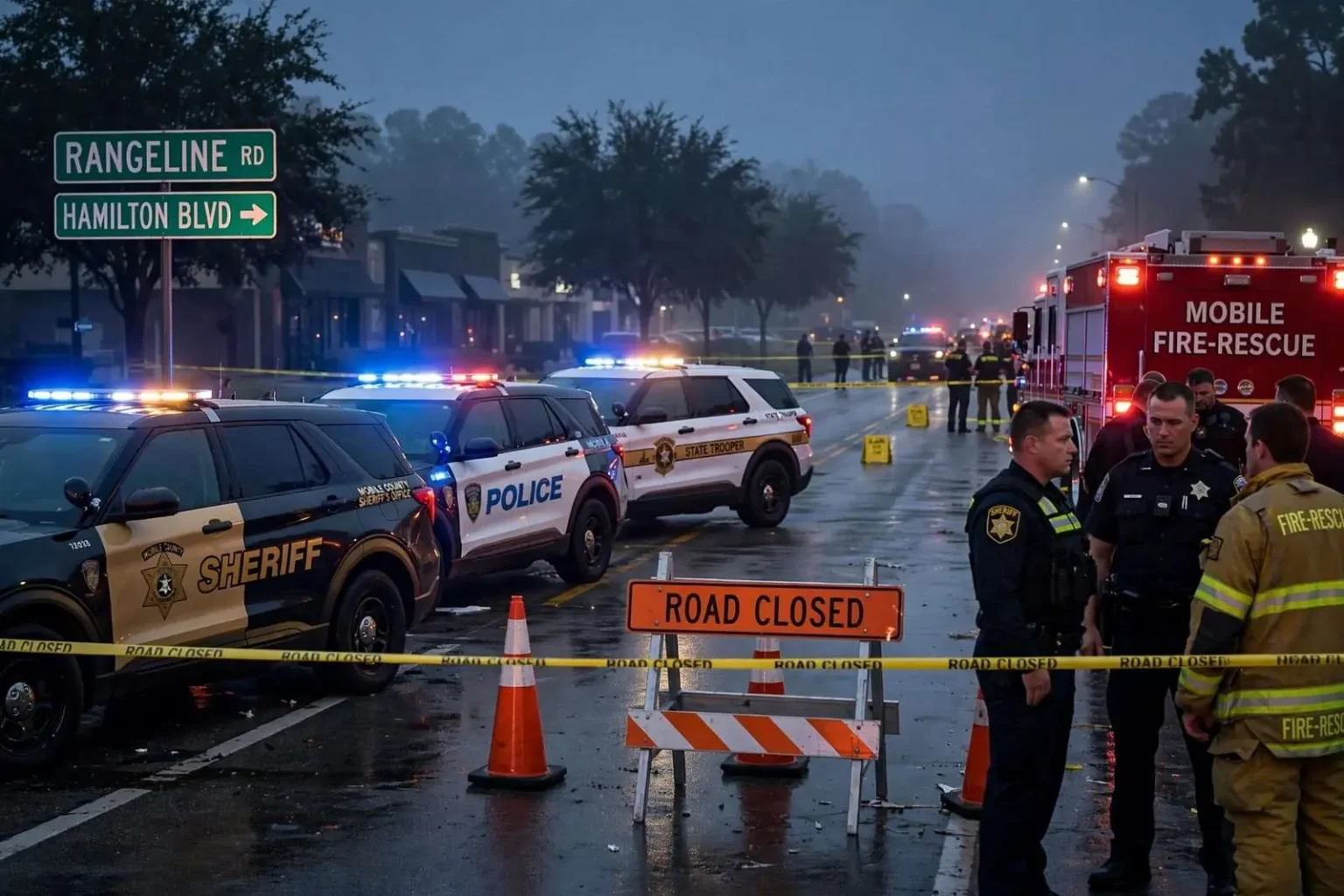
A Mobile County sheriff’s deputy was hurt and another driver was killed in a head-on collision on Rangeline Road early one Thursday morning, according to the Mobile County Sheriff’s Office. The wreck happened near Hamilton Boulevard during the pre-dawn hours, when visibility is at its lowest and traffic is light enough that vehicles often travel at full speed along the corridor.
The deputy was driving along Rangeline Road when his vehicle collided with an oncoming car, said Sheriff’s Office spokeswoman Lori Myles. The driver of the other vehicle, who was not immediately identified, died at the scene. Authorities withheld the motorist’s name pending notification of family members, a standard step that can take hours or longer when investigators are still working to confirm identities.
Early accounts pointed to the other motorist crossing into the wrong lane before impact. “We do have witnesses saying the deceased was driving on the wrong side of the road,” Myles said. Investigators cautioned that witness accounts gathered in the first hours after a crash are preliminary, and that a full reconstruction would weigh physical evidence, vehicle damage and scene measurements against what witnesses reported seeing.
Myles emphasized that the deputy was not responding to a call or engaged in a pursuit at the time of the collision. “The deputy was just driving — he wasn’t in a chase or anything like that,” she said. The distinction matters in how such crashes are evaluated, because emergency responses involving lights and sirens follow different rules of the road than ordinary patrol driving.
Deputy expected to recover
Emergency crews took the deputy to a local hospital, where he was treated for cuts and was expected to make a full recovery. “He doesn’t have anything life-threatening but he’s shaken up,” Myles said. Deputies spend long stretches of their shifts driving county roads alone, and collisions of this kind resonate throughout a department whose personnel face the roadway risks of the job every day.
The crash drew a large response from several agencies. Sheriff’s deputies, Mobile police officers and Alabama State Troopers all reported to the scene, along with medical personnel from Mobile Fire-Rescue Department. Fire-Rescue Capt. Brian Gilliland confirmed the multi-agency turnout as first responders worked to secure the area and tend to those involved.
Scenes involving a law enforcement officer injured in a crash bring added layers of procedure. Fellow deputies secure the site, hospital staff treat the injured deputy under the same triage standards as any patient, and because a local agency was involved in the collision, the investigation itself is handed to an outside department to avoid any appearance of a conflict of interest.
Responsibility for determining what led to the crash fell to the Mobile Police Department, which took over the investigation. Turning the case over to a separate agency is standard practice in the region when a sheriff’s deputy is involved, and it means the findings will come from investigators with no connection to the injured officer. Crash reconstruction teams typically document skid marks, examine the vehicles, download data from onboard systems when available and re-interview witnesses before reaching conclusions.
Road closed, drivers rerouted
Authorities shut down Rangeline Road in both directions shortly after the collision was reported, and officials did not immediately say how long the closure would remain in place. Drivers in the area were forced to find alternate routes during the morning hours while crews cleared the roadway, investigated the scene and removed the wreckage. Closures following fatal crashes routinely last several hours, since investigators must document the scene thoroughly before the roadway can be reopened.
For commuters who use Rangeline Road daily, the sudden closure turned a routine morning drive into a detour through surrounding neighborhoods and parallel thoroughfares. Serious crashes on the corridor reliably produce similar disruptions, and local drivers have learned to monitor traffic alerts when word of a major wreck spreads in the early hours.
Head-on collisions are among the deadliest crash types on any roadway, because the closing speed of two vehicles traveling in opposite directions compounds the force of impact. When such a crash happens in darkness, before dawn, the risks multiply: drivers are more likely to be fatigued, headlights reduce depth perception, and a moment of inattention or drowsiness can carry a car across the center line before a driver can react.
Head-on collisions on busier corridors like Rangeline Road often prompt renewed calls for caution, particularly during the low-visibility conditions common in the pre-dawn hours. Safety advocates regularly urge drivers to stay alert for oncoming vehicles drifting over the line, to avoid distractions behind the wheel and to be especially wary of the elevated fatigue that comes with early morning and late-night driving.
The corridor itself is typical of the arterial roads that stitch together Mobile County’s unincorporated communities: a mix of residential cut-throughs, commercial driveways and commuter traffic moving between neighborhoods and the region’s main highways. Roads of that character see constant turning movements and frequent access points, which is why law enforcement agencies repeatedly single them out in safety campaigns.
The Mobile County Sheriff’s Office, which patrols the county’s unincorporated areas, works those roads every day and night, and deputies accumulate substantial miles on corridors exactly like this one. The agency has not indicated whether any charges will result from the crash, saying only that the investigation was in the hands of Mobile police and that more information would be released as it becomes available.
Anyone who witnessed the collision or who has information that might assist investigators was encouraged to come forward, as investigators assembling the final picture of a crash rely heavily on accounts from drivers who were on the road at the time. In the meantime, the death serves as a stark reminder of how quickly a routine drive can turn fatal on a darkened highway, and of the risks that the deputies patrolling those same roads accept on every shift.
How fatal crash investigations unfold
Fatal collision investigations follow a deliberate sequence, and the public often underestimates how long each stage takes. The first hours belong to scene documentation: investigators photograph the roadway from multiple angles, measure final resting positions of the vehicles, mark debris fields and look for gouges or scrapes on the pavement that reveal where impact occurred and how the vehicles moved afterward. Only after that documentation is complete can the roadway safely reopen, which is why closures following a fatal wreck so often stretch from the pre-dawn hours into the middle of the day.
Next comes vehicle examination. Investigators look at each car’s damage pattern to confirm the direction of travel and the angle of impact, check whether headlights and taillights were illuminated at the time of the crash, and in many modern vehicles retrieve event data recorder information showing speed, braking and steering inputs in the seconds before impact. That electronic evidence has transformed crash reconstruction in recent years, giving investigators objective numbers to compare against witness recollections.
Toxicology testing is another routine element in fatal crashes, particularly those suspected of involving impairment or wrong-way driving. Samples are analyzed at a laboratory, and results can take weeks to return. Until all of that evidence is assembled, investigators generally decline to assign fault publicly, which is why early statements about who crossed the center line are framed as preliminary accounts from witnesses rather than final findings.
The wider toll of pre-dawn wrecks
Emergency responders across the Gulf Coast see a familiar pattern in serious overnight crashes: empty roads that tempt higher speeds, drivers who have been awake for many hours, and the reduced visibility that makes an oncoming car’s drift across the center line harder to spot in time. Statistics compiled by national highway safety agencies consistently show that fatal crash rates per mile driven climb steeply during late-night and early-morning hours, even though traffic volume is a fraction of what it is at midday.
Local agencies have responded over the years with a mix of enforcement and education, from stepped-up nighttime patrols to public reminders about drowsy and impaired driving. For the deputies who patrol Rangeline Road and corridors like it, the message carries personal weight: the roadway where this deputy was hurt is the same kind of road those deputies drive on every shift, and the crash was a reminder that being struck by another motorist is among the hazards of the job that has nothing to do with pursuits or emergency calls.
The identity of the driver who died had not been released as of the initial reports, and authorities said additional details, including the deputy’s condition and any findings from the reconstruction, would be released once investigators had confirmed them. In the days that followed, the crash stood as a sobering data point in an ongoing conversation about safety on Mobile County’s busiest throughfares, where a single crossing of the center line can change or end a life in an instant.