Alex Lofton, “Huggy Bear da Poet,” Named Mobile’s 2026-2027 Poet Laureate
The Mobile Arts Council has named Alex Lofton, known as “Huggy Bear da Poet,” as the city's 2026-2027 Poet Laureate to promote literary arts and community engagement.
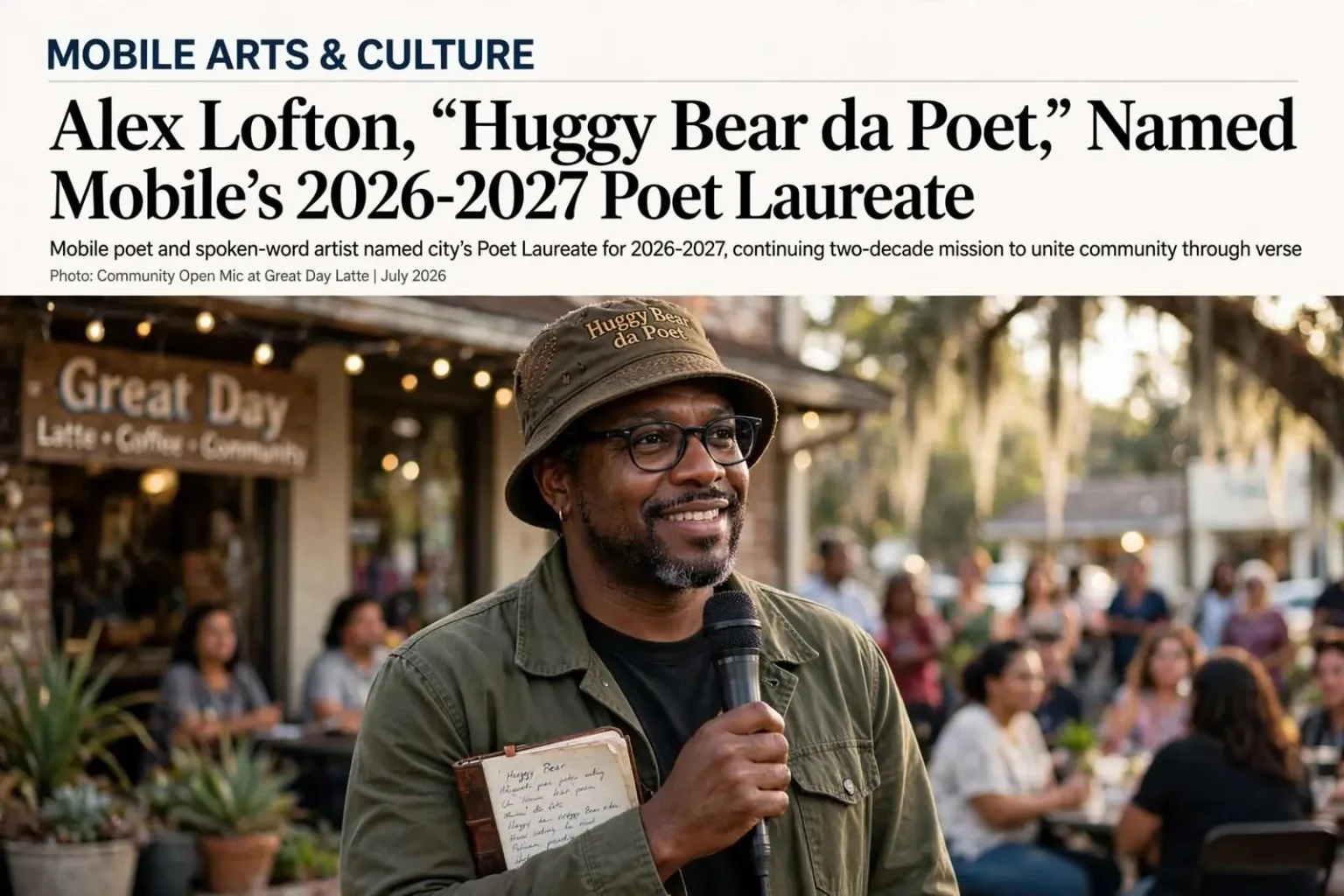
The Mobile Arts Council, in partnership with the City of Mobile and the Alabama State Council on the Arts, has named Alex Lofton as the city’s Poet Laureate for 2026-2027. Lofton, widely known throughout the community by his stage name, “Huggy Bear da Poet,” will serve as an ambassador for the literary arts, using poetry to deepen community engagement and celebrate Mobile’s cultural life over the coming year.
The Poet Laureate program is designed to celebrate the power of poetry to uplift, connect and inspire residents of Mobile. As laureate, Lofton will use both written and spoken word to promote creative expression and highlight the city’s cultural vibrancy, continuing a tradition the Mobile Arts Council has championed in partnership with city and state arts officials.
Honorary poet laureates occupy a distinct role in American civic life. Unlike positions in academia or publishing, a municipal laureate’s job is public: to appear where the city gathers, to mark its moments in verse, and to carry the idea that language and imagination belong to everyone into classrooms, community centers and public events. In Mobile, a city whose cultural identity runs through Mardi Gras traditions, jazz and blues history and a deep storytelling culture, the laureateship is a natural fit.
Roots in Mobile, Prichard and Citronelle
Lofton’s connection to the region runs deep and spans multiple generations. He was raised between the heart of Mobile, the neighborhoods of Prichard, and the red-clay hills of Citronelle, and his earliest performances took place inside his grandmother’s country church. He went on to refine his voice and passion for the arts at John L. Leflore Magnet High School, where organizers say he developed the integrity, purpose and creative drive that have since shaped his career as a poet.
That three-part geography — the city’s downtown neighborhoods, Prichard just to the north, and Citronelle at the county’s rural edge — gave Lofton an unusually wide window on the Gulf Coast. Church performances taught the cadence and call-and-response that still mark spoken-word traditions across the South, while school gave structure and audience to a talent that might otherwise have stayed in the pews. The path from a country church to a citywide platform is one of the oldest stories in American arts, and it remains legible in Lofton’s style today.
John L. Leflore Magnet High School has its own place in Mobile’s story. The school, named for the longtime civil rights leader who edited the Mobile Sentinel and led the local NAACP for decades, draws students from across the city into its programs, creating a student body that mirrors the whole community rather than one neighborhood. For an artist whose work sets out to bridge divides, an education built on bringing the city’s young people together was a fitting apprenticeship.
Two Decades of Poetry as a Bridge
For more than 20 years, Lofton has authored, performed, educated and advocated through the art of poetry. According to the Mobile Arts Council, his mission has remained constant throughout that time: using poems as a bridge that unites people across racial, social and political divides, empowers young people, and strengthens the fabric of the community.
Lofton described the appointment as the culmination of a calling he has followed for two decades. “Poetry has been my fervor and my untamed zeal for over a score,” he said. “It’s my vocation and chosen life mission. Despite more lucrative opportunities, my purpose has always been to author, perform, educate, and advocate for the people through the art of verse. I’ve been doing the work for the last 20 years because it was aligned with my purpose. I am honored to now serve the City of Mobile as its Poet Laureate.”
The emphasis on service over profit sets Lofton’s career apart in an era when many working poets migrate toward commercial work. His decision to remain rooted in community performance — open mics, school visits, civic forums — reflects the spoken-word tradition’s insistence that poetry is made in rooms full of people, not only on the page. In cities across the South, that tradition has been carried by artists who treat the mic as a civic institution, and Lofton’s two decades of steady work place him squarely in that lineage.
A Packed Calendar for the New Laureate
Lofton’s tenure has already included a run of community events. An Evening of Poetry was held July 23, and he took part in the SPLC/Mobile United Voting Rights Forum on July 25. He also continues to host a recurring Poetry Open Mic on the second Friday of every month at Great Day Latte, giving local poets and spoken-word artists a standing venue to share their work with the community.
The range of those appearances says something about how Lofton sees the laureateship. A voting rights forum is not a typical booking for a poet, but in Lofton’s framing, verse belongs wherever the community works out its future — civic halls as much as coffeehouses. That blend of art and advocacy has been the through-line of his career, and it suggests his term will push the laureateship outward into parts of the city that formal arts programming rarely reaches.
The monthly open mic, meanwhile, functions as the pipeline that keeps the local scene alive. Second Friday gatherings at Great Day Latte give first-time performers a low-stakes stage and give experienced writers a room that will listen. Over years, such regular nights produce the next generation of featured readers, workshop leaders and, eventually, laureates — which is why longtime participants describe the open mic as the heartbeat of the scene Lofton now formally represents.
Open mics also tend to be where a city’s changing voice shows up first. New residents, students, returning veterans and teenagers finding their footing all end up at the same microphone, and the material that emerges reflects what the community is living through in a way few formal forums capture. Hosting that room for years, as Lofton has, is a form of civic listening as much as performance — a qualification for laureate that no resume quite captures but every regular in the audience can attest to.
A City Investing in Its Literary Life
The partnership structure behind the appointment — the Mobile Arts Council working with the City of Mobile and the Alabama State Council on the Arts — reflects how cultural programs are built in Alabama. The state arts council channels public funding and statewide expertise to local projects, while city governments and nonprofit arts councils supply the local knowledge, venues and audiences. A laureateship sits at that intersection: ceremonial enough to belong to the city, resourced enough to actually reach residents.
Mobile’s investment in the role arrives at a moment when cities across the country are reassessing what public art can do. Beyond murals and monuments, literary ambassadors have been used to mark civic anniversaries, open council meetings, lead writing workshops in schools and give voice to neighborhoods in the middle of change. For a city working to tell its own story — from its 300-plus years of history to its modern revitalization — a poet whose roots span Mobile, Prichard and Citronelle offers a narrator who knows all three settings firsthand.
For young writers in particular, the visibility of a working poet in an official role can matter as much as any program budget. Seeing someone from the local spoken-word scene stand before the city with a title sends the message that the art form is viable, that community work counts, and that the path from an open mic night to a citywide platform is real. Lofton’s own trajectory — church stage to magnet school to laureate — is the demonstration.
Looking Ahead to the Term
Laureates in cities across the country have used the platform differently — some heavy on ceremonial verse, others on teaching, others on advocacy. What they share is a term in which the office amplifies whatever the poet already does. In Lofton’s case, that means two decades of performance and mentorship suddenly carrying an official seal, with the city’s name attached to events that had previously run on their own momentum.
The Mobile Arts Council and its partners say they are looking forward to continuing the Poet Laureate program and to championing the role poetry can play in strengthening community bonds, celebrating local voices and enriching the cultural landscape of Mobile. As the city’s newest literary ambassador, Lofton is expected to build on that mission throughout his term, extending a platform for verse that has already reached audiences across Mobile, Prichard and Citronelle for two decades.
If the early calendar is any guide, the 2026-2027 term will be active. An Evening of Poetry in July and a voting rights forum days later suggest a laureate who intends to keep his existing commitments while adding the weight of the office to them — and the second Friday open mic will continue, giving the city a standing monthly appointment with its own voices. Two decades into the work he describes as his vocation, Lofton begins the tenure the way he has done everything else: in front of people, with a microphone, making the case that poetry belongs to everyone in the room.