Beninese Musician Yewhe Yeton Joins Africatown Drummers in Mobile to Link Heritage and the Vote
Beninese musician Yewhe Yeton joined the Mobile Alabama Africatown Drummers at Kazoola on Oct. 8 for a Stand Up Mobile event connecting Benin's music, Africatown's history and voter participation.
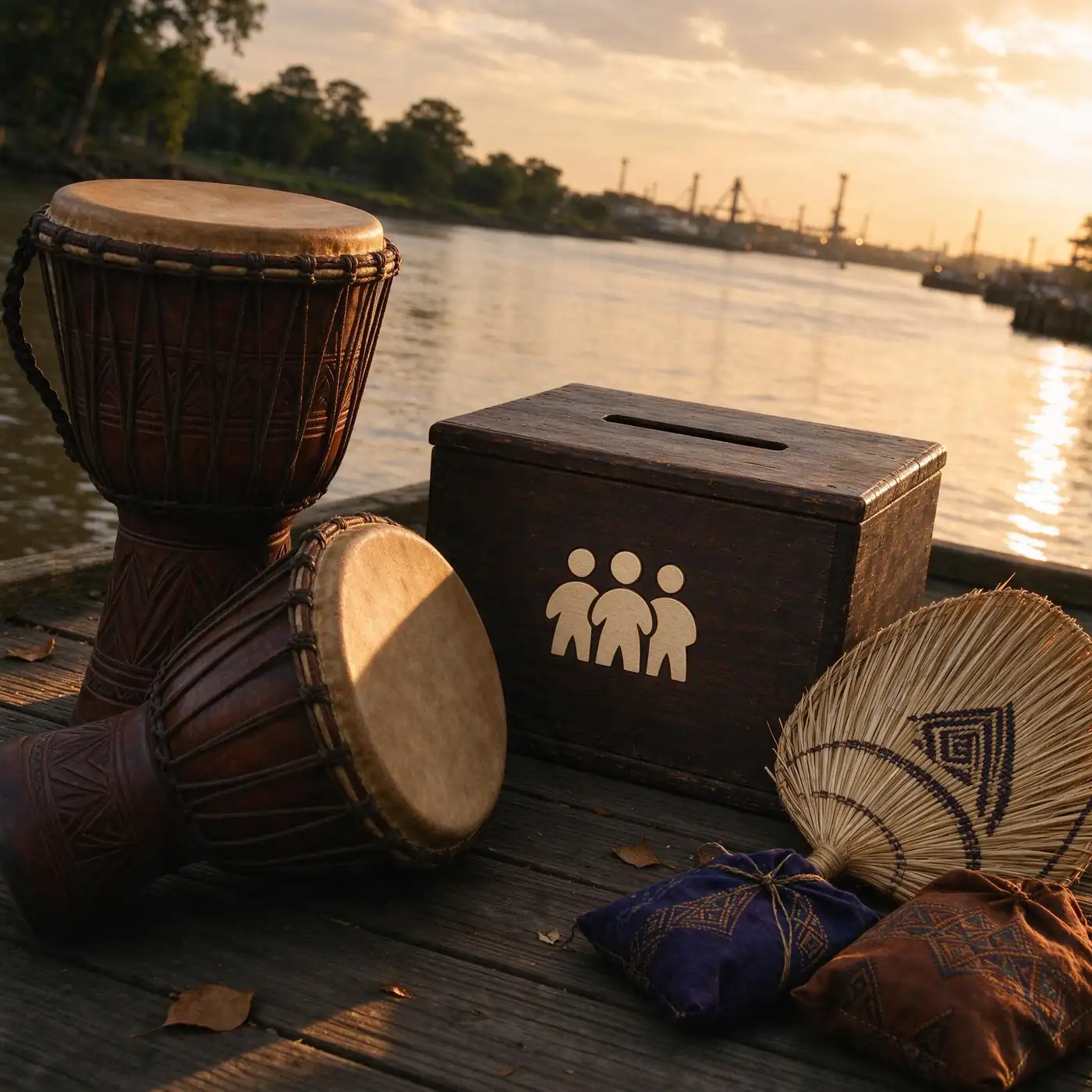
MOBILE, Ala. — The drum, Beninese musician Yewhe Yeton told a Mobile audience last week, always carries a message. On Thursday, Oct. 8, Yewhe Yeton joined the Mobile Alabama Africatown Drummers at Kazoola Entertainment & Eatery for an evening that tied the musical traditions of Benin to Africatown’s history of survival, with an eye toward the ballot box less than a month before the Nov. 3 general election.
The event was presented by Stand Up Mobile, a nonpartisan voter engagement group, and the Mobile Alabama Africatown Drummers. Organizers used music and storytelling to start conversations in the community and to encourage people to take part in the upcoming election.
‘Vodun Rock’ and the secret rhythm
Yeton describes his music as “Vodun Rock.” At its root, he says, is “the secret rhythm,” a foundation from his Beninese heritage that he fuses with a wide range of genres, from hip-hop to jazz.
Born Gbetognon Houenou, Yeton traces his roots to the banks of the Ouémé River in Benin, the West African nation that borders Nigeria and Togo. He began his career with the groups DiFlex and Benin International Musical before going solo, and he has performed more than 100 concerts internationally, including at Carnegie Hall. His solo album “LOKO” blends Beninese rhythms and melodies, including music from vodun traditions, with hip-hop. He has held artist residencies in France, Ghana, Guadeloupe and at SUNY Purchase in New York, as well as in Africatown, and founded an arts education organization, Atche Binon Art & Culture.
Vodun, the religious and cultural tradition often spelled vodou or voodoo in the Americas, has deep roots in the region that is now Benin, and its drumming and song traditions traveled across the Atlantic with enslaved West Africans.
Songs about betrayal, humanity and memory
Yeton performed three original songs during the evening. One of them, “Doolo,” takes its title from a phrase meaning “to say a proverb.” The song deals with the betrayal Africans suffered through enslavement, and Yeton built it around the drum, treating the instrument as a messenger whose meaning the audience has to work to hear.
“The drum told you something,” Yeton explained. “So you have to listen carefully and catch this message from the drop.”
His most recent project, “Mède Miwa,” centers on the humanity of the Black diaspora. Yeton summed up its core message plainly: “we are also human—we are not your prisoner.”
Why Africatown, and why Mobile
The pairing of a Beninese artist with Africatown’s drummers carries particular weight in Mobile. Africatown, just north of downtown, was founded by survivors of the Clotilda, the last known ship to bring enslaved Africans to the United States. The schooner arrived in Mobile Bay in 1860, more than 50 years after Congress outlawed the importation of enslaved people, and was burned and sunk afterward to hide the crime.
The 110 or so captives aboard the Clotilda had been purchased at the port of Ouidah, in what is now Benin. After emancipation, a group of survivors who could not raise the money to return home bought land north of Mobile and built their own community, governing it by their own customs. Their descendants still live in and around Africatown today. The wreck of the Clotilda was confirmed in the Mobile River in 2019, renewing national attention on the community and its story.
That shared geography, from the West African coast to the banks of the Mobile River, gave the evening its frame: Benin’s musical traditions on one side, and on the other the community its people built after surviving the Middle Passage.
Music as a call to civic action
For Stand Up Mobile, the performance was also about civic power. The group was founded in Mobile in 2021 by Amelia Bacon and Beverly Cooper as a nonpartisan advocacy organization focused on voter education, empowerment and turnout, with an emphasis on building strength among Mobile’s Black voters. It marked its fifth anniversary earlier this year.
Stand Up Mobile representative Reggie Weaver said the event was meant as a reminder of the legacy of resilience and resistance that has always empowered Black people.
“I think a lot of the time, we feel as if our work, our voice, our vote doesn’t matter,” Weaver said. “So I hope that people are reminded of the power we do have.”
Key dates for voters
With the general election set for Tuesday, Nov. 3, Alabama voters who want to participate have several deadlines coming up:
- Oct. 19: Last day to register to vote in the Nov. 3 general election.
- Oct. 27 (by mail) or Oct. 29 (in person): Deadlines for absentee ballot applications to reach the local absentee election manager.
- Nov. 2 (hand-delivered) or noon Nov. 3 (by mail): Deadlines for completed absentee ballots to reach the absentee election manager.
- Nov. 3: Polls open from 7 a.m. to 7 p.m.
Voters can check their registration status and polling place through the Alabama Secretary of State’s website or by contacting the Mobile County Board of Registrars.
‘A seed we put in the ground’
Asked what he hoped people would take with them from the performance, Yeton answered with an image from the land.
“I hope it will be like a seed we put in the ground,” he said. “And the rain will come…and the seed will become a tree. And one day we can come to eat the fruit of this history.”