Jitney in Italian: August Wilson Drama With a Black Italian Cast Comes to Spring Hill College
An Italian-language production of August Wilson's 'Jitney,' with an all-Black Italian cast, plays Spring Hill College's Arlene Mitchell Theater Oct. 15-17, brought to Mobile by Terrence Spivey's Powerful Long Ladder.
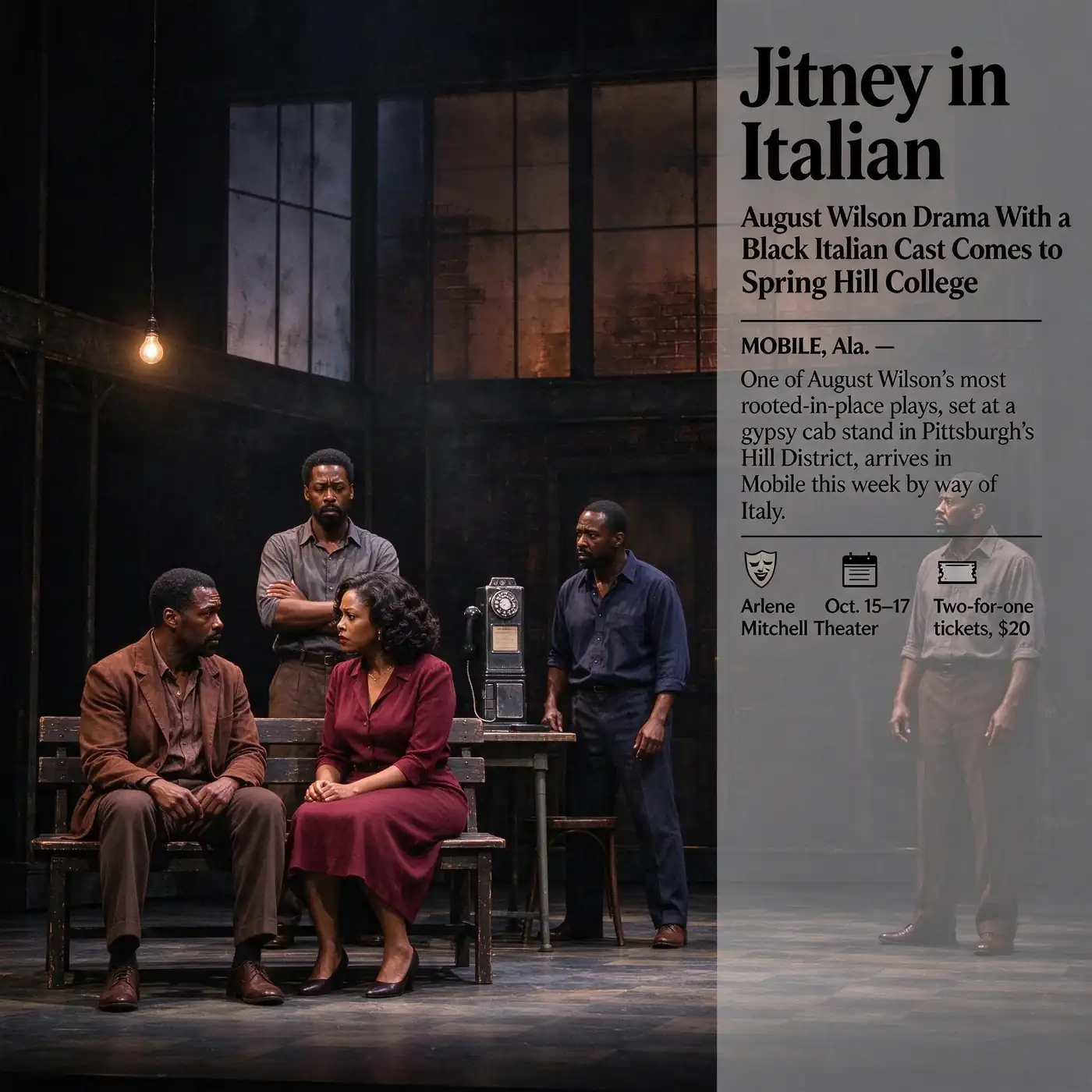
MOBILE, Ala. — One of August Wilson’s most rooted-in-place plays, set at a gypsy cab stand in Pittsburgh’s Hill District, arrives in Mobile this week by way of Italy. This staging of Jitney in Italian, performed by a cast made up entirely of Black Italian actors, plays Thursday through Saturday, Oct. 15-17, at Spring Hill College’s Arlene Mitchell Theater, making Mobile one of only a handful of American cities to see the production.
The show was first staged in Italy by Sardegna Teatro and La Piccionaia. It is one of the very few times Wilson’s work has been translated, and is likely the first translation of a Wilson play into Italian. It is performed in Italian with English supertitles projected above the stage, in the style of an opera house. Two-for-one tickets are $20.
A very American play
Wilson, who was born in the Hill District in 1945 and died in 2005, spent much of his career on a 10-play cycle, often called the American Century Cycle or the Pittsburgh Cycle, with one play set in each decade of the 20th century. His aim was to document the lives of Black Americans across those 100 years, capturing both the way they spoke and the struggles they faced. The cycle brought him two Pulitzer Prizes for Drama, for “Fences” and “The Piano Lesson,” along with a Tony Award for Best Play for “Fences.”
“Jitney,” the first play of the cycle that Wilson wrote, is its 1970s entry. It is about as specific as theater gets: a day or two in the life of an unlicensed taxi stand in the Hill District in the late 1970s, where drivers who serve a neighborhood the city’s cab companies ignore trade stories, grudges and hopes while the building that houses the stand faces demolition under the city’s redevelopment plans. The play had its first production in Pittsburgh in 1982 and reached Broadway in 2017, when the Manhattan Theatre Club revival won the Tony Award for Best Revival of a Play.
That specificity is what makes an Italian version such an unusual experiment. The world of “Jitney” is unfamiliar to most Americans, regardless of race, which raises the obvious question of how well it can travel to another language and another culture, and what an American audience might hear differently when it comes back.
How it landed in Mobile
Mobile’s place on the tour runs through Africatown. After the wreck of the Clotilda, the last known ship to bring enslaved Africans to the United States, was confirmed found near Mobile in 2019, the story drew artists from around the country. One of them was Terrence Spivey.
A Texas native, Spivey is a playwright, director and producer who worked for years in Cleveland, where he was artistic director of Karamu House, one of the oldest Black theaters in the country. In Mobile, he led development of “An Ocean in My Bones,” a play that retells the Clotilda’s last voyage and portrays the struggles and pride of its survivors and their descendants.
Those Mobile connections paid off when Italian director Renzo Carbonera asked Spivey for help organizing an American tour. Spivey thought of Mobile, and the local run is presented by his company, Powerful Long Ladder, in association with Spring Hill College.
The Mobile performances are the sixth stop in the United States. Last spring, the production played St. Louis, Cleveland and Pittsburgh, Wilson’s hometown, and it has more recently been staged at Auburn University and in Atlanta.
Why ‘Jitney,’ and why Italy
Carbonera said he deliberately reached for Wilson’s earliest cycle play instead of one of the Pulitzer winners. “One of the reasons was that I wanted to start from the first first play he wrote,” he said. “Another reason is the play is set in the ’70s, at the end of the ’70s, which is the period of time when Italy switched from being a country from where people migrated from, to a country to which people migrate to.”
That history is personal for the director. His father was one of hundreds of thousands of Italian “guest workers” who moved to Germany in the decades after World War II, where he married a German woman. When Italy’s economy strengthened in the 1970s, the flow reversed, and Italy began receiving migrants “especially from South America and Africa,” Carbonera said. “Especially from Africa.”
The cast reflects that shift. “So all the actors were born in Italy, but their parents migrated to Italy beginning from that time on,” Carbonera said. “So they are the first and second generation of Italian-born black people. Their parents are immigrants and their grandparents, many of them have the grandparents still in Nigeria or other countries. … They have a totally different background from black American citizens at the moment.”
Assembling that cast was a challenge in itself. “In Italy, we don’t have many black Italian actresses and actors by now. We still don’t have many,” he said. “A big part of the work was scouting them, finding them. Because August Wilson plays are not easy to play.”
Common ground
Carbonera acknowledged that Italian audiences might miss some details about Pittsburgh, American geography or Black American culture, but said American movies and popular culture have made much of it familiar. And the play’s central setting needed little explanation.
“At the core of the play, it’s this jitney station, which is basically illegal cabs,” he said. “Which is something with which people are familiar here, especially in southern Italy. This idea of illegal Uber services. [It’s like] Uber before Uber. … This was not, let’s say, the reason why I chose the play, but it’s definitely something which makes the play more understandable.”
“Jitney” is a relatively spare play to begin with, and the Italian production strips it down further, with a minimalist, somewhat abstract set and actors taking on dual roles. Spivey said Carbonera brings a filmmaker’s eye to the staging. “You can see a cinematic prowess,” he said. “All in the play with shadows and imagery and all that.”
‘I was biting my nails’
Spivey, a longtime admirer of Wilson, admitted the artistic risks worried him. Then he saw the show in Cleveland. “My God, I was just blown away,” he said. “You just got caught into a story already you could follow because of the emotions going on.”
He was just as nervous about whether anyone would come. “I was biting my nails weeks out, wondering who was gonna come, how many people?” he said. “But people started coming in the first night. Folks came in and they gave it a standing O. … The second night we had it, the ushers started going to the closet, grabbing chairs out. There was so many walk-ins.”
Audience members told him that within about 30 minutes they had stopped reading the supertitles and were simply following the emotion on stage. “Some of them said, ‘Oh, I want to see his plays now because of this,'” Spivey said.
What translation reveals
Both men said the experiment ends up making a case for Wilson as a universal writer, one whose very American settings carry human truths that cross borders.
Spivey said he initially wanted Mobile audiences to hear Wilson in English. “I want people to see as much as they can about the way of life in the Hill District, that really reflects every Black neighborhood in the country,” he said. “I wanted people to hear those words, particularly in Mobile, Alabama.”
“But then I sat back and I said, ‘Wait a minute,'” he continued. “This is showing how universal this guy is. For them to go this far to do a translation of his work … He’s universal just as much as Tennessee Williams and Arthur Miller and all those great playwrights, and a lot of their works have been translated over the years.”
Carbonera said he had worried about how audiences who grew up with Wilson’s plays would react. “But I must say that what I found out is that, in fact, Wilson’s language is universal. So I really found out that what he wrote are modern classics,” he said. “The emotions, the relationships, father, son, couple, you know, the struggles of people, are universal in a certain way, and people understand that, and this is what comes through.”
“You laugh and you cry with the actors, and this is probably the most important thing,” he said. “And when you sit there for two hours, then you stand up in mixed feelings because you had such powerful feelings. Well, that’s basically universal, and that’s basically what classics are made of.”
If you go
- What: August Wilson’s “Jitney,” presented by Italy’s Sardegna Teatro and La Piccionaia in collaboration with Powerful Long Ladder, in association with Spring Hill College
- When: 7 p.m. Thursday, Oct. 15, and Friday, Oct. 16; 2 p.m. Saturday, Oct. 17
- Where: Arlene Mitchell Theater, Spring Hill College, 1495 Rimes Road, Mobile
- Tickets: Two-for-one tickets, $20
- Running time: 2 hours, 20 minutes, including a 15-minute intermission
- Language: Performed in Italian with English supertitles
- Extra: Each performance is followed by a discussion with the director and cast