Mobile County Deputy Travels to New York to Honor Fallen NYPD Officer
A Mobile County Sheriff's Office deputy traveled to New York in January 2015 to attend the funeral of a slain NYPD officer, citing Katrina-era ties.
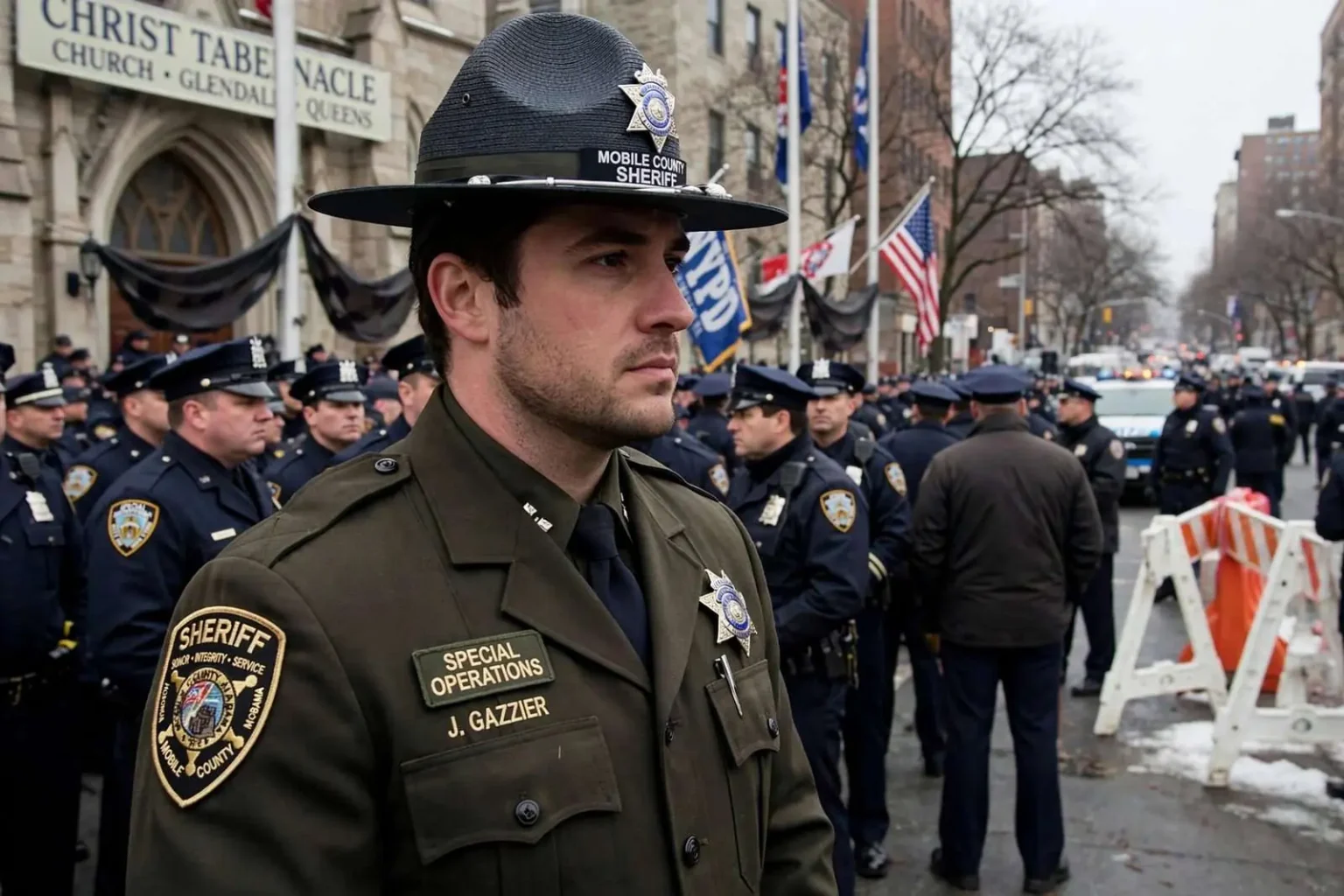
Amid a sea of thousands of uniformed officers gathered in New York in January 2015, a Mobile County Sheriff’s Office deputy stood to pay his respects to a fallen NYPD officer, drawing a line back to a debt he felt Mobile owed New York from nearly a decade earlier. Deputy James Gazzier made the trip north alongside a Mobile County Sheriff’s Office reserve deputy to attend the funeral of NYPD Officer Wenjian Liu, who was fatally shot alongside his partner, Officer Rafael Ramos, while sitting in their patrol car in a Brooklyn neighborhood in December 2014.
The ambush killings of Liu and Ramos sent shockwaves through law enforcement nationwide. The two partners had been sworn in only weeks earlier and were seated in their marked patrol car in the Bedford-Stuyvesant section of Brooklyn when they were shot without warning. Liu, 32, was a two-year veteran of the department and the son of Chinese immigrants; Ramos, 40, was a father of two who had left a career as a school bus attendant to join the NYPD. Both were posthumously promoted to detective, and their funerals drew mourners that included Vice President Joe Biden and dignitaries from around the world.
The two officers’ deaths, which came amid a period of heightened national tension between police departments and the communities they serve, drew law enforcement officers from across the country to New York for a series of funeral services. In the weeks following the shootings, tens of thousands of officers from departments large and small traveled to New York at their own expense, standing shoulder to shoulder along avenues in Queens and Brooklyn for viewings and processions. The gatherings became one of the largest mobilizations of law enforcement in the city’s history, a display of solidarity that transcended departmental boundaries and state lines.
Gazzier described a powerful sense of solidarity among the assembled officers, despite most having never met each other before. He recalled standing near a group of Syracuse, New York, police officers and quickly finding common ground, saying the shared experience of loss and purpose made total strangers feel like family within minutes of introducing themselves.
That bond is a familiar phenomenon to anyone who has attended a line-of-duty funeral. Officers who arrive from hundreds of miles away share a working vocabulary of shift work, court dates, radio calls and the constant calculation of risk that defines the profession. At memorial services, that shared identity compresses the usual social distance: a deputy from the Gulf Coast and a patrol officer from upstate New York can stand together in dress uniform and feel, within minutes, that they serve the same community. For many attendees, the funerals of Liu and Ramos provided exactly that reassurance at a moment when the profession felt under siege.
Before joining the Sheriff’s Office nearly five years earlier, Gazzier spent more than three years with the Mobile Police Department. He currently works in the Sheriff’s Office’s special operations unit.
The Mobile County Sheriff’s Office is one of the largest law enforcement agencies on the Gulf Coast, responsible for patrolling the unincorporated areas of a county of more than 400,000 residents and for operating the Metro Jail in downtown Mobile. Its special operations unit handles some of the department’s most demanding assignments, from warrant service and critical incidents to support for other divisions during major events. Deputies assigned to such units often develop close working relationships with agencies across the region and beyond — networks that matter when tragedies strike far from home.
He said his decision to make the roughly 1,000-mile trip was rooted partly in gratitude toward New York’s first responders for their assistance to the Gulf Coast following Hurricane Katrina in 2005, a storm that killed nearly 2,000 people and devastated much of the region, including parts of Mobile and Baldwin counties. The Fire Department of New York had sent personnel and resources to help the Gulf Coast in the aftermath of Katrina, an act of mutual aid Gazzier said stuck with him and shaped his decision to show up for New York’s own first responders during a moment of tragedy nearly a decade later.
Katrina remains the defining disaster in the modern history of the northern Gulf Coast. When the storm came ashore in late August 2005, it flattened communities in Mississippi and Louisiana and lashed the Alabama coast with destructive winds, storm surge and tornadoes. Mobile and Baldwin counties sustained extensive damage — downed power lines, flooded neighborhoods, shattered roofs and weeks without basic services. In the days and months that followed, first responders from across the country poured into the region, and among them were FDNY personnel who brought search-and-rescue experience and hard-earned lessons from their own city’s darkest day on September 11, 2001.
For Gulf Coast residents who lived through that period, the sight of New York firefighters working alongside local crews left a lasting impression. Many local agencies had sent personnel north to assist at Ground Zero after the 2001 attacks, and the post-Katrina response closed a circle of mutual aid between the two regions. Gazzier’s trip to Brooklyn a decade later reflected that reciprocal bond — the understanding, common in the first-responder community, that the help extended after a catastrophe is remembered and repaid in grief as readily as in resources.
A Funeral That Drew a Nation’s Police
The funeral for Officer Liu was the second of the two services, held at Christ Tabernacle Church in the Glendale section of Queens after a wake that stretched over multiple days. Officer Ramos had been laid to rest the week before in a ceremony that drew an estimated 25,000 mourners and jammed streets for blocks. City officials asked officers attending the services to avoid turning their backs on Mayor Bill de Blasio, who had clashed with the police union in the months before the shootings, and the appeal was largely — though not entirely — observed. The moment underscored how charged the atmosphere was around the department as it buried two of its own.
The killings occurred at an especially raw time in the national conversation about policing. Protests had erupted in New York and cities across the country following grand jury decisions in the deaths of Eric Garner in New York and Michael Brown in Ferguson, Missouri. When the two officers were ambushed in their car, police leaders described the department as under attack, and rank-and-file officers spoke of feeling isolated. Against that backdrop, the arrival of delegations from departments like the Mobile County Sheriff’s Office carried a message that went beyond condolence: the profession, stretched across thousands of jurisdictions, saw itself as one family.
Why It Mattered From Mobile
For Mobile County, the trip was a small but symbolic expression of a connection that runs deep in local memory. The Gulf Coast’s experience with Katrina taught a generation of emergency responders that help arrives from strangers, and that the debt is real. Deputies, firefighters and paramedics across the region still recount stories of out-of-state crews who worked seventeen-hour days restoring order in the storm’s aftermath. When news broke that two New York officers had been killed in their car, the instinct to return the favor — to stand, visibly, on New York’s streets — followed naturally for officers like Gazzier who had made that history part of their own careers.
Gazzier and his fellow deputy paid their own way, as did the vast majority of the officers who made similar journeys. There was no official delegation, no expense account, no press release from the Sheriff’s Office announcing the trip. It was, by all appearances, a personal act of remembrance by two Gulf Coast lawmen who understood that solidarity is not an abstraction but a practice — one measured in miles driven, uniforms pressed and cold hours spent standing with the family of a fallen officer from a department 1,000 miles away.
The Lasting Lesson
A decade later, the funeral remains a touchstone in conversations about the bonds among America’s police agencies. The deaths of Liu and Ramos prompted the creation of memorials, scholarships and support funds, and their names are now among those honored each May during National Police Week in Washington, D.C., where their names are inscribed on the National Law Enforcement Officers Memorial. For the deputies from Mobile County who stood among the thousands in New York, the lesson they carried home was simple: the community of those who wear the badge is national, and it shows up for its own — just as New York once showed up for the Gulf Coast.
Back home in Mobile County, the gesture drew quiet appreciation from colleagues who understood what the trip represented. Deputies often speak of the profession as a calling that follows them off duty, and the decision to spend personal time and money attending a stranger’s funeral in another state resonated within the ranks. The Sheriff’s Office, like agencies across the Gulf Coast, has lost its own officers in the line of duty over the years, and local deputies know firsthand how much the presence of out-of-town uniforms means to grieving families and departments. In traveling north, Gazzier and his fellow deputy simply returned the courtesy that visiting officers had extended to Mobile County in its own moments of loss.