Five Volunteer Cleanup Crews Just Turned Their Trash-Picking Hours Into $5,500 for Mobile County Neighborhood Projects
Five Mobile County volunteer teams earned a combined $5,500 in Love Your Community grants for neighborhood cleanup and beautification projects, part of a program that has awarded more than $74,500 since 2021.
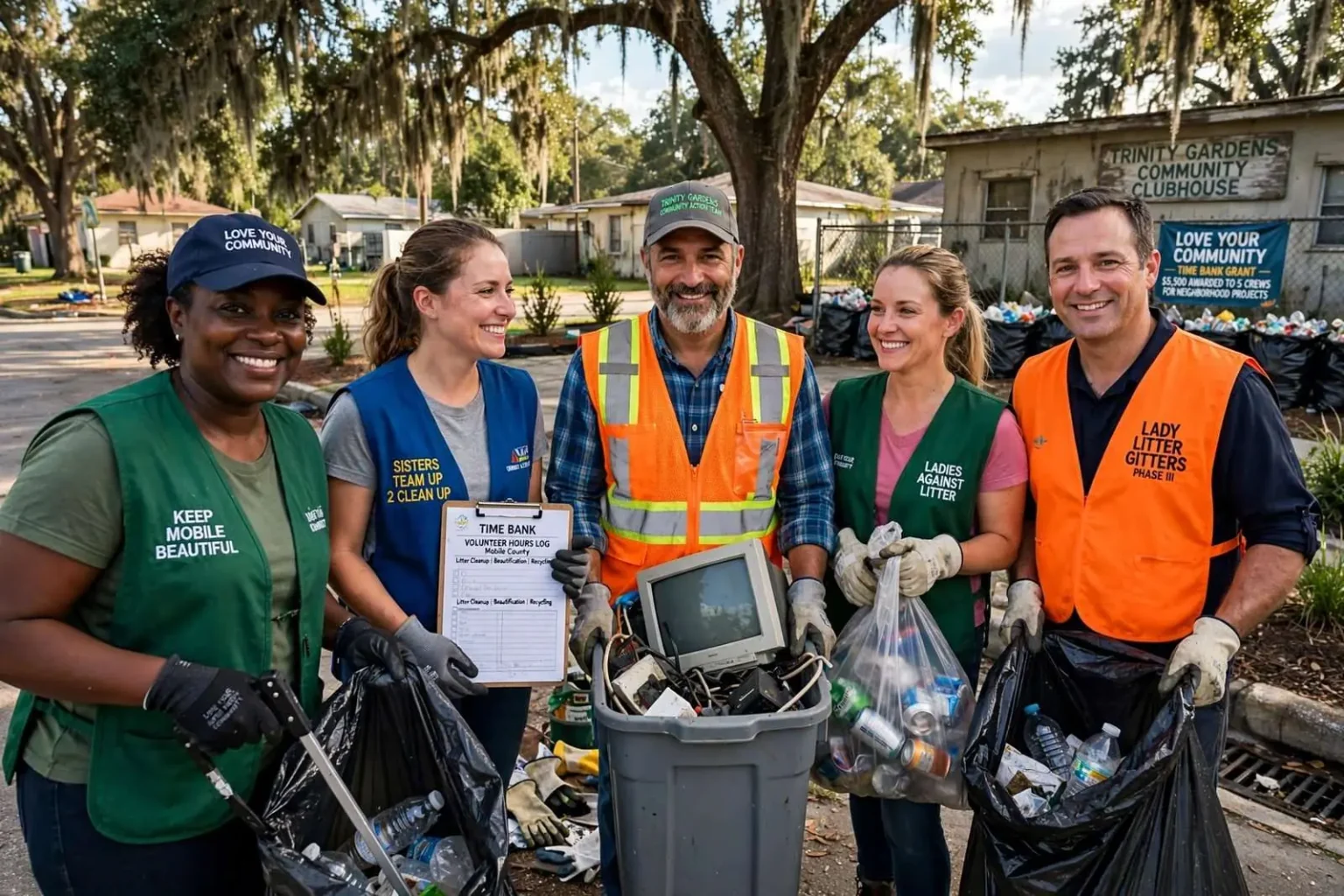
Five volunteer teams across Mobile County are splitting $5,500 in grant money after converting hours spent picking up litter and beautifying their neighborhoods into funding for local projects, an approach that has quietly become one of the county’s most durable tools for community improvement. The Mobile County Commission awarded the grants for time banked through the county’s Love Your Community program, which lets volunteer teams earn grant funding by logging hours spent on litter cleanup, beautification, recycling and other environmental stewardship projects in public spaces.
The Time Bank model at the heart of the program is deliberately simple. Volunteer teams record the hours their members spend working on eligible projects, and those hours translate into grant dollars the teams can direct toward specific needs they have identified in their own neighborhoods. Rather than a top-down allocation of public money, the program rewards the sweat equity that residents are already putting into their streets, parks, and gathering places.
“What I love most about this program is that it is resident-driven,” said Commissioner Connie Hudson, who leads the county’s Love Your Community initiative. “Teams identify a need, volunteer to improve their community, and earn the resources to turn those ideas into projects with lasting improvements.”
Since the program relaunched in 2021, roughly 250 teams have earned more than $74,500 in grants through the Time Bank. That pace of participation has made Love Your Community one of the larger grassroots funding efforts in the county, reaching neighborhoods from the inner-city communities around downtown Mobile to the suburban and rural areas that stretch toward the Mississippi line and down the western shore of Mobile Bay.
Love Your Community is funded by the Mobile County Commission and operated in partnership with Keep Mobile Beautiful, the long-running anti-litter organization that has coordinated cleanup and beautification efforts across the city and county for decades. Program funding is supported by the Gulf of Mexico Energy Security Act, the federal law that shares offshore energy revenue with Gulf Coast states and their coastal counties, directing a portion of that money toward environmental and conservation purposes.
How the Time Bank Works
The Time Bank concept turns volunteer labor into a kind of currency. Teams affiliated with churches, neighborhood associations, civic clubs, and informal groups of friends and family members log their cleanup hours with the program, and the banked hours qualify them for grant awards in successive rounds. The structure is designed to keep volunteers engaged over time, since each new round of grants rewards the teams that keep showing up.
County officials have described the approach as a way to stretch public dollars while building local ownership of community spaces. When the crew that picks up the trash is also the crew that decides how the grant money is spent, the projects tend to match real neighborhood priorities, from a broken-down clubhouse that needs a fresh coat of paint to a street corner that has become a dumping ground.
The environmental argument for the program is just as practical. Mobile County’s network of creeks, rivers, and bayous ultimately drains into Mobile Bay, and litter dropped on streets and roadsides tends to wash into storm drains and waterways after rain. Volunteer cleanups intercept that trash before it travels, reducing the burden on municipal crews and protecting the waterways that define the region’s identity and economy.
Trinity Gardens, a historic community north of downtown Mobile, has been a repeated focal point for the program, with multiple teams based in the neighborhood earning grants across successive rounds. The cluster of Trinity Gardens awards in this cycle reflects the way a single engaged neighborhood can build momentum, as one team’s success encourages neighbors to organize their own crews and qualify for the next round of funding.
Two $1,000 grants went to the Trinity Gardens Community Action Team, for television recycling and community e-cycling education, and to Sisters Team Up 2 Clean Up, for a community recycling event with education on proper recycling and waste disposal. A $500 grant went to Ladies Against Litter for clubhouse landscaping and shrub installation.
The emphasis on recycling in several of the awards points to a persistent gap in the region. Curbside recycling options in Mobile County have long been limited, and older televisions and electronics are among the hardest items for residents to dispose of legally, which leads to illegal dumping in vacant lots, along rural roads, and near neighborhood clubhouses. E-cycling events give residents a legitimate, free outlet for those items while teaching them what can and cannot go into the waste stream.
A Program With Deep Roots
The Love Your Community program originally launched in 2018 to engage residents in tackling litter, protecting local waterways and beautifying neighborhoods throughout Mobile County. After a pause, the 2021 relaunch rebuilt the program around the Time Bank structure, and participation has grown steadily in the years since, with the roughly 250 funded teams representing communities across the county’s more than 1,200 square miles.
The partnership with Keep Mobile Beautiful gives the county program an experienced operational backbone. Keep Mobile Beautiful has coordinated large-scale cleanup days, adopted-road efforts, and education campaigns for years, and its staff helps volunteer teams with the logistics that small groups often struggle with, from arranging debris pickup to documenting hours and project outcomes.
The GOMESA funding stream adds another layer of stability. Because the Gulf of Mexico Energy Security Act directs shared offshore energy revenue to coastal counties for eligible purposes, Mobile County has been able to sustain programs like Love Your Community without relying solely on general fund dollars, insulating the grants from year-to-year budget pressure.
What the Grants Mean for Neighborhoods
For the five teams in this round, the awards are less about the dollar amounts than about completing projects that volunteers could not fund out of pocket. A sprinkler system keeps new landscaping alive through a Gulf Coast summer. A protective cover keeps a Little Free Library and a Blessing Box usable through storms and years of weather. A community cleanup event supplies gloves, bags, and disposal costs that would otherwise come from volunteers’ own pockets.
County officials have pointed to the program as a model of how small grants can produce outsized visible results. Litter has an outsized effect on how a neighborhood feels, and residents frequently describe a freshly cleaned street as the first step toward broader improvement, from code enforcement follow-up to new investment. The program’s resident-driven structure is meant to lock in those gains, because the people who cleaned the street are the people most likely to keep it clean.
Volunteer teams in the program come in every shape. Some are long-standing neighborhood associations with decades of history behind them, while others are families who adopted a stretch of their own street. The names on this round’s award list, including teams built around fathers and daughters, sisters, and groups of neighbors who gave themselves a memorable name, capture the informal spirit that county officials say they want to encourage. No formal nonprofit status is required to take part, which lowers the barrier for communities that have never organized around a project before.
The round’s awards also show how the program layers improvements over time. Lady Litter Gitters’ Phase III designation indicates a project built on earlier rounds of work, with each grant adding to what came before. That pattern, in which a first cleanup leads to landscaping, a landscaping effort leads to a sprinkler system, and a completed clubhouse becomes a hub for the next project, is exactly the progression the Time Bank structure is designed to reward.
Education runs alongside the physical work in most funded projects. The recycling events funded in this round pair the collection of electronics and household materials with information sessions on what belongs in the waste stream and where hazardous items should go. Program administrators have long treated that education component as central, since a neighborhood that understands its disposal options generates less litter in the first place.
Across the Gulf Coast, communities from New Orleans to Pensacola have experimented with similar volunteer-driven grant programs, but Mobile County’s Time Bank approach has drawn attention for its longevity and its reliance on existing neighborhood networks rather than new bureaucratic structures. By routing the money through the county commission and Keep Mobile Beautiful, the program avoids the administrative overhead that often consumes small grant programs elsewhere.
For the volunteers themselves, the payoff is often visible within weeks. A cleaned street corner, a replanted flower bed, or a protected neighborhood library box changes how a block looks and how residents feel about it. County officials have said the strongest advertisement for the program is the work itself, and the steady growth in participating teams since the 2021 relaunch suggests that the message is traveling from one neighborhood to the next on its own.
Teams interested in participating in future rounds track their volunteer hours on eligible projects in public spaces, including litter cleanup, beautification, recycling and other environmental stewardship work, and submit that record to the program for consideration in the next grant cycle. County staff administer the rounds through the partnership with Keep Mobile Beautiful, with the Mobile County Commission approving each round of awards.
With this round’s five awards, the program’s running total since the 2021 relaunch has climbed past $74,500 spread across roughly 250 teams, a figure that continues to grow with every grant cycle as more residents across Mobile County turn volunteer hours into lasting neighborhood improvements.