
After Deadly Boat Crash, Dauphin Island Residents Demand Safer Airport Runway
A petition with 3,000+ signatures demands better lighting at Dauphin Island's airport runway after a boat crash killed Quinton Zirlott and injured four.
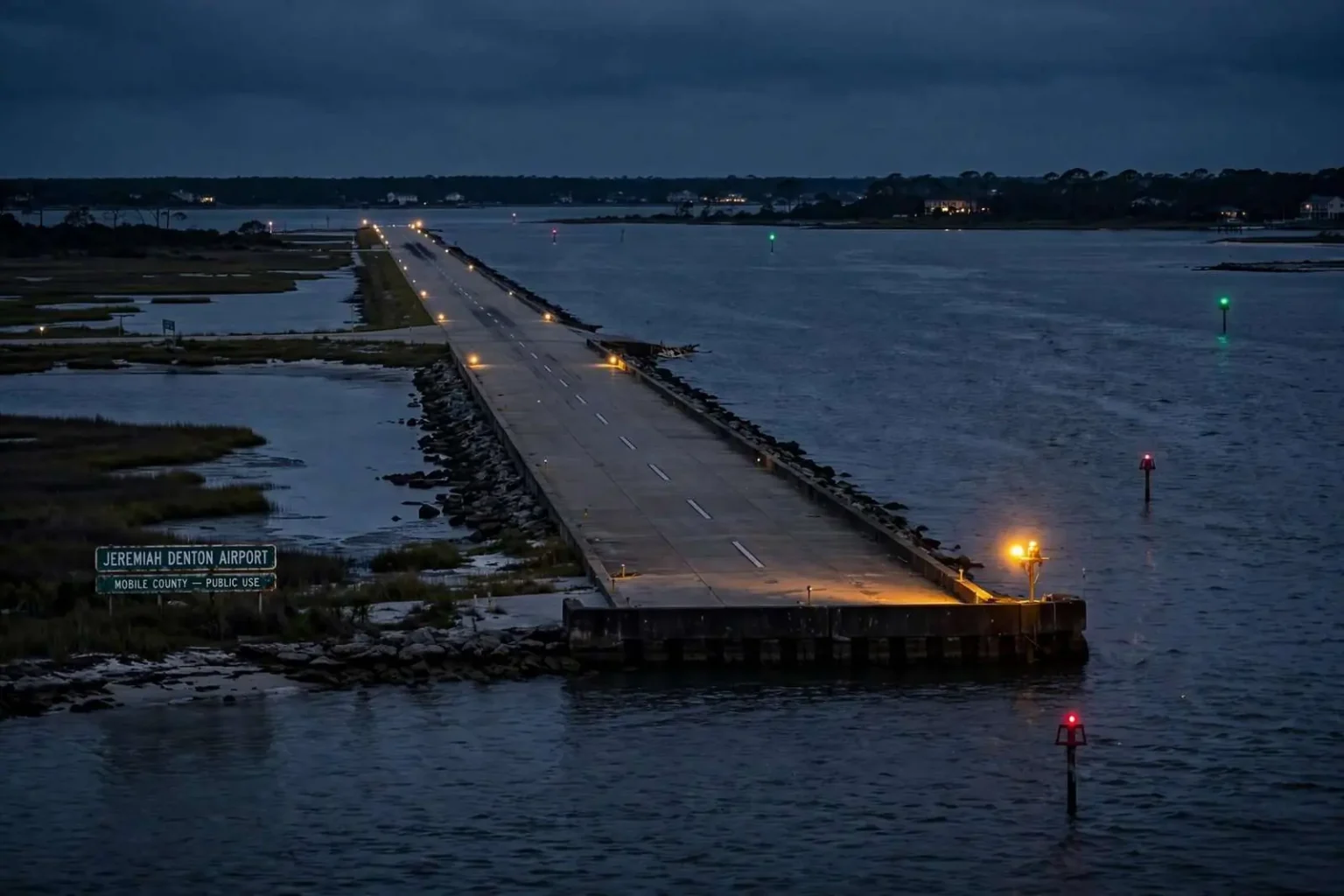
A deadly boat crash at Dauphin Island’s airport runway has boaters and residents calling for changes to make the hazard easier to see after dark. Quinton Zirlott, 22, was killed late Friday night when the boat he was riding in crashed into the runway at Jeremiah Denton Airport. Four others were hurt.
By day, the runway is easy to spot from land — a long line of concrete reaching out into the water at the eastern end of the island. Boaters say that after dark it becomes a potentially deadly obstacle for water traffic, a hard structure sitting directly in the path of vessels that move between the open waters of Mobile Bay and the island’s shoreline after sundown.
The airport’s unusual placement is at the center of the debate. Jeremiah Denton Airport, named for the Mobile native and Medal of Honor recipient who spent years as a prisoner of war in Vietnam, is owned not by the town but by Mobile County, and its runway extends into Mobile Bay on a filled causeway. That means the end of the strip and the barriers at its base sit in the same waters that recreational boaters, anglers and commercial operators use every night, particularly in warm months when fishing and pleasure runs continue well past dark.
What Investigators Say Happened
According to the Alabama Law Enforcement Agency, the single-boat crash occurred around 11:30 p.m. Friday when the vessel struck a concrete barrier at the base of the runway that extends into Mobile Bay. The impact ejected Quinton E. Zirlott from the boat.
The driver, 23-year-old Robert C. Zirlott, was taken to Springhill Medical Center with injuries. Three other people aboard the vessel were also hurt in the crash and received medical care after the collision. ALEA, the state agency that handles major traffic and vessel crash investigations across Alabama, continued to work the case as the weekend went on, and the episode left a close-knit island community grieving a young man many of them knew by name.
Boating crashes into fixed structures are not unheard of in coastal Alabama, but the circumstances here struck a nerve because the structure involved is permanent, known to nearly every local boater, and — residents argue — surprisingly difficult to pick out at night from the water. The concrete barrier at the base of the runway sits low to the water’s surface, and without active lighting or enhanced reflective marking, it can blend into the dark horizon for a boat approaching from the bay.
For a town of a few thousand year-round residents that swells considerably in summer, the loss landed hard. Dauphin Island sits at the southern mouth of Mobile Bay, and its residents are tied to the water in ways that go well beyond recreation — many work on or around the bay, and nearly everyone who lives there crosses or launches a boat regularly. A crash that kills one young man and injures four more in a single night is the kind of event that reshapes the conversation about safety on the water for years.
Petition Draws Thousands of Signatures
A friend of the young man killed launched an online petition urging changes to make the runway more visible to boaters at night, arguing that proper lighting could prevent future tragedies. It gathered more than 3,000 signatures in less than 24 hours.
The speed of the petition’s growth reflected both the reach of Zirlott’s family and friendships across the island and the Gulf Coast, and the fact that the concern itself was not new. Boaters had complained for years about picking out the runway and its barrier after dark, and the petition gave that frustration a focal point at the exact moment the community was mourning. Signatures came not only from Dauphin Island but from across Mobile County and the broader Alabama Gulf Coast, where recreational boating is a fixture of daily life from early spring through late fall.
Dauphin Island Mayor Jeff Collier said the focus is on whether more can be done to keep a similar crash from happening again.
“It brings attention to the fact that there’s a runway there, and it’s been there for a number of years,” Collier said. “If there’s anything we can do to prevent such tragic incidents from occurring, we need to look at that.”
Collier’s remarks captured the town’s careful position. The island’s government does not own the airport, but its residents are the ones who live with the hazard, and the mayor’s office has consistently emphasized cooperation with the county and federal partners rather than assigning blame while the investigation remains open. Town leaders have long balanced the airport’s value as a general aviation asset against the realities of the island’s geography, where almost everything sits close to the water.
Residents Along De Soto Avenue Say Crashes Are Far Too Common
Homeowners along De Soto Avenue near the runway said crashes there are far too common, describing years of close calls and repeated damage to boats that have found the structure in low light or poor weather. For people who live on that stretch of the island, the concern is not abstract — they hear the impacts and see the aftermath.
Wendy McCain, at a nearby marina bait shop, suggested a simple fix: “I think they should put some sort of a blinker or flasher there — something to let people know there’s something out there.”
Marina operators and bait shop owners occupy a unique vantage point in these debates. They talk to boaters every day, they know which routes people run when they leave the ramp in the evening, and they hear immediately when someone has hit something in the dark. McCain’s suggestion — a blinking or flashing marker of the kind used on channel buoys and bridge fenders across the region — is the type of low-cost, widely understood fix that residents hope federal reviewers will consider.
Navigation markers of that sort are a familiar sight throughout Mobile Bay and the Gulf Intracoastal Waterway, where red and green channel lights, hazard buoys and lighted ranges guide vessels through shoals, bridges and fixed structures. The question residents are now asking is why a substantial concrete structure at the edge of a busy boating area has not carried similar treatment.
County Ownership Shapes What Happens Next
The airport is owned by Mobile County rather than the town, a fact that matters for any potential fix. A county spokesperson said the airport manager and county officials will consult with the FAA and Coast Guard to determine whether changes are warranted — and possible.
That review process is standard for any structure associated with a public-use airport. The Federal Aviation Administration regulates obstruction lighting and marking around airfields, and any beacon, flasher or light array added near a runway would need to satisfy aviation safety rules so that the lights meant to warn boaters do not confuse pilots on approach or departure. The Coast Guard, which oversees aids to navigation in navigable waters, would have a parallel role in determining what kind of water-side marking is appropriate for the barrier and the runway’s edge.
County officials have not committed to a specific remedy, and the outcome of the review will shape the options. Possible measures discussed in similar situations elsewhere include additional reflective marking on the barrier itself, water-side warning lights visible from a distance, updated charts and notices to mariners, and public education about running the area at night. Any change would also have to account for the runway’s continuing role in general aviation on the island.
What This Means for Local Boaters
In the meantime, experienced area boaters are urging extra caution around the eastern end of Dauphin Island after dark, particularly for operators who are new to the bay or visiting from outside the area. The waters around the island carry a mix of traffic — anglers running to the passes, pleasure boats crossing from the mainland, and commercial vessels working the bay — and the stretch near the runway sits directly along routes many boaters use regularly.
Safety guidance that veteran captains repeat is straightforward: slow down in unfamiliar or poorly lit water, keep a sharp lookout for fixed structures that may not be illuminated, use radar or GPS overlays where available, and never assume that a hazard visible by day will be visible at night. Life jackets and careful weight distribution matter as well, since the force of striking a fixed barrier at speed can throw passengers from a vessel before anyone can react, as investigators say happened in this crash.
A Community Looking for Answers
For now, the island is waiting on two parallel tracks — the completion of the state crash investigation and the county’s consultations with federal agencies over whether the runway and its barrier can be made more visible to the boats that pass them every night. The petition continues to circulate, and residents along De Soto Avenue and around the marinas say they will keep pressing for a marker, a light, a flasher — anything that makes the structure unmistakable to the next boat running the bay after dark.
What nearly everyone agrees on is that the crash should not have taken a life, and that whatever combination of lighting, marking and awareness comes out of the review, the measure of its success will be simple: no more boats finding the runway by impact. For a community still mourning Quinton Zirlott, that outcome is the only fitting result of the attention his death has brought to the water at the end of the island.


